

What Is GEO? Generative Engine Optimization Explained
What is GEO? Generative Engine Optimization (GEO) is the practice of structuring and positioning your brand’s content so that generative AI systems (ChatGPT, Perplexity, Google AI Overviews, and Gemini) cite, quote, or recommend it in their answers. Where SEO earns you a ranking on a results page, GEO earns you a mention inside the answer itself.
That distinction is the whole game. A growing share of research and buying journeys now start and end inside a chat window, with no click, no results page, and no ten blue links: just a synthesized answer with a handful of sources woven in. If your brand isn’t one of those sources, you’re invisible in a channel that’s becoming a primary entry point to the internet. GEO is the discipline of making sure you are.
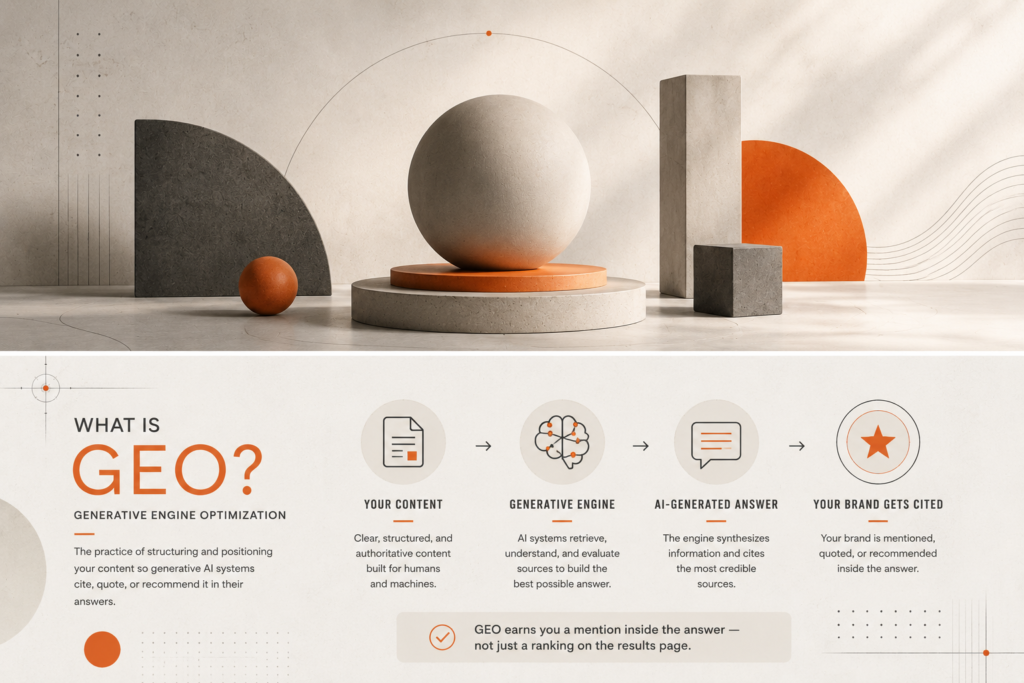
What Is GEO?
So, in one line: what is GEO? It’s optimizing your content to be the source an AI reaches for when it writes an answer, rather than a link a human scrolls past on a results page. Traditional search rewards you for ranking near the top; generative engines reward you for being clear, credible, and easy to quote, because the model has to lift a trustworthy statement from somewhere, and GEO makes that statement yours.
The practical implication is that GEO changes who you’re optimizing for. You’re no longer only persuading a human to click; you’re also making it effortless for a machine to retrieve your content, understand it, trust it, and repeat it accurately.
Why GEO Emerged
For two decades, “being findable” meant ranking on a search engine results page. Users typed a query, scanned ten blue links, and clicked through. SEO optimized for that click.
Generative engines break that model. When someone asks ChatGPT “what’s the best CRM for a 10-person sales team” or asks Perplexity to compare two SaaS tools, the engine doesn’t hand back a list of links to evaluate: it synthesizes an answer, often citing three to eight sources inline. The user reads the synthesis and may never visit any of the cited pages. The AI has already done the comparison shopping on their behalf.
This shift happened fast, for three converging reasons:
- Answer engines went mainstream. ChatGPT, Perplexity, Copilot, and Google’s AI Overviews moved from novelty to daily-use tools for a huge share of internet users within a few years.
- Search itself got a generative layer. Google now surfaces AI-generated summaries above traditional results for a large share of queries, meaning even “normal” search behavior increasingly runs through a generative filter first.
- Zero-click behavior became the norm, not the exception. By SparkToro’s analysis, fewer than a third of Google searches now send a click to the open web. Users increasingly get their answer without a website visit at all, which means the old proxy for success — organic traffic — no longer captures the full picture of whether your brand is winning the conversation.
Brands that only optimize for the SERP are optimizing for a shrinking share of the discovery journey. GEO is the response: it treats “getting cited by the AI” as a distinct, measurable objective, not a byproduct of ranking well.
How Generative Engines Choose Sources
Generative engines don’t cite content at random, and they don’t cite it just because it ranks #1 on Google. Understanding how they actually select and weight sources is the foundation of any GEO strategy.
Retrieval, not just ranking
Most generative engines use some form of retrieval-augmented generation (RAG): the model doesn’t answer purely from what it memorized during training. It retrieves relevant, current content from an index (its own crawl, a search API, or both), then synthesizes an answer grounded in what it retrieved. That means your content has to be crawlable, indexable, and topically relevant to the exact question being asked, not just broadly authoritative on the subject.
Clarity and extractability win over cleverness
Generative engines favor content that’s easy to lift a clean, self-contained answer from. A direct, well-scoped sentence that answers a specific question outperforms a beautifully written paragraph that buries the point five sentences in. The original GEO research (Aggarwal et al., KDD 2024) found that adding citations, quotations, and statistics to content measurably increased how often generative engines surfaced it. Clear headers, explicit definitions, comparison tables, and tightly scoped Q&A sections all make content easier for a model to extract and cite accurately.
Trust signals still matter, differently
Generative engines weigh source credibility, just like search engines do, but the signals shift toward things that indicate genuine expertise and reliability: clear authorship, demonstrated first-hand experience, consistent factual accuracy, structured data that removes ambiguity, and a track record of being cited elsewhere (including by other AI-visible sources). Backlinks still matter, but being referenced accurately across the web (in forums, review sites, comparison content, and other publications the engine also crawls) matters just as much.
Freshness and specificity
Broad, evergreen authority helps, but many generative answers favor sources that address the query’s specific angle precisely: the exact comparison, the exact use case, the exact number. Generic “ultimate guide” pages often lose out to narrower pages that answer one question completely. If you want help putting this into practice, our GEO services are built around exactly this kind of retrieval-first content work.
GEO vs. SEO vs. AEO
These three disciplines overlap but aren’t the same, and treating them as identical is a common (and costly) mistake.
SEO (Search Engine Optimization) optimizes for ranking position on traditional search results pages. The goal is a click. Success is measured in rankings, organic traffic, and click-through rate.
AEO (Answer Engine Optimization) optimizes content to directly answer a specific question in a format built for extraction: think featured snippets, “People Also Ask” boxes, and voice assistant answers. AEO is narrower and more tactical than GEO: it’s about winning a single answer slot for a single query. (For a deeper dive, see what is AEO.)
GEO (Generative Engine Optimization) optimizes for being cited, quoted, or synthesized into a generative AI’s response across a conversation, not just a single query-answer pair. GEO also has to account for how models retrieve and weigh sources, not just how a snippet algorithm parses a page.
In practice, the three are complementary rather than competing. Strong SEO fundamentals (crawlability, site structure, topical authority) make GEO easier. AEO-style direct-answer formatting makes your content more extractable for generative engines too. Think of it as concentric circles: SEO is the foundation, AEO is a formatting discipline that sits on top of it, and GEO is the broader strategic layer that determines whether AI systems trust and select your content at all.
Core GEO Tactics
GEO isn’t a single technique: it’s a set of practices that work together. Each of the tactics below is part of what a full GEO services engagement puts in place.
Structure content for extraction
Lead with the direct answer. Use descriptive H2/H3 headers that mirror real questions. Keep key facts in short, self-contained sentences a model can lift without needing surrounding context. Use tables for comparisons and lists for steps.
Build genuine topical depth
Generative engines are more likely to trust and cite sources that demonstrate comprehensive coverage of a topic, not just a single optimized page. A cluster of interlinked, specific pages around a subject signals real expertise in a way a single page can’t.
Use structured data
Schema markup (Article, FAQPage, Organization, Person) doesn’t just help traditional search: it gives generative engines unambiguous, machine-readable facts about who wrote the content, what organization stands behind it, and what questions it answers. Less inference required means more accurate citation.
Earn mentions beyond your own site
Because generative engines synthesize across many sources, being accurately described on third-party sites (review platforms, comparison articles, industry publications, forums) increases the odds your brand shows up in an AI’s answer, even when the AI never visits your website directly.
Answer the question completely, once
Fragmented content that half-answers a question across five different pages is harder to cite than one page that answers it fully. Depth and completeness on a single, well-scoped page consistently outperforms thin content spread across many pages.
Keep facts current and accurate
Because generative engines weigh accuracy and consistency, outdated or contradicted claims quietly erode citation likelihood over time. Treat cornerstone content as something to revisit and correct, not something to publish and forget.
How to Measure GEO
GEO doesn’t have the mature analytics tooling SEO has had for twenty years, but it’s not unmeasurable: you just have to track different signals.
- Direct prompting audits. Regularly ask the major generative engines the questions your buyers would ask, and log whether your brand is mentioned, cited, or recommended, and in what context.
- Referral traffic from AI platforms. Most analytics platforms can now segment traffic originating from ChatGPT, Perplexity, and similar tools. Track it as its own channel, not folded into “other.”
- Share of voice in AI answers. Compare how often your brand appears in AI-generated answers to a defined set of category questions versus how often competitors appear in the same answers.
- Brand mention sentiment and accuracy. When you are cited, is the information correct? Inaccurate citations are a signal that your content isn’t structured clearly enough for the model to extract it faithfully.
- Downstream conversion signals. Where analytics allow it, track what visitors who arrive via an AI citation actually do: this is often a small but high-intent segment.
None of these metrics replace organic traffic and rankings; they sit alongside them as a second measurement system for a second discovery channel.
How to Get Started with GEO
You don’t need to rebuild your content strategy from scratch. Start with a focused sequence:
- Audit your current AI visibility. Ask ChatGPT, Perplexity, and Google AI Overviews the questions your buyers actually ask. Note whether you show up, who does instead, and why their content likely won a citation.
- Fix extractability on your highest-intent pages first. Rewrite openings to lead with a direct answer. Add clear headers, FAQ sections, and structured data.
- Build out topical depth around your core categories, rather than spreading effort thin across unrelated keywords.
- Strengthen your presence beyond your own site. Accurate listings, reviews, and mentions on third-party sources the engines also crawl.
- Set up a recurring measurement cadence so you can see whether citation frequency and accuracy improve over time, not just guess.
Treat it as an ongoing discipline, not a one-time project. Generative engines update how they retrieve and weigh sources continually, and your content needs to keep pace.
How And Zeros Approaches GEO
We treat GEO as a strategic discipline, not a set of prompt-injection tricks. That means auditing how generative engines currently talk about your brand and your category, rebuilding cornerstone content so it’s genuinely easy for a model to retrieve and cite accurately, and putting measurement in place so you can see the impact instead of guessing at it. If you want a second opinion on where your brand currently stands in AI-generated answers, learn more about our geo or get in touch with And Zeros. It’s usually a short conversation to find out.
FAQ
What is GEO in one sentence?
GEO (Generative Engine Optimization) is the practice of structuring and positioning your content so that generative AI systems like ChatGPT, Perplexity, and Google AI Overviews cite, quote, or recommend your brand inside their answers.
Is GEO the same as SEO?
No. SEO optimizes for ranking position on a traditional search results page and earning a click. GEO optimizes for being cited or synthesized into a generative AI’s answer, which may never produce a click at all. They share foundational overlap, but they’re measured differently and require different tactics.
How is GEO different from AEO?
AEO is a narrower, tactical discipline focused on winning a single direct-answer slot, like a featured snippet or voice response, for one query. GEO is broader: it covers how generative engines retrieve, weigh, and synthesize your content across a whole conversation, including trust signals, structured data, and topical depth AEO doesn’t address.
Do I need to abandon SEO to do GEO?
No. SEO fundamentals such as site structure, crawlability, topical authority, and backlinks are the foundation GEO builds on. GEO extends that foundation to cover how generative engines retrieve, weigh, and cite content across AI platforms. Most brands should run both in parallel rather than choosing one over the other.
Which AI platforms does GEO cover?
Generally ChatGPT, Perplexity, Google AI Overviews, Gemini, Copilot, and any other generative system that retrieves and cites external sources when answering. Tactics vary slightly by platform, but the underlying principles (extractability, accuracy, structured data, third-party corroboration) apply broadly across all of them.
How long does GEO take to show results?
There’s no fixed timeline, and anyone promising a specific number of weeks is guessing. Because generative engines recrawl and reweight sources on their own schedules, changes can show up faster than traditional SEO in some cases and slower in others. Consistent, ongoing optimization matters more than a single push.
Can small or local businesses do GEO, or is it just for big brands?
Small and local businesses can compete effectively in GEO, often more easily than in traditional SEO, because generative engines reward specific, well-structured answers to narrow questions rather than sheer domain authority. A well-built local or niche page can out-cite a much bigger competitor’s thin content.