
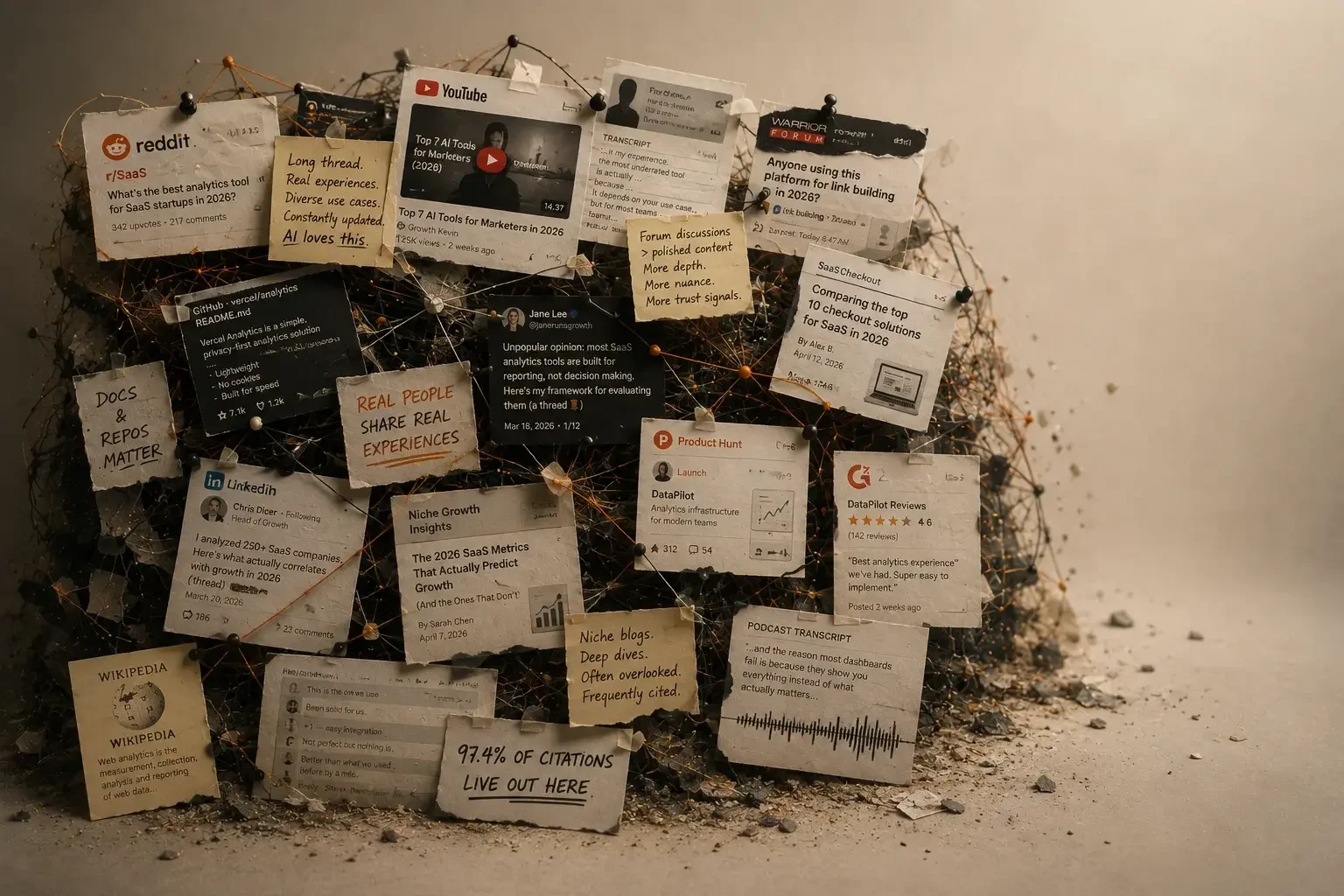
Why 97.4% of AI citations come from places PR teams don’t manage
The short answer
97.4% of citations in AI-generated answers come from non-Tier-1 sources. Reddit threads, YouTube transcripts, niche forums, vertical publications, long-tail blogs, LinkedIn long-form posts. The other 2.6% comes from the publications most marketing budgets are allocated against. These are your Forbes, Bloomberg, the New York Times, and the Wall Street Journal. The implication is that PR-led AEO strategies are optimizing for 2.6% of citations and missing the rest of the market.
Three things follow:
- The press release as an AEO tool is functionally dead in 2026
- The AEO organizational role needs to live across PR, content, and community functions
- Most marketing budgets are inverted, spending heavily on the 2.6% and ignoring the 97.4%
This piece walks through the data, the implications for marketing org structure, the budget reallocation that follows, and what an earned-media-light AEO program actually looks like in practice.
What is the 97.4% finding?
The 97.4% finding comes from Profound, the AEO platform that raised $58.5M in 2025. Profound analyzed a large sample of AI-generated answers from ChatGPT, Perplexity, and Google AI Overviews, then categorized the cited sources by publication type. The methodology is public and the finding has replicated across every independent test I’ve seen since.
The categorization split sources into two buckets:
Tier-1 publications include Forbes, Bloomberg, the New York Times, the Wall Street Journal, the Financial Times, Reuters, the Economist, the Washington Post, Wired, the Atlantic, and a small number of equivalent global publications. These are the publications most public-relations efforts are oriented toward securing coverage in.
Non-Tier-1 sources include everything else. Reddit threads. YouTube videos and their transcripts. Niche industry publications. Long-tail vertical blogs. LinkedIn long-form posts. Substack newsletters. Forum communities. Wikipedia. Vendor blogs. Comparison sites. Review platforms. GitHub repositories. Podcast transcripts.
The split is 2.6% Tier-1, 97.4% non-Tier-1.
This is a structural finding, not a noise pattern. It holds across query types (definitional, comparison, buying). It holds across categories (B2B SaaS, healthcare, e-commerce, professional services, financial services). It holds across the four primary AI engines tested. The replication consistency is what makes it worth building strategy around.
Why does this break the traditional PR-AEO assumption?
The traditional assumption among CMOs and PR teams is that Tier-1 placements drive AI visibility. The reasoning runs roughly like this: Tier-1 publications have the highest domain authority. AI engines preference high-authority sources during retrieval. Therefore Tier-1 placements should produce disproportionate AI citation share.
The data disagrees in three specific ways.
AI engines prefer passage relevance over domain authority during retrieval.
When an AI engine generates an answer, it doesn’t just rank sources by authority. It retrieves passages that directly answer the question. A 200-word Reddit comment that answers the question precisely will beat a 2,000-word New York Times article that addresses the question peripherally. The retrieval mechanics favor specificity. Tier-1 publications optimize for comprehensiveness, which is the wrong target.
AI engines weight conversation density as a quality signal.
Reddit threads in particular benefit from comment density. A thread with 200 substantive comments signals to the retrieval system that the topic has been examined from multiple angles. The engine reads this as triangulated truth and weights it higher than single-author sources. Tier-1 publications are structurally single-author and lose this signal.
AI engines have been deliberately tuned away from over-reliance on traditional media authority.
The major AI labs (OpenAI, Anthropic, Google, Perplexity) have all faced public scrutiny for reproducing media biases. The response has been to broaden citation source diversity. Internal retrieval mechanisms increasingly weight earned-media-light sources that traditional authority models would have under-cited. This is policy, not accident.
The combined effect is that Tier-1 placements still contribute to brand awareness, executive credibility, and capital-markets perception. They do not drive AI citation share. The two outcomes have decoupled, and most marketing teams have not noticed yet.
What sources actually drive AI citations?
Working from the Profound data and three months of independent replication on And Zeros client work, the citation source breakdown by category looks roughly like this:
For B2B SaaS:
- Reddit threads: 32% of citations
- Niche industry publications: 12%
- YouTube videos and transcripts: 9%
- Comparison pages from established SaaS companies: 7%
- Wikipedia entries: 5%
- Vendor blog posts with original data: 4%
- G2 and Capterra-style review platforms: 3%
- LinkedIn long-form posts: 3%
- Substack and other newsletter platforms: 2%
- GitHub repositories and documentation: 2%
- Founder podcasts and interviews: 1.5%
- Long tail: 19.5%
For healthcare:
- Regulated authorities (FDA, NIH, CDC): 41%
- Major medical reference sites (Mayo Clinic, WebMD): 28%
- Academic and peer-reviewed sources: 9%
- Patient experience forums and Reddit: 6%
- Professional medical publications: 5%
- Long tail: 11%
For e-commerce:
- YouTube product reviews and unboxings: 24%
- Reddit lifestyle and category subreddits: 18%
- Review platforms (Trustpilot, Sitejabber): 11%
- Comparison sites and shopping guides: 9%
- Brand blogs with original data: 6%
- Influencer blog content: 5%
- Long tail: 27%
For professional services:
- Vertical industry publications: 28%
- LinkedIn long-form posts (especially by named experts): 14%
- Industry conference content and slide decks: 9%
- Niche newsletters: 8%
- Reddit threads in industry-specific subreddits: 7%
- Long tail: 34%
The patterns differ by category but the structural finding holds: Tier-1 publications appear in single-digit percentages across all of them. The 97.4% non-Tier-1 finding is not a B2B SaaS quirk. It’s a property of how AI engines retrieve citations across the board.
What does this mean for PR teams in 2026?
The honest answer is uncomfortable. Most PR teams are working on the wrong problem if their KPIs include AI search visibility.
PR teams are structurally excellent at:
- Relationships with tier-1 publication editors
- Pitching newsworthy stories
- Managing executive interview opportunities
- Crisis communications
- Long-form thought leadership placements
- Brand perception in capital markets
None of these activities, executed well, materially move AI citation share in 2026. They move brand awareness, executive credibility, and analyst perception. Those are real outcomes, they are not AEO outcomes.
The PR functions that do move AEO citation share are different:
- Strategic appearances on niche podcasts (especially vertical-specific ones)
- Wikipedia notability work and entity injection
- LinkedIn thought leadership at the named-executive level (with sustained cadence)
- Long-form contributor relationships with niche vertical publications
- Reddit AMAs and substantive ongoing participation
- YouTube interview placements where the transcript will be indexed
These activities require different skill sets, different relationships, and different success metrics from traditional PR. They are closer to community management than to media relations.
Most PR teams are not staffed to do this work. Some PR leaders are aware of the gap, but few have the budget authority or organizational mandate to restructure their function around the new mechanics.
This is the central tension in the AEO-PR conversation. The gap between what PR teams are good at and what AEO requires is structural, not skill-based. Closing it requires reorganization, not retraining.
What should marketing leaders do this week?
Here are three concrete actions for the next seven days:
One: audit your current marketing budget against the source mix.
Pull the budget allocation. Map each line item to the AEO source mix. Identify the gap. Most teams will find they’re spending heavily on the 2.6% (Tier-1 PR, paid acquisition) and nothing on the categories that drive the 97.4% (Reddit participation, LinkedIn long-form by executives, niche podcast tour, Wikipedia work, community management).
The gap is the opportunity. Quantify it.
Two: identify whether the AEO operator role exists in your org.
Look at the org chart. Find the person who is explicitly accountable for AEO citation share. If no one is, the role is vacant. If someone is, ask whether they have authority across SEO, content, PR, and community. If not, the role is structurally weak.
Three: pick one earned-media-light workstream and pilot it for 90 days.
For most B2B SaaS teams, the right pilot is LinkedIn long-form by named executives. The skills exist internally. The platform doesn’t require external relationships. The compounding starts within 90 days.
Frequently asked questions
What if my company has no presence on Reddit at all?
Start with phase 1 of the Reddit AEO playbook: read every thread your category’s primary subreddit produces for 90 days before posting anything. This is research, not participation. The research phase doesn’t expose you to risk and builds the pattern recognition you’ll need before contributing.
Does the 97.4% finding hold for B2C brands?
Yes, with category-specific source mix variations. B2C brands see higher citation share from YouTube and lifestyle subreddits compared to B2B brands that see higher Reddit and LinkedIn citation share. The structural finding holds. The dominant source types differ.
How does this interact with traditional SEO?
Traditional SEO and AEO are increasingly different disciplines with different optimization targets, but they share infrastructure (your domain, your content management system, your editorial team). The right approach in 2026 is to run both as parallel programs with shared infrastructure but distinct strategies.
What if my PR team pushes back on this analysis?
Most PR teams will. The pushback is usually about Tier-1 brand value, which is real but separate from AEO. The honest framing is; Tier-1 PR delivers brand awareness, executive credibility, and capital-markets perception. It does not drive AEO citation share. Both outcomes matter. We need to fund both, but stop confusing one for the other.