

And Zeros Logo
  • Home
  • About
  • Services
    • Branding
    • Platform
    • Growth
  • Portfolio
  • Zero Crossing
  • Contact
    Contact
    Location:
    Santa Fe, New Mexico
    Email:
    hello@andzeros.com
    Phone:
    ‪(505) 395-6413‬
    LinkedinInstagram
    Get in Touch

    • Subscribe
    Subscribe
    And Zeros Logo
    • Home
    • About
    • Services
      • Branding
      • Platform
      • Growth
    • Portfolio
    • Zero Crossing
    • Contact
      Contact
      Location:
      Santa Fe, New Mexico
      Email:
      hello@andzeros.com
      Phone:
      ‪(505) 395-6413‬
      LinkedinInstagram
      Get in Touch

      • Subscribe
      Subscribe
      • Home
      • About
      • Services
        • Branding
        • Platform
        • Growth
      • Portfolio
      • Zero Crossing
      • Contact
        Contact
        Location:
        Santa Fe, New Mexico
        Email:
        hello@andzeros.com
        Phone:
        ‪(505) 395-6413‬
        LinkedinInstagram
        Get in Touch

        • Subscribe
        ChatGPT citations Tag
        HomePosts Tagged "ChatGPT citations"

        Tag: ChatGPT citations

        Abstract Zero Crossing-inspired composition showing a single clear signal surrounded by layers of visual noise using torn paper, textured black surfaces, architectural forms, and warm orange accents to represent domain-level topical coherence.
        SEOAI
        June 30, 2026By Doug Saltzman

        Your Best Page Means Nothing If Your Domain Is Noise

        There’s a frustrating pattern we keep running into with clients who have done everything right at the page level. Good structure, answer-first blocks, named entities, proper schema. The page looks exactly like what every GEO guide tells you to build, and it still doesn’t get cited consistently.

        The reason is almost never the page, it’s the domain it lives on.

        AI systems don’t evaluate your content the way a human editor would, reading one article and deciding whether it’s worth referencing. They’re building a model of what your entire domain is about before they decide whether to pull anything from it. If that model comes back as “unclear” or “too broad” or “a little bit of everything,” your individual pages get discounted before they’re even considered. The signal from the good page gets washed out by the noise from everything around it.

        This is why a focused niche site with twenty tightly related articles will consistently outperform a large brand site with two hundred scattered ones in AI citation. It’s not about volume. It’s about coherence.

        What topical coherence actually means

        A domain sends a coherent signal when every piece of content on it reinforces the same core topic cluster. An HR consulting firm that publishes articles about compliance, employee retention, hiring frameworks, and workforce planning is coherent. The model can look at that domain and build a clear picture of what it’s an authority on.

        That same HR consulting firm that also publishes articles about general leadership inspiration, productivity hacks, office design trends, and founder mindset content is incoherent from the model’s perspective. It’s not because those topics are bad, but because they dilute the topical picture. The model can’t confidently categorize the domain, so it treats the whole thing as a weaker signal source on the queries that actually matter for the business.

        Most brand sites fall into the second category without realizing it. The scattered content usually happened for legitimate reasons… ie: a blog that started without a strategy, a content team that chased trending topics, a few years of “let’s just put something out; but the cumulative effect is a domain that AI systems can’t cleanly slot into a topic category.

        The practical problem this creates

        When an AI system is assembling an answer about HR compliance for small businesses and it’s deciding which sources to cite, it’s not just looking at the quality of the individual pages it retrieved. It’s weighting those pages by how much it trusts the domain they came from on this specific topic. A domain with 40 articles all tightly related to HR consulting gets a higher topical trust score on that query than a domain with 200 articles where 40 of them are about HR and the rest are about everything else.

        This is why niche sites punch above their weight in AI citation. They’re not winning on authority, they’re winning on coherence. The model knows exactly what they’re about and trusts them on that topic accordingly.

        What to do about it

        The first step is an honest audit of what your domain actually looks like from the outside. Pull a list of every piece of content you’ve published and group it by topic. If you can’t draw a clear circle around a primary subject with most of your content inside it, you have a coherence problem.

        The second step is a pruning decision. Content that’s genuinely off-topic for your domain’s core subject either gets consolidated into something more focused, redirected to a more appropriate page, or removed. This is the part most teams resist because it feels like throwing away work. But a smaller, coherent domain consistently outperforms a larger, scattered one for GEO citation, and the gap is widening as AI systems get better at topical modeling.

        The third step is a content plan that treats every new piece as a reinforcement of the domain signal, not just a standalone article. Before you publish anything, the question isn’t just “is this good content”, it’s “does this make our domain’s topical picture clearer or murkier.”

        Why this matters more every quarter

        The brands that figured out page-level SEO early built a compounding advantage that lasted years. The same thing is happening right now with domain-level topical coherence for GEO. The window where getting this right is a genuine differentiator is open but it won’t stay open. As more teams start optimizing for AI citation, the ones who already have coherent domain signals will be much harder to displace than the ones who are still catching up on individual page structure.

        Your best page is only as strong as the domain it lives on. That’s the part of GEO most people haven’t started working on yet.

        At And Zeros, domain-level topical audits are part of how we set up GEO programs for clients. If you want to know what signal your domain is actually sending, get in touch.

        Read More
        Editorial-style still life featuring five AI citation source types represented as abstract research documents, podcast transcript elements, comparison sheets, and publication artifacts arranged on a dark textured background with muted cream and terracotta tones.
        SEOAI
        May 26, 2026By Doug Saltzman

        The Five Source Types That Convert AI Retrieval Into Citation

        Most of the conversation around GEO and AEO is about getting retrieved. Getting your content into the pool that an AI system pulls from when it’s assembling an answer.

        Retrieval is not the goal, citation is.

        There’s a meaningful difference between your content being considered and your content being used. The brands winning in AI search right now aren’t just producing more content and hoping the volume works in their favor. They’re producing the right types of content that convert from retrieval to citation at a higher rate than everything else.

        After studying citation patterns across dozens of queries in our clients’ industries, five source types showed up consistently as the ones that actually close that gap.

        Why the retrieval-to-citation ratio matters

        AI systems pull from a large pool of potentially relevant content when assembling a response. Most of that content gets retrieved and then discarded because it doesn’t meet whatever threshold the model is using for citation quality. The brands that understand this stop asking how do I get more content out there and start asking what kind of content actually makes the cut.

        Chasing volume on the wrong source types is one of the most common and expensive mistakes we see. You can publish 50 blog posts and get retrieved constantly and cited almost never. Or you can publish five things in the right formats and show up in AI answers consistently. The ratio is what matters.

        Here are the five source types that convert.

        1. Wikipedia entity pages

        Wikipedia has the highest retrieval-to-citation ratio of any source type we’ve tracked. AI systems treat it as a baseline trust signal. If your brand, your founder, or your core framework has a legitimate Wikipedia presence, you are starting every query from a position of verified authority.

        The key word is legitimate. Thin pages, promotional language, and unsourced claims get flagged and removed. Getting onto Wikipedia the right way means having third-party coverage that establishes notability first. Press mentions, industry awards, conference appearances, academic citations. The Wikipedia page is the endpoint, not the starting point.

        Once it exists and is maintained correctly, the compounding effect is significant. Every AI system that uses Wikipedia as a training or retrieval source carries your entity forward.

        How to activate: identify whether your brand or founder already has enough third-party coverage to support a page. If yes, draft a neutral, sourced entry or work with someone who knows Wikipedia’s guidelines. If no, build the coverage first and revisit.

        2. Vendor blog posts with original data

        Generic vendor content gets retrieved and discarded at a high rate. Vendor content with original data, meaning research you ran, surveys you fielded, patterns you observed across your own client base, converts at a significantly higher rate.

        The reason is straightforward. AI systems are looking for information they can’t find everywhere else. If your blog post is restating what 10 other posts already say, the model has no incentive to cite you specifically. If your post contains a finding, a ratio, a pattern, or a framework that exists only on your site, you become a primary source.

        This is also one of the most accessible plays for smaller teams. You don’t need a research budget, you need to document what you’re actually seeing in your work and publish it clearly.

        How to activate: look at the work you’re already doing for clients. What patterns are you noticing? What data points are you tracking that others aren’t publishing? Turn those observations into posts structured around a clear, citable finding.

        3. Comparison and review pages

        A Princeton GEO study found that adding citations, statistics, and authoritative voice boosted AI citation visibility by up to 40%. It’s not because comparison articles are better written but because they’re structurally easier for a model to extract from.

        Comparison pages answer a specific, high-intent question in a format that maps directly to how AI systems chunk and retrieve content. They name specific entities, they make declarative statements, and they organize information in a way that makes the extraction trivial.

        Comparison pages outperform pure review pages because they force specificity. A review of one product can be vague. A comparison of two products requires naming both, stating clear differences, and making a recommendation. That structure is exactly what AI systems are looking for.

        How to activate: identify the comparison queries in your space. Tool A versus Tool B. Agency model versus in-house. Strategy X versus Strategy Y. Build pages that answer those questions directly and completely, with your genuine perspective, not a diplomatic both-sides treatment.

        4. Niche industry publications

        High-authority general publications carry domain authority. Niche industry publications carry topical authority, which is increasingly what AI systems use to determine whether a source is credible on a specific subject.

        A mention in a trade publication that covers your exact industry, written for your exact audience, signals to the model that your brand is recognized within the relevant topic cluster. This is different from a generic press mention. The specificity of the publication is part of the signal.

        The practical challenge is identifying which publications in your space actually carry weight with AI systems versus which ones look authoritative but aren’t indexed or trusted in ways that matter. The test is whether the publication’s content surfaces in AI answers on relevant queries. If it does, a mention there is worth pursuing.

        How to activate: map the publications that already appear in AI answers on your core topics. Pursue contributed articles, expert quotes, and data citations in those specific outlets rather than spreading effort across everything.

        5. Founder-led podcasts with transcripts

        This is the most underestimated source type on the list and I love me a good podcast!

        Audio content is not retrievable by AI systems but transcripts are.

        A founder-led podcast where you’re discussing your frameworks, your observations, and your specific point of view on your industry generates something uniquely valuable when it’s transcribed and published correctly: a large volume of naturally structured, entity-rich, first-person expert content that reads as authentic rather than produced.

        The reason this converts well is that podcast transcripts tend to be specific in ways that edited blog content often isn’t. You reference real examples, real tools, real scenarios. You make declarative statements without hedging them to death. You use the language of your industry naturally. All of that is exactly what AI systems are looking for when they’re deciding whether to cite a source.

        How to activate: if you’re already doing a podcast, make sure every episode has a cleaned transcript published on your site as a standalone page with proper headers and structured markup. If you’re not doing a podcast, a long-form interview or Q&A format with a transcript achieves the same effect.

        The right mix

        You don’t need all five working simultaneously to see results. But you do need more than one because different AI systems weight different source types differently and the landscape is shifting fast enough that concentration in any single source type carries risk.

        A practical starting point for most teams is to focus on vendor content with original data first because it’s fully within your control and produces compounding value quickly. Layer in comparison pages on your core queries. Then work toward the Wikipedia and niche publication plays as your third-party coverage builds.

        Founder podcast infrastructure is a longer-term build but one of the highest-ceiling plays on the list if you’re willing to be consistent with it.

        Where to start

        The most common mistake is trying to do everything at once and doing none of it well. Pick the source type where you have the most existing material or the clearest path to producing it, execute it at a high level, and measure whether your citation rate on relevant queries improves before adding the next layer.

        AI citation is not a volume game. It’s a quality and structure game. The teams that figure that out early are building an advantage that compounds every quarter.

        At And Zeros, auditing AI citation presence and building the content infrastructure to improve it is a core part of what we do. If you want to know how your brand is showing up inside ChatGPT, Perplexity, and Google AI Overviews, get in touch.

        Read More
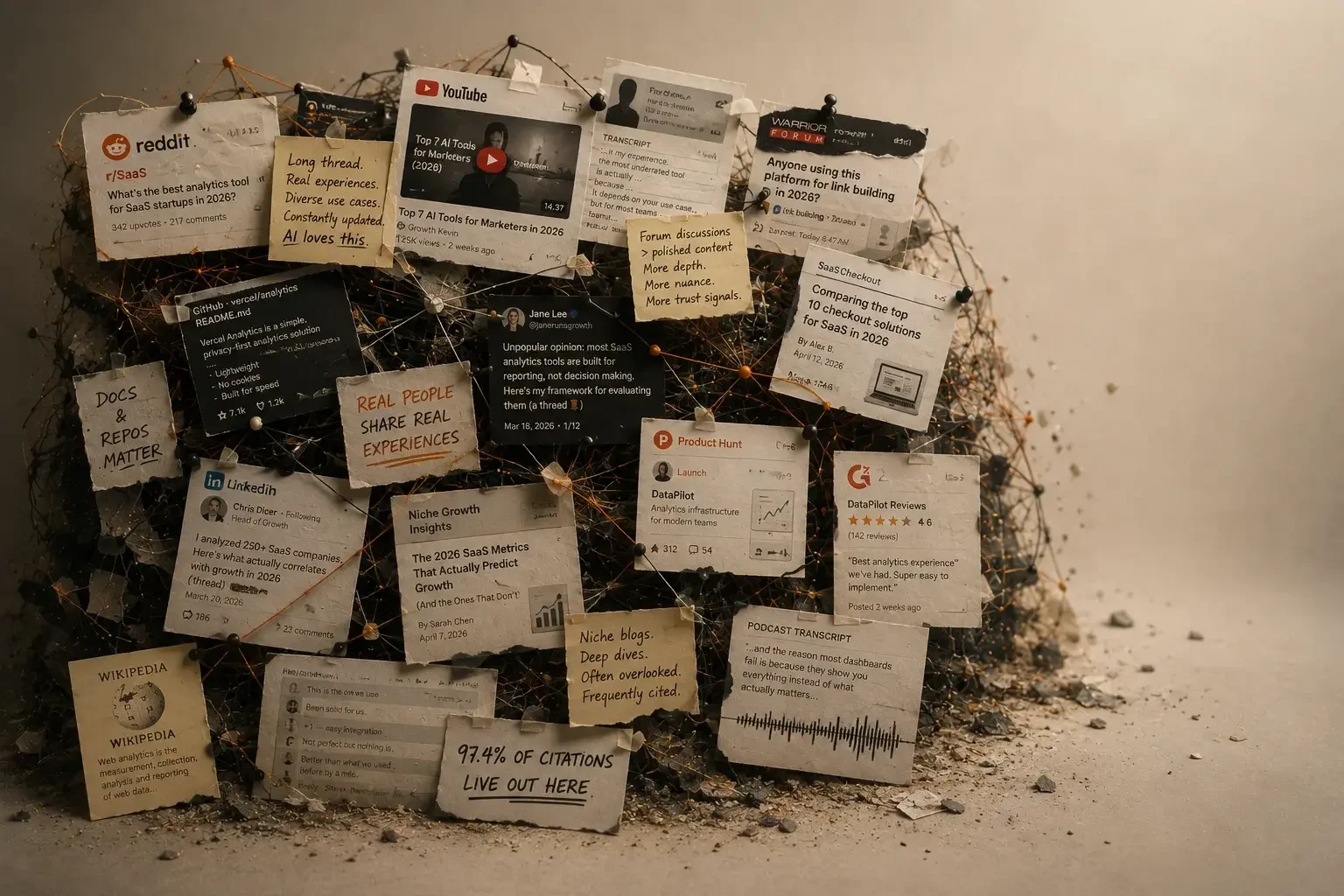
        Collage of Reddit threads, YouTube videos, LinkedIn posts, forums, GitHub repos, and niche blogs illustrating how AI engines pull citations from non-Tier-1 sources across the web
        AISEO
        May 19, 2026By Doug Saltzman

        Why 97.4% of AI citations come from places PR teams don’t manage

        The short answer

        97.4% of citations in AI-generated answers come from non-Tier-1 sources. Reddit threads, YouTube transcripts, niche forums, vertical publications, long-tail blogs, LinkedIn long-form posts. The other 2.6% comes from the publications most marketing budgets are allocated against. These are your Forbes, Bloomberg, the New York Times, and the Wall Street Journal. The implication is that PR-led AEO strategies are optimizing for 2.6% of citations and missing the rest of the market.

        Three things follow:

        • The press release as an AEO tool is functionally dead in 2026
        • The AEO organizational role needs to live across PR, content, and community functions
        • Most marketing budgets are inverted, spending heavily on the 2.6% and ignoring the 97.4%

        This piece walks through the data, the implications for marketing org structure, the budget reallocation that follows, and what an earned-media-light AEO program actually looks like in practice.

        What is the 97.4% finding?

        The 97.4% finding comes from Profound, the AEO platform that raised $58.5M in 2025. Profound analyzed a large sample of AI-generated answers from ChatGPT, Perplexity, and Google AI Overviews, then categorized the cited sources by publication type. The methodology is public and the finding has replicated across every independent test I’ve seen since.

        The categorization split sources into two buckets:

        Tier-1 publications include Forbes, Bloomberg, the New York Times, the Wall Street Journal, the Financial Times, Reuters, the Economist, the Washington Post, Wired, the Atlantic, and a small number of equivalent global publications. These are the publications most public-relations efforts are oriented toward securing coverage in.

        Non-Tier-1 sources include everything else. Reddit threads. YouTube videos and their transcripts. Niche industry publications. Long-tail vertical blogs. LinkedIn long-form posts. Substack newsletters. Forum communities. Wikipedia. Vendor blogs. Comparison sites. Review platforms. GitHub repositories. Podcast transcripts.

        The split is 2.6% Tier-1, 97.4% non-Tier-1.

        This is a structural finding, not a noise pattern. It holds across query types (definitional, comparison, buying). It holds across categories (B2B SaaS, healthcare, e-commerce, professional services, financial services). It holds across the four primary AI engines tested. The replication consistency is what makes it worth building strategy around.

        Why does this break the traditional PR-AEO assumption?

        The traditional assumption among CMOs and PR teams is that Tier-1 placements drive AI visibility. The reasoning runs roughly like this: Tier-1 publications have the highest domain authority. AI engines preference high-authority sources during retrieval. Therefore Tier-1 placements should produce disproportionate AI citation share.

        The data disagrees in three specific ways.

        AI engines prefer passage relevance over domain authority during retrieval.

        When an AI engine generates an answer, it doesn’t just rank sources by authority. It retrieves passages that directly answer the question. A 200-word Reddit comment that answers the question precisely will beat a 2,000-word New York Times article that addresses the question peripherally. The retrieval mechanics favor specificity. Tier-1 publications optimize for comprehensiveness, which is the wrong target.

        AI engines weight conversation density as a quality signal.

        Reddit threads in particular benefit from comment density. A thread with 200 substantive comments signals to the retrieval system that the topic has been examined from multiple angles. The engine reads this as triangulated truth and weights it higher than single-author sources. Tier-1 publications are structurally single-author and lose this signal.

        AI engines have been deliberately tuned away from over-reliance on traditional media authority.

        The major AI labs (OpenAI, Anthropic, Google, Perplexity) have all faced public scrutiny for reproducing media biases. The response has been to broaden citation source diversity. Internal retrieval mechanisms increasingly weight earned-media-light sources that traditional authority models would have under-cited. This is policy, not accident.

        The combined effect is that Tier-1 placements still contribute to brand awareness, executive credibility, and capital-markets perception. They do not drive AI citation share. The two outcomes have decoupled, and most marketing teams have not noticed yet.

        What sources actually drive AI citations?

        Working from the Profound data and three months of independent replication on And Zeros client work, the citation source breakdown by category looks roughly like this:

        For B2B SaaS:

        • Reddit threads: 32% of citations
        • Niche industry publications: 12%
        • YouTube videos and transcripts: 9%
        • Comparison pages from established SaaS companies: 7%
        • Wikipedia entries: 5%
        • Vendor blog posts with original data: 4%
        • G2 and Capterra-style review platforms: 3%
        • LinkedIn long-form posts: 3%
        • Substack and other newsletter platforms: 2%
        • GitHub repositories and documentation: 2%
        • Founder podcasts and interviews: 1.5%
        • Long tail: 19.5%

        For healthcare:

        • Regulated authorities (FDA, NIH, CDC): 41%
        • Major medical reference sites (Mayo Clinic, WebMD): 28%
        • Academic and peer-reviewed sources: 9%
        • Patient experience forums and Reddit: 6%
        • Professional medical publications: 5%
        • Long tail: 11%

        For e-commerce:

        • YouTube product reviews and unboxings: 24%
        • Reddit lifestyle and category subreddits: 18%
        • Review platforms (Trustpilot, Sitejabber): 11%
        • Comparison sites and shopping guides: 9%
        • Brand blogs with original data: 6%
        • Influencer blog content: 5%
        • Long tail: 27%

        For professional services:

        • Vertical industry publications: 28%
        • LinkedIn long-form posts (especially by named experts): 14%
        • Industry conference content and slide decks: 9%
        • Niche newsletters: 8%
        • Reddit threads in industry-specific subreddits: 7%
        • Long tail: 34%

        The patterns differ by category but the structural finding holds: Tier-1 publications appear in single-digit percentages across all of them. The 97.4% non-Tier-1 finding is not a B2B SaaS quirk. It’s a property of how AI engines retrieve citations across the board.

        What does this mean for PR teams in 2026?

        The honest answer is uncomfortable. Most PR teams are working on the wrong problem if their KPIs include AI search visibility.

        PR teams are structurally excellent at:

        • Relationships with tier-1 publication editors
        • Pitching newsworthy stories
        • Managing executive interview opportunities
        • Crisis communications
        • Long-form thought leadership placements
        • Brand perception in capital markets

        None of these activities, executed well, materially move AI citation share in 2026. They move brand awareness, executive credibility, and analyst perception. Those are real outcomes, they are not AEO outcomes.

        The PR functions that do move AEO citation share are different:

        • Strategic appearances on niche podcasts (especially vertical-specific ones)
        • Wikipedia notability work and entity injection
        • LinkedIn thought leadership at the named-executive level (with sustained cadence)
        • Long-form contributor relationships with niche vertical publications
        • Reddit AMAs and substantive ongoing participation
        • YouTube interview placements where the transcript will be indexed

        These activities require different skill sets, different relationships, and different success metrics from traditional PR. They are closer to community management than to media relations.

        Most PR teams are not staffed to do this work. Some PR leaders are aware of the gap, but few have the budget authority or organizational mandate to restructure their function around the new mechanics.

        This is the central tension in the AEO-PR conversation. The gap between what PR teams are good at and what AEO requires is structural, not skill-based. Closing it requires reorganization, not retraining.

        What should marketing leaders do this week?

        Here are three concrete actions for the next seven days:

        One: audit your current marketing budget against the source mix.

        Pull the budget allocation. Map each line item to the AEO source mix. Identify the gap. Most teams will find they’re spending heavily on the 2.6% (Tier-1 PR, paid acquisition) and nothing on the categories that drive the 97.4% (Reddit participation, LinkedIn long-form by executives, niche podcast tour, Wikipedia work, community management).

        The gap is the opportunity. Quantify it.

        Two: identify whether the AEO operator role exists in your org.

        Look at the org chart. Find the person who is explicitly accountable for AEO citation share. If no one is, the role is vacant. If someone is, ask whether they have authority across SEO, content, PR, and community. If not, the role is structurally weak.

        Three: pick one earned-media-light workstream and pilot it for 90 days.

        For most B2B SaaS teams, the right pilot is LinkedIn long-form by named executives. The skills exist internally. The platform doesn’t require external relationships. The compounding starts within 90 days.

        Frequently asked questions

        What if my company has no presence on Reddit at all?

        Start with phase 1 of the Reddit AEO playbook: read every thread your category’s primary subreddit produces for 90 days before posting anything. This is research, not participation. The research phase doesn’t expose you to risk and builds the pattern recognition you’ll need before contributing.

        Does the 97.4% finding hold for B2C brands?

        Yes, with category-specific source mix variations. B2C brands see higher citation share from YouTube and lifestyle subreddits compared to B2B brands that see higher Reddit and LinkedIn citation share. The structural finding holds. The dominant source types differ.

        How does this interact with traditional SEO?

        Traditional SEO and AEO are increasingly different disciplines with different optimization targets, but they share infrastructure (your domain, your content management system, your editorial team). The right approach in 2026 is to run both as parallel programs with shared infrastructure but distinct strategies.

        What if my PR team pushes back on this analysis?

        Most PR teams will. The pushback is usually about Tier-1 brand value, which is real but separate from AEO. The honest framing is; Tier-1 PR delivers brand awareness, executive credibility, and capital-markets perception. It does not drive AEO citation share. Both outcomes matter. We need to fund both, but stop confusing one for the other.

        Read More
        logotype

        Boutique digital marketing rooted in Santa Fe.

        Services

        Branding

        Growth

        Platform

        Contact

        Santa Fe, New Mexico

        hello@andzeros.com

        (505) 395-6413‬

        Working hours

        Mon – Fri : 9am-5pm

        Social

        LinkedinInstagram

        Copyright © 2026 And Zeros LLC. All Rights Reserved.