

Answer Engine Optimization: 7 Smart, Proven Steps to Get Cited
AEO, or Answer Engine Optimization, is the practice of structuring your brand’s content, data, and authority signals so that AI answer engines (ChatGPT, Perplexity, Google AI Overviews, Gemini) choose to cite you when they generate an answer. Where SEO earns you a ranking position on a results page, Answer Engine Optimization earns you a mention inside the answer itself.
That distinction is the whole ballgame right now. A growing share of searches never produce a click. The answer engine reads across dozens of sources, synthesizes a response, and names (or doesn’t name) a handful of sources as it does. Answer Engine Optimization is the discipline of making sure your brand is one of the names.
What Answer Engine Optimization Actually Means
Answer Engine Optimization is not a rebrand of SEO and it’s not a single tactic. It’s a set of practices aimed at one specific outcome: getting a large language model or answer engine to surface your brand, your data, or your point of view when it responds to a user’s question.
Concretely, that means:
- Structuring content so a specific answer can be lifted out of it cleanly, without the model needing to infer or guess.
- Making your entity (your company, your founder, your product) unambiguous and well-defined across the web, so models can confidently attach facts to you.
- Building the kind of third-party citations, mentions, and structured data that answer engines use as trust signals when deciding who to quote.
Answer Engine Optimization sits downstream of a real shift in how people find information. It isn’t a theoretical concept: it’s a response to the fact that a meaningful and growing share of information-seeking behavior now happens inside a chat interface instead of a search results page.
Why Answer Engine Optimization Exists Now
For two decades, “search” meant typing a query into a box and getting ten blue links back. You did the synthesis. You clicked, compared, and decided who to trust.
Answer engines invert that. The model does the synthesis and hands you a finished answer, often with a short list of sources attached, or sometimes with no visible sources at all. The user experience has moved from “give me options” to “give me the answer.” That shift changes who wins.
A few forces are driving it:
Generative answers are now a default surface.
Google’s AI Overviews sit above traditional results for a large share of queries, and Google’s own documentation now treats AI features as a standard part of Search. ChatGPT, Perplexity, and Copilot have gone from novelty to daily habit for millions of people researching purchases, comparing vendors, and asking “what is” and “how do I” questions that used to live entirely in Google.
Zero-click behavior was already rising before AI made it worse.
Users have been getting answers directly on the results page (featured snippets, knowledge panels, People Also Ask) for years. SparkToro’s zero-click research found that for every 1,000 U.S. Google searches, only about 360 clicks reach the open web. Answer engines are the natural extension of that trend, not a break from it.
Trust has shifted from “I found this myself” to “the assistant told me this.”
When a chatbot names a source, it functions less like a search result and more like a recommendation. Being the source an assistant reaches for is a different kind of authority than ranking #3 for a keyword.
None of this means SEO is dead. It means the finish line has moved. Ranking well is still often a precondition for being crawled, indexed, and considered, but ranking alone no longer guarantees you get cited when a model answers the question.
How Answer Engines Decide Who to Cite
Answer engines don’t work like traditional search rankers, and they don’t fully disclose their methods, but the observable pattern is consistent across ChatGPT, Perplexity, and AI Overviews. A few factors show up again and again:
Clear, extractable answers. Models favor content where the answer to a specific question is stated plainly and isn’t buried in throat-clearing, marketing copy, or a wall of unstructured prose. A direct definition, a clean comparison, a numbered process: these are easy for a model to lift and attribute.
Entity clarity. Answer engines build an internal understanding of who and what you are: your company, your founder, your product, your category. If your name, your business, and your claims are consistent and well-documented across your site, structured data, and third-party mentions, a model can attach information to you with confidence. If your identity is fragmented or ambiguous, it’s safer for the model to cite someone else.
Structured data and machine-readable signals. Schema markup, FAQ markup, and clean HTML structure don’t just help traditional search engines parse your page: they lower the cost for an AI system to confirm what a page is actually saying, rather than guessing. Vocabularies like Schema.org exist precisely so machines can read your claims without ambiguity.
Independent corroboration. Models weigh whether a claim shows up in more than one place. A single self-published claim on your own site is weaker evidence than the same claim appearing in your content, in a third-party review, in a directory listing, and in a forum discussion. Citation authority is built externally, not just on-page.
Freshness and specificity. Vague, evergreen-sounding claims are less citable than specific, well-scoped ones. Answer engines are more likely to surface content that answers a narrow question precisely than content that gestures broadly at a topic.
Answer Engine Optimization vs. SEO: What’s the Difference
Answer Engine Optimization and SEO share a lot of DNA (both depend on crawlable, well-structured, authoritative content), but they optimize for different outcomes.
| SEO | AEO | |
|---|---|---|
| Goal | Rank on a results page | Get cited inside a generated answer |
| Success metric | Position, organic traffic, click-through rate | Citation frequency, share of voice inside AI answers, brand mentions |
| Content shape | Long-form pages built to rank for a keyword cluster | Answer-shaped content built to be lifted and quoted directly |
| Trust signals | Backlinks, domain authority, on-page relevance | Entity clarity, structured data, cross-platform corroboration |
| User outcome | A click to your site | A citation, with or without a click |
The practical implication: SEO and Answer Engine Optimization aren’t competing strategies, they’re overlapping ones. Most of what makes a page good for SEO (clear structure, real expertise, credible sourcing) also makes it more citable. But AEO adds specific requirements SEO alone doesn’t demand: unambiguous entity data, answer-first formatting, and a deliberate strategy for showing up in the third-party sources that answer engines actually trust.
The Core Pillars of Answer Engine Optimization
Most Answer Engine Optimization work falls into three connected pillars. Skipping any one of them weakens the other two.
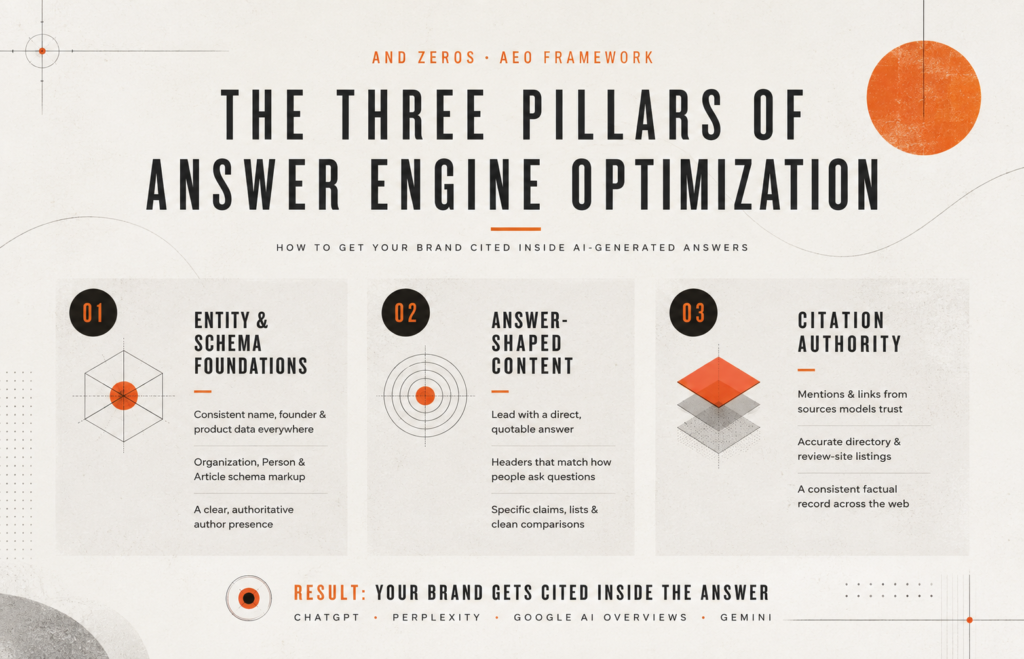
1. Entity and Schema Foundations
Before an answer engine can cite you, it has to understand who you are. That means:
- Consistent business, founder, and product naming across your site, social profiles, directories, and press mentions.
- Organization, Person, and Article schema markup that explicitly states facts a model would otherwise have to infer.
- A clean, well-maintained “About” and author presence: answer engines increasingly weigh who wrote something, not just what was written.
2. Answer-Shaped Content
Content built for Answer Engine Optimization answers the question in the first sentence or two, then supports it. That means:
- Leading sections with a direct, quotable answer before expanding into nuance.
- Using clear headers that match how people actually phrase questions.
- Building FAQ sections that mirror real query patterns, not marketing-speak.
- Favoring specific claims, comparisons, and structured lists over vague narrative.
3. Citation Authority
Answer engines corroborate. Being cited depends on showing up credibly in places you don’t fully control:
- Earning mentions and backlinks from sites the model already trusts.
- Being listed accurately in relevant directories, review sites, and industry roundups.
- Contributing genuinely useful commentary, data, or perspective that other sites choose to reference.
- Maintaining a consistent factual record across every place your brand appears, so there’s nothing for a model to reconcile or doubt.
How to Get Started With Answer Engine Optimization
You don’t need to overhaul your entire site to begin. A practical starting sequence for Answer Engine Optimization:
- Audit how AI answer engines currently describe you. Ask ChatGPT, Perplexity, and Google AI Overviews questions your prospects would ask. Note whether you’re mentioned, cited, misdescribed, or absent entirely.
- Fix entity ambiguity first. Make sure your company name, founder name, and core claims are stated consistently and are backed by schema markup site-wide.
- Rewrite your highest-intent pages to lead with the answer. Pick the handful of pages that target real “what is,” “how do I,” and “best X for Y” questions, and restructure the opening of each section to answer directly before elaborating.
- Add FAQ and Article schema to key pages. This is low-effort, high-signal work that directly supports how answer engines parse and trust your content.
- Build a deliberate citation plan. Identify the sites, directories, and communities where your category gets discussed, and get genuinely useful, accurate information about your brand into those conversations.
- Re-test regularly. Answer Engine Optimization isn’t a one-time project. Answer engines update constantly, and your visibility inside them should be tracked the same way you’d track keyword rankings.
How And Zeros Approaches Answer Engine Optimization
We treat Answer Engine Optimization as a structural discipline, not a content trick. Every engagement starts with an audit of how AI answer engines currently represent a client (what they get right, what they get wrong, and where the client is invisible) and works backward from there: entity and schema cleanup, answer-first content architecture, and a deliberate program to earn the third-party citations that answer engines actually trust.
If you want a clear picture of where your brand stands inside AI answers today, get in touch with And Zeros and we’ll walk you through what we’re seeing.
FAQ
Is AEO the same as SEO?
No, but they overlap heavily. SEO optimizes for ranking on a results page; Answer Engine Optimization optimizes for being cited inside an AI-generated answer. Strong SEO fundamentals (clear structure, real expertise, credible sourcing) support AEO, but AEO adds requirements SEO doesn’t, like explicit entity data and answer-first formatting.
How do I get cited by ChatGPT?
Give it unambiguous, well-structured facts to work with: clear entity data (who you are, backed by schema), content that states answers directly rather than burying them, and corroboration from credible third-party sources. ChatGPT and similar tools favor sources they can confidently attribute a claim to.
Does AEO replace SEO?
No. Most Answer Engine Optimization work depends on SEO fundamentals (crawlability, indexability, authority) being in place first. AEO is better understood as an additional layer on top of SEO, aimed at a different distribution surface.
What is GEO, and is it different from AEO?
GEO (Generative Engine Optimization) and AEO are closely related terms often used interchangeably. Both describe optimizing for AI-generated answers rather than traditional rankings. Some practitioners use GEO for the broader discipline and AEO for the specific goal of earning citations; in practice, the two overlap almost completely.
How long does AEO take to show results?
It varies by how much rework is needed and how competitive the category is. Entity and schema fixes can influence how models describe you relatively quickly; earning durable third-party citation authority takes longer, similar to traditional link-building timelines.
Can a small or local business benefit from AEO?
Yes. Answer engines are frequently used for local and category-specific questions (“best marketing agency in Santa Fe,” for example), and smaller businesses with clear, well-structured, well-corroborated information can be cited ahead of larger competitors with messier entity data.