Everyone is writing “What is GEO” guides right now.
Almost nobody is actually studying what ChatGPT cites, or why.
So we did. Across dozens of commercial queries in our clients’ industries, we pulled the sources ChatGPT returned, compared them against traditional Google rankings, and looked for the patterns. Here’s what showed up in almost every answer.
The #1 Predictor Isn’t What You Think
If you had to guess, you’d probably say domain authority, or backlinks, or some algorithmic edge case only Neil Patel understands.
It’s not.
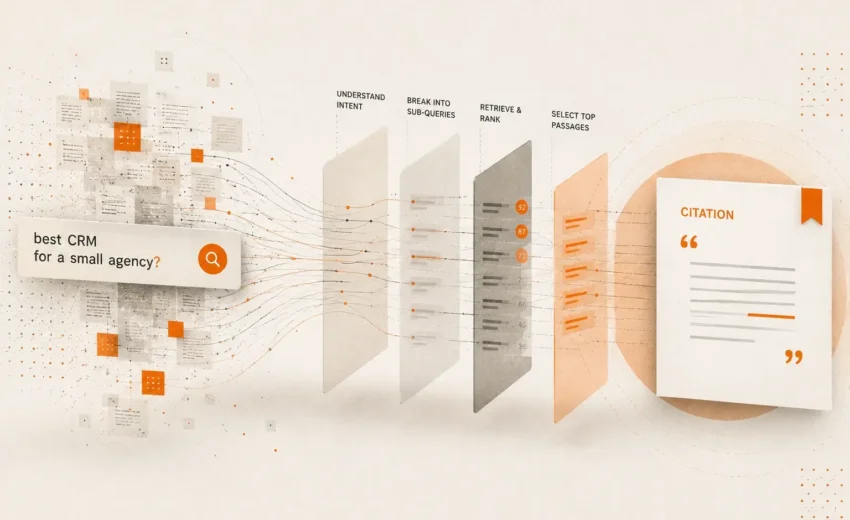
The single strongest predictor of whether a page gets cited by ChatGPT is structural clarity. Simple explanation is whether the page is built in a way an LLM can actually extract from. A Princeton, Georgia Tech, and Allen Institute for AI study found that 32.5% of AI citations come from comparison articles, not because comparison articles are better written, but because they’re structurally easier for a model to chunk.
Domain authority helps, but a clean Reddit thread will get cited over a DR 85 marketing blog if the Reddit thread answers the question in 60 words and the marketing blog buries it in paragraph nine.
Five Patterns We Saw Repeatedly
01: The answer lives above the fold.
Every cited page we studied had a direct, definitional answer in the first 100 words. Not an intro or a hook. A straight-up declarative sentence that a model could lift verbatim. If your content opens with “In today’s rapidly evolving landscape…” you are already out of the running.
02: The entities are specific and named.
Cited pages named the tools, the people, the studies, the companies, the frameworks. Vague pages lost every time. “Enterprise marketing platforms” gets beaten by “HubSpot, Marketo, and Salesforce Marketing Cloud.” The model cites the one that lets it build a knowledge graph.
03: The structure is chunkable.
H2s that ask the question a user would ask. Short paragraphs (3–5 sentences). Bulleted lists where bullets actually stand alone. If you have to read 400 words to extract a 50-word answer, the model won’t bother. It’ll cite the page that already did the extraction for it.
04: Recency matters more than depth on fast-moving topics.
For anything time-sensitive (prices, policies, product releases, 2026 trends), ChatGPT and Perplexity heavily favor content updated in the last 90 days. A thin but fresh article will beat a deep but stale one. This isn’t fair, but it’s how the systems behave.
05: The page exists as a node, not an island.
Cited pages link out to authoritative sources (studies, official docs, named experts) and link internally to related content. They behave like nodes in a knowledge graph, which is exactly what models are modeling. Orphan pages get ignored no matter how good they are.
What This Means for Your Content
Stop writing for humans who might skim.
Start writing for models that will extract.
This doesn’t mean robotic content, it means content with enough structural integrity that both a reader and an LLM can find the answer they came for in under 10 seconds. The best cited pages we saw were genuinely useful to humans and easy to chunk. Those aren’t competing goals anymore.
The practical shift:
- Lead every section with a standalone answer:
A 40-60 word block that works if pulled out of context. - Name specific entities:
No “leading CRM platforms.” Say HubSpot, Salesforce, Pipedrive. - Update aggressively on fast-moving topics:
If your post says “2024 trends” in April 2026, it’s not getting cited. - Build clusters, not islands:
Pillar + spoke structure. The system rewards topical density. - Treat structured data as a required input, not an optional nice-to-have:
Schema gives the model the map.
The Bigger Shift
The agencies that figure this out in the next 18 months will build the category.
The ones that don’t will keep sending ranking reports to clients whose traffic is getting quietly rerouted into AI answers they don’t show up in.
We track both for our clients. If you want to see what your brand looks like inside ChatGPT, Perplexity, and Google AI Overviews, before your competitors do, that’s what we do.
You’re not ranking anymore. You’re being cited… or you’re not.