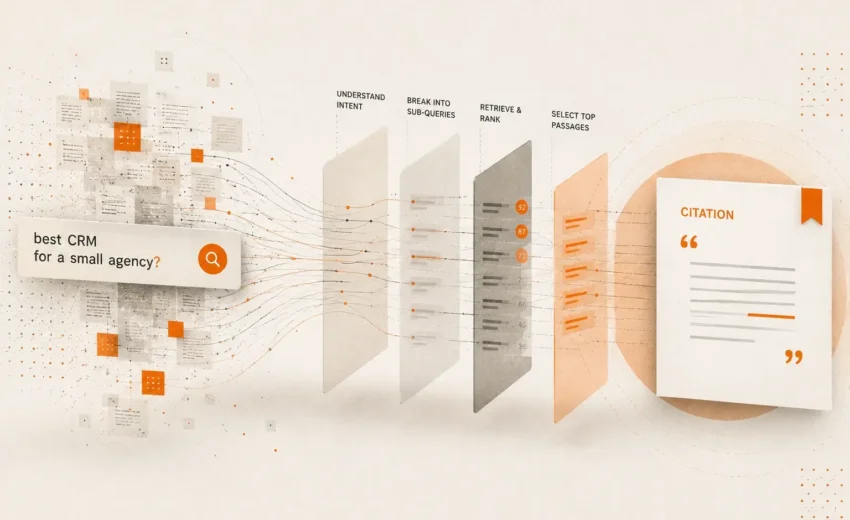
Entity authority is how confidently an AI engine understands who your brand is and whether it trusts you enough to reuse you in an answer. Keyword authority gets you traffic from Google. Entity authority gets you cited by ChatGPT, Perplexity, and AI Overviews. The two are different optimization targets, and most SEO teams are still chasing the first. HubSpot, Notion, and Stripe each built a moat on the second, and the playbook is replicable.
A brand can rank on page one and still get summarized away in AI answers, because ranking measures page relevance and citation measures entity trust. Those are not the same machine reading the same signal.
The data backs the split. One 2026 analysis put the correlation between Domain Authority and AI citation probability at roughly 0.18, while E-E-A-T signals correlated around 0.81. A separate Moz study of nearly 40,000 queries found that 88% of Google AI Mode citations sit outside the organic top 10. So the positions teams spent a decade fighting for are mostly not the positions AI pulls from. That gap is the whole story.
This post breaks down what entity authority is, how AI engines build the knowledge graph that decides who gets quoted, three brand teardowns you can copy, and a literal checklist for auditing where you stand today.
Entity authority is the level of confidence a search or AI system has that it knows who you are, what category you belong to, and why it should rely on you. Keyword authority is page-level relevance to a search string. Entity authority is brand-level trust across the whole web.
Topical authority answers “what does this site talk about.” Entity authority answers “who is this, and should we rely on them.” A keyword-optimized page proves you covered a term. An entity-authoritative brand proves, across many sources, that you are the reference voice for a subject. AI engines reason with entities, not pages. When an engine builds an answer, it is not pulling one ranked URL. It is weighing sources against each other and checking whether the same brand shows up, described the same way, across Wikipedia, LinkedIn, Reddit, review platforms, news, and third-party mentions.
That difference has a practical edge. A brand with a small content library but strong entity authority can displace a much larger publisher in AI answers, because the engine has a clear, corroborated model of who is speaking. A five-year-old site with no named authors and no original data gets out-cited by a six-month-old site that has both. Keyword authority is a ranking input. Entity authority is a trust substrate that other signals attach to.
How AI engines build the knowledge graph
AI engines do not read your site the way a crawler checks a keyword. They resolve entities first, then decide what is citable. Entity resolution is the step where the system unambiguously identifies your brand, classifies it into a category, and maps its relationships to other known entities. Everything downstream depends on that step clearing. If the engine cannot resolve who you are, your credibility signals have nothing to attach to.
Three things drive whether resolution succeeds and citation follows. First, corroboration across channels. Engines look for consistent factual profiles, your name, description, and category, repeated the same way across independent sources. Second, brand mention frequency. Research from The Digital Bloom found brand search volume correlated about 0.334 with LLM citations, outweighing backlinks. AI models prefer brands people already search for. Third, co-citation patterns. When trusted sources reference you alongside the category leaders, the system reads that pattern and places you in the same neighborhood.
Then there is extractability. Pages updated within the last 30 days have been measured earning roughly 3.2 times more ChatGPT citations, and adding statistics to content has been shown to lift AI visibility 30 to 40% in the Princeton and Georgia Tech GEO study. Structure matters too. Tables, clear definitions, named authors, and visible “last updated” dates all make a page easier for an engine to pull without paraphrasing. But structure has a ceiling. Content that lives only on your own domain, no matter how well-formatted, hits a wall that earned third-party authority breaks through.
HubSpot teardown: how adjacent concept pages built a moat
HubSpot’s play is the cleanest example of building entity authority through topical architecture. The company popularized the pillar-and-cluster model, a comprehensive pillar page on a broad topic, surrounded by cluster pages that each go deep on one subtopic and link back. The structure was designed for Google, but it maps almost perfectly onto what AI engines reward.
Here is why it works for citation. Each cluster page is a standalone answer to one question, with room for its own data, examples, and named-expert input. The pillar signals comprehensive coverage of the category. The internal linking tells the engine these pages form a connected body of expertise rather than scattered one-offs. HubSpot’s own research found that more interlinking correlated with better placement and rising impressions. When they restructured, the team even manually de-linked old posts so each cluster’s authority concentrated cleanly instead of leaking across unrelated pages.
The moat is built from adjacency. HubSpot does not just own “CRM.” It owns the dozens of concept pages around CRM, marketing, and sales that AI engines now treat as the connected map of the category. HubSpot’s own State of AEO 2026 report, analyzing citations across ChatGPT, Gemini, Perplexity, and AI Overviews, found that pages with outbound links, statistics, author bios, and visible update dates earned more citations. Those are exactly the elements a cluster page has room to carry. The lesson for a smaller brand is not the scale. It is the architecture. Pick a category, map its connected concepts, and build a standalone, evidence-backed answer for each one.
Notion teardown: winning a category they don’t compete in
Notion’s entity authority comes from owning a vocabulary it did not invent. Search “second brain,” “Life OS,” or “productivity system” and the results are saturated with Notion. The PARA method came from Tiago Forte. The second-brain concept predates Notion’s marketing. Notion attached its brand to that language so thoroughly that AI engines now resolve the category and the product as neighbors.
The mechanism is the template ecosystem plus a flood of corroborating third-party content. Notion’s own marketplace hosts countless “second brain” and “productivity system” templates, and an enormous independent layer of creators, bloggers, YouTubers, and Medium writers reinforces the same association. When thousands of independent sources describe building a second brain in Notion, the engine reads consistent co-occurrence. The brand and the concept become linked entities, even though the concept is older and broader than the tool.
This is the move most teams miss. Notion is not winning a keyword war for “note-taking app.” It is winning a conceptual association for how people think about personal knowledge management. The brand sits inside the category’s vocabulary rather than next to it. For a smaller brand, the replicable version is to find the concept your customers use to describe the job they are doing, then become the corroborated reference for that concept across owned and earned channels, not just your own site.
Stripe built entity authority by becoming an intellectual brand, not just a payments API. The clearest artifact is Stripe Press, the in-house publisher releasing books on technological and economic advancement. A payments company publishing books looks like a detour until you see it as entity engineering. Founder Patrick Collison framed it as building tools and infrastructure to grow the online economy, and the press is one of those tools.
The strategy works on two layers at once. The first is “engineering as marketing,” where deep developer documentation and technical tools act as acquisition channels and earn strong rankings for technical queries. The second is the intellectual layer, where Stripe Press and the annual data reports position the brand alongside ideas about progress and economic growth. Stripe’s Global Payments and Treasury Report uses proprietary transaction data and has earned coverage in the Financial Times and the Wall Street Journal, the kind of earned authority that strengthens entity resolution far more than any owned page can.
The result is a brand AI engines resolve cleanly as “the economic infrastructure for the internet,” a category phrase Stripe authored and now owns. Stripe also reinforces this with original data nobody else has. When an engine needs a citable claim about online payments or internet commerce, Stripe’s reports are the corroborated source. The transferable principle for a B2B brand is original data plus earned coverage. You do not need a publishing house. You need one proprietary dataset and one piece of coverage in a source the engines already trust.
Start by testing what the engines already believe about you. Open ChatGPT, Perplexity, Gemini, and Google AI Overviews and ask the same set of category questions a real buyer would ask, the research-stage prompts like “what is X” and the comparison prompts like “best X for Y.” Record who gets cited and how often. This is not keyword research. The prompts have to match how buyers actually research, or being in the answer means nothing commercially.
Then map three things. First, entity clarity. Does each engine describe your brand consistently, in the right category, with the right specialty. Inconsistent or vague descriptions mean resolution is failing. Second, source diversity. Count the distinct domains the engines cite when your brand appears. If a competitor gets pulled from 15 domains and you get pulled from three, the gap is corroboration, not content. Third, citation share. Within your tracked prompt set, what percentage of answers cite you versus each competitor. That number is your real position in AI search, and it rarely matches your Google ranking.
The five-step entity expansion playbook
Once the audit shows where you stand, expansion follows a repeatable sequence. Each step targets a different driver of entity resolution.
- Lock entity hygiene. Make your name, description, and category identical everywhere, your site, LinkedIn, Crunchbase, review platforms, and any directory. Add Organization, Person (for authors), and relevant schema so machines parse identity without guessing. Inconsistency here quietly poisons every other step.
- Map and build the concept cluster. Identify the connected concepts in your category, then build a standalone, evidence-backed answer for each, linked together. This is the HubSpot move at a smaller scale. Each page should answer one question fully and stand on its own as an extraction target.
- Claim a category vocabulary. Find the phrase your customers use for the job they are doing and become the corroborated reference for it, the Notion move. Use it consistently across owned content and seed it into the earned and community channels where buyers actually research.
- Produce original data and earn coverage. One proprietary dataset, one report, one piece of coverage in a source the engines trust, the Stripe move. Original numbers are inherently citable, and earned mentions break the owned-domain ceiling that structure alone cannot.
- Maintain freshness and named expertise. Refresh key pages on a regular cadence, keep visible update dates, attach named authors with real credentials, and add statistics to every claim. These are the extractability signals that move a resolved entity into the cited set.
The 18-24 month investment horizon
Entity authority compounds, which is the good news and the catch in the same sentence. Each placement in a trusted publication strengthens resolution. Each well-structured page adds an extraction target. Each consistent mention reinforces the category association. None of those pay off in a single sprint. This is a multi-quarter program, and realistic teams should plan on roughly 18 to 24 months before the citation share moves meaningfully and holds.
The reason to start now is the same reason it takes time. Competitors building this infrastructure today are accumulating an advantage that widens monthly. Entity-dependent signals are becoming more central to AI search, not less, so the gap between brands that invested early and brands that waited will keep compounding. Keyword authority still matters for traditional ranking. But entity authority is the substrate the next decade of discovery runs on, and substrates are slow to build and slow to lose.
FAQ
How do I know if I already have entity authority?
You have entity authority when AI engines describe your brand consistently and cite you for category questions without prompting. Test it directly. Ask ChatGPT, Perplexity, and Gemini a set of buyer-stage questions in your category and see whether you appear, how you are described, and how many distinct sources back the mention. Consistent description plus citations from several independent domains means resolution is working. Vague or contradictory descriptions mean it is not.
Can a startup build entity authority?
Yes. Entity authority rewards clarity and corroboration more than size, so a small brand with a tight category definition and consistent cross-channel presence can out-cite a larger, vaguer competitor. A six-month-old site with named authors, original data, and current pages has been measured out-citing older, higher-DR sites that lack those signals. The startup path is narrower focus, not bigger budget. Own one clearly defined slice completely rather than covering a broad category thinly.
Does Wikipedia count more than other sources?
Not categorically. A Wikipedia entry helps entity resolution because it is a structured, corroborated identity record, and pursuing one is worth it if your brand is notable enough to qualify. But no single source type is universally more valuable. In some categories editorial listicles dominate AI citations, in others Reddit threads or review platforms carry more weight. The only reliable answer is to reverse-engineer what the engines actually cite for your category and build presence there, rather than assuming Wikipedia is the whole game.
Is this just thought leadership rebranded?
No. Thought leadership is content you publish on your own properties. Entity authority is how machines resolve and trust your brand across the whole web, most of which you do not control. Thought leadership can feed it, since original ideas attract the mentions and coverage that strengthen resolution. But you can produce endless thought leadership and still fail to be cited if the engine cannot form a clear, corroborated model of who is speaking. The work happens off your domain as much as on it.
Use this as a literal checklist. Run it once to baseline, then quarterly to track movement.
Step 1, build your prompt set. Write 15 to 25 questions a real buyer asks, split across research-stage (“what is [category],” “how does [job] work”) and comparison-stage (“best [category] for [use case],” “[competitor] alternatives”). Avoid your own keyword list. Use the language buyers use.
Step 2, run every prompt across four engines. ChatGPT, Perplexity, Google AI Overviews, and Gemini. Record for each answer: whether your brand appears, how it is described, and every source domain cited.
Step 3, score entity clarity (0 to 5). Across the four engines, is your brand described consistently, in the correct category, with the right specialty. 5 means identical and correct everywhere. 0 means absent or wrong. Self-verify by checking each engine’s description against your own one-line positioning.
Step 4, score source diversity. Count the distinct domains that cite you across the full prompt set. Then count the same for your top two competitors. The ratio is your corroboration gap.
Step 5, calculate citation share. Of all answers in your set, what percentage cite you, versus each competitor. This is your AI search position. Compare it to your Google ranking for the same topics, the gap between the two numbers is the size of your entity-authority opportunity.
Step 6, audit entity hygiene. Confirm your name, description, and category match exactly across your site, LinkedIn, Crunchbase, G2 or Capterra, and any directory. Flag every inconsistency. Confirm Organization and author schema are present and valid.
Step 7, log freshness and evidence. For your top 10 category pages, record last-updated date, presence of named author, and number of original statistics. These are the extractability signals. Anything stale, anonymous, or evidence-thin goes on the fix list.
Re-run steps 2 through 5 every quarter. Movement in citation share and source diversity, not keyword rank, tells you whether the entity work is landing.