SEO
Summary: To rank in ChatGPT, you have to become the source it's most confident citing: a brand with clear, consistent information across your own site, Wikipedia, Wikidata, industry directories, and third-party editorial coverage; because ChatGPT has no ranking algorithm to game, only a confidence threshold to clear.
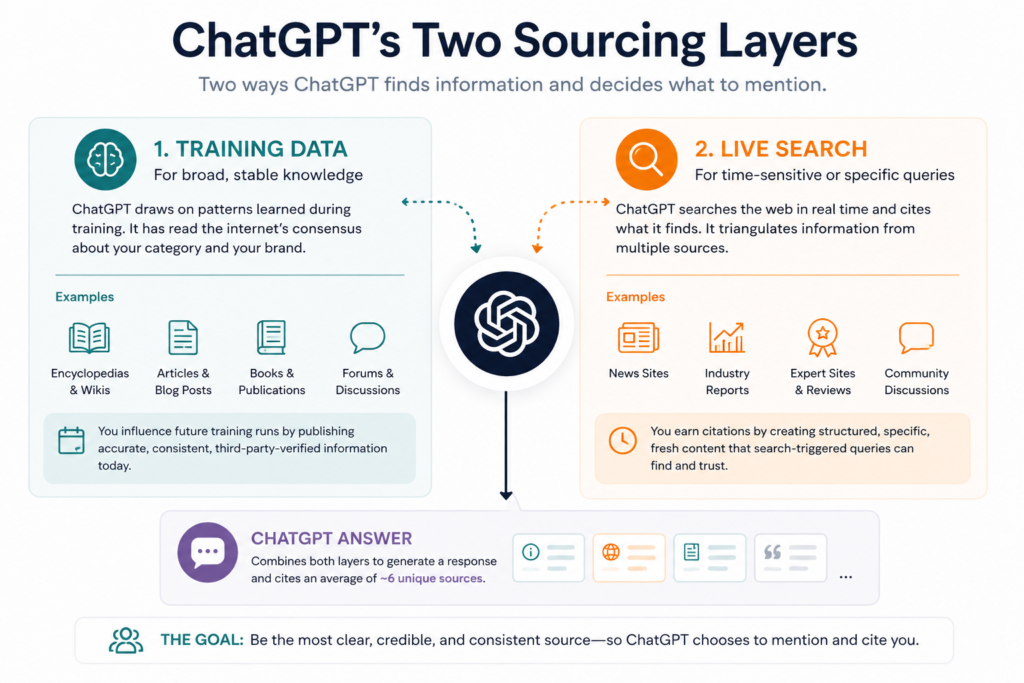
ChatGPT decides what to mention by combining two layers: what it absorbed during training (which shapes what it “knows” about your category and the brands in it) and what it retrieves through live web search when a query needs fresh or specific information. In both layers, it favors entities that show up repeatedly, described the same way, in sources it already trusts.
That means the levers you actually control are:
- Entity clarity: one canonical name, one consistent description, and structured data (Organization, Person, Product) that ties them together across the web.
- Third-party corroboration: mentions in Wikipedia, Wikidata, Crunchbase, G2, industry publications, and podcasts, all saying the same things about you.
- Answer-shaped content: pages that state the answer to a specific question in the first sentence, then support it, so a model can lift a clean quote without stitching paragraphs together.
- Crawlability for AI: allowing GPTBot and OAI-SearchBot, publishing in clean HTML, and keeping the important facts out of JavaScript, images, and PDFs.
This is a different game than classic SEO, and most teams are still playing the old one even as the majority of Google searches now end without a click. Below is how each of those levers works in practice, followed by a step-by-step plan to get your brand into ChatGPT’s answers.
How ChatGPT decides what to mention
ChatGPT pulls from two layers, and knowing which one is in play changes your strategy.
Training data. For broad, stable knowledge (“what is AEO,” “best CRM for small teams”), ChatGPT draws on patterns baked into the model during training. It has effectively read the internet’s consensus about your category and your brand, if you’re in it. You don’t influence this in real time; you influence what future training runs will find, which means the content and mentions you publish today shape how you show up months or years from now.
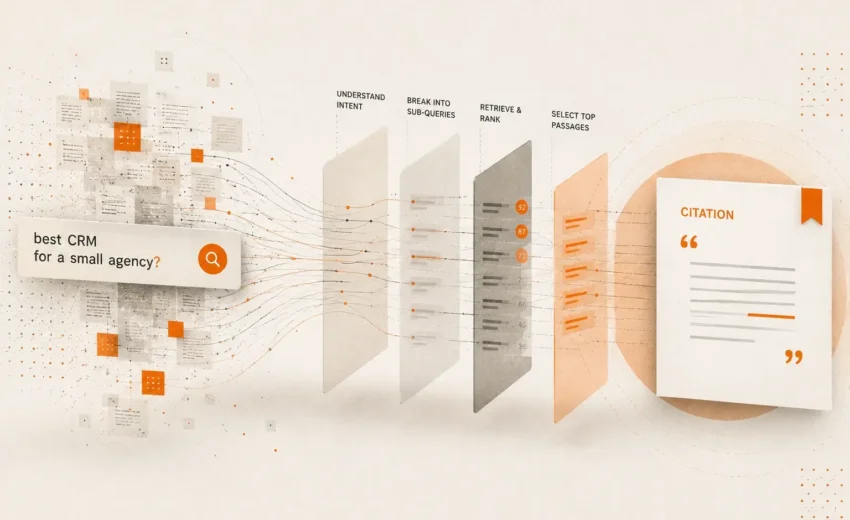
Live search. For time-sensitive or specific queries, ChatGPT triggers a web search and cites what it finds, similar to how it behaves in ChatGPT Search and browsing mode. Research analyzing hundreds of thousands of real ChatGPT conversations found that search triggers in roughly one in five conversations, and it’s far more likely on the first question in a session than by the tenth turn: factual, “what is” and “how does” style openers are what activate sourcing. When it does search, ChatGPT doesn’t pick one winner; it triangulates, citing an average of roughly six unique sources per conversation.
Two patterns matter for your strategy:
- Authority layering. ChatGPT leans on a baseline of broadly trusted references (Wikipedia shows up in a large share of cited conversations) and then adds more specific, topical sources on top. You’re not trying to dethrone Wikipedia. You’re trying to be the specific, credible source layered on top of it for your niche.
- Domain clustering. Sources tend to travel in packs by topic: review sites cluster with review sites, medical publishers cluster with health authorities, community forums cluster with reference sites. Getting cited isn’t just about your own site’s authority. It’s about being present in the cluster of sources ChatGPT already trusts for your category.
The upshot: ChatGPT SEO is really two disciplines running in parallel: shaping the training-data-era reputation of your brand (consistent facts, third-party corroboration) and earning live citations (structured, specific, freshly-updated content that a search-triggered query can find and quote).
The levers you control
Understanding how to rank in ChatGPT comes down to the levers you actually control. You can’t buy your way into a ChatGPT answer, and you can’t submit a sitemap and wait. What you can do is make your brand easy to find, easy to trust, and easy to quote.
1. Entity clarity. ChatGPT needs to know unambiguously who you are, what you do, and how you’re different, the same way a new hire would need it explained on day one. That means a consistent name, description, and category across your website, About page, LinkedIn, Crunchbase, G2, and any directory that fits your industry. Inconsistent descriptions across sources create ambiguity, and ambiguous entities get left out of answers in favor of ones the model can describe confidently.
2. Third-party mentions. This is the single highest-leverage lever. ChatGPT weighs what other credible sources say about you far more than what you say about yourself. That’s true of the training layer and doubly true of live search, which favors clustered, cross-verified sources over solo claims. Press coverage, analyst write-ups, comparison and “best of” roundups, podcast transcripts, review platforms, and Wikipedia-adjacent references (industry wikis, association directories) all function as citations that teach the model your brand is real, categorized correctly, and worth surfacing.
3. Structured, extractable content. Content written to be quoted gets quoted. That means direct-answer openers, clear H2/H3 structure, defined terms, numbered steps, and comparison tables: the same formatting that makes a page easy for a human to skim in five seconds makes it easy for a model to lift a clean, self-contained answer out of it. Walls of unstructured prose rarely get cited because there’s no clean span of text to extract. Academic research on generative engine optimization found that structuring content for extraction can lift its visibility in AI answers by up to 40%.
4. Being on sites ChatGPT already trusts. Getting a mention on a site that already sits in ChatGPT’s citation clusters (an established trade publication, a well-known review platform, a widely-cited community forum in your space) carries more weight than the same claim on your own blog. Prioritize placements on sites the model already trusts, then reinforce with your owned content.
5. Freshness and specificity. Live search rewards content that answers a specific, current question well, not evergreen filler. Pages with dates, version numbers, pricing, and concrete specifics outperform vague brand copy when a search-triggered query needs a quotable fact.
How to rank in ChatGPT: a step-by-step plan
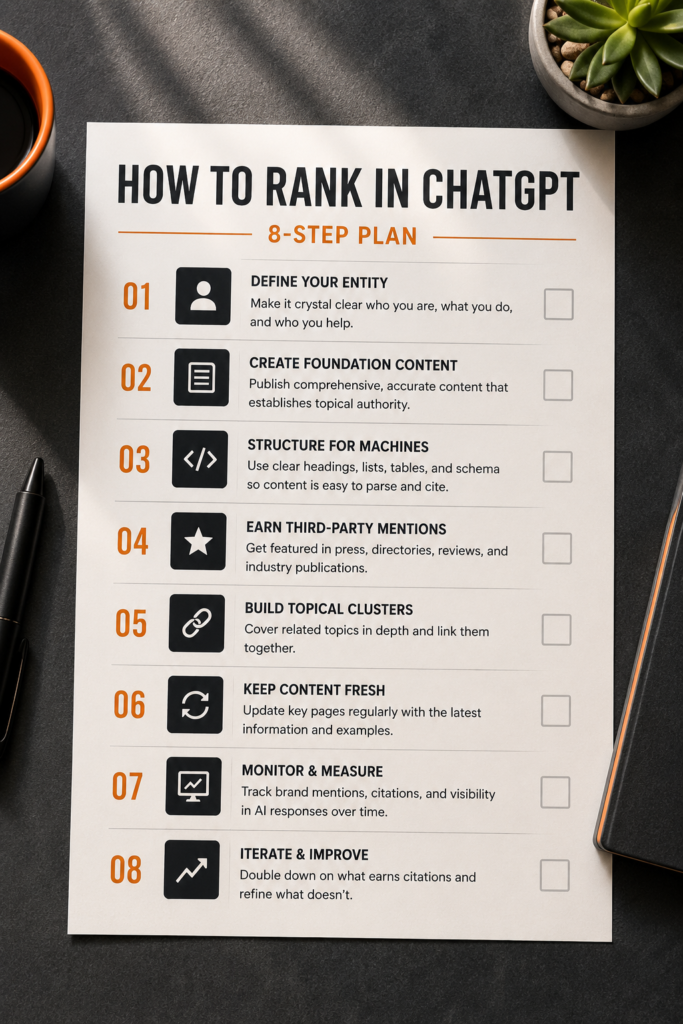
- Audit your current visibility. Ask ChatGPT (and Perplexity, Gemini, and Copilot, since they overlap) the questions your buyers actually ask: category questions, “best X for Y,” “X vs Z,” and questions naming your brand. Note whether you’re mentioned, what’s cited, and what’s wrong or missing.
- Fix entity ambiguity first. Standardize your company description, category, and key facts across your website, LinkedIn, Crunchbase, G2/Capterra, Wikipedia (if eligible), and any industry directory. Inconsistency is the fastest way to get skipped.
- Publish direct-answer content for your core questions. For each question from step 1, write a page or section that opens with a 2 to 3 sentence direct answer, then backs it up with structure: steps, tables, defined terms. Make the first 100 words good enough to be quoted on their own.
- Earn third-party mentions deliberately. Pitch trade press, get listed in relevant comparison and “best of” roundups, contribute to industry publications, and pursue analyst or association recognition. Treat this as digital PR with an AEO lens, not a link-building afterthought.
- Get corroborated on sites ChatGPT already cites in your category. Identify which domains show up when you run step 1’s queries and prioritize placements, reviews, or mentions there over lower-authority channels.
- Add structured data. Use Organization, Article, FAQPage, and Product schema so both crawlers and answer engines can parse who you are and what you’re claiming without guessing.
- Keep content current. Update pricing, statistics, and specifics on a schedule. Stale pages lose out to fresher ones in live-search citation moments.
- Re-test monthly. Re-run your question set, track new mentions and citations, and double down on what’s working.
Common mistakes
- Treating it like keyword SEO. Stuffing “chatgpt seo” into a title tag doesn’t move the needle if the underlying content isn’t clear, structured, or corroborated elsewhere.
- Only publishing on your own domain. Self-published claims about your own quality are the weakest signal in the system. Third-party corroboration is what moves you into an answer.
- Inconsistent entity information. Different taglines, categories, or facts across your site, LinkedIn, and directories confuse the model about who you are.
- Writing for skimmers, not extractors. Long, unstructured pages without a direct-answer opener rarely get quoted because there’s nothing clean to lift.
- Expecting instant results. Training-data influence lags by months. Live-search citations can happen faster, but only once you have structured, findable, freshly-updated content in place.
- Ignoring the free-vs-paid confusion. ChatGPT’s organic answers are not ad inventory. See the FAQ below.
How to measure it
Traditional rank trackers don’t apply here, so measure differently:
- Manual prompt testing. Run a fixed set of category, comparison, and brand questions monthly and log whether you’re mentioned, cited, or absent.
- Citation tracking tools. Platforms built for AI visibility (Profound, Peec AI, and similar) monitor mentions and citations across ChatGPT, Perplexity, and other assistants at scale.
- Referral traffic from AI sources. Segment analytics for traffic tagged as coming from chatgpt.com or similar AI referrers: it’s a real, growing signal, even if the volume is smaller than organic search.
- Share of voice vs. competitors. In head-to-head or “best X” prompts, track how often you appear relative to named competitors, not just whether you appear at all.
How And Zeros helps
We’re an AEO/GEO agency, so this is the whole job, not a side project bolted onto traditional SEO. And Zeros audits your current visibility across ChatGPT and other assistants, fixes entity ambiguity across your web presence, builds the direct-answer content and schema that make you quotable, and runs the digital-PR and placement work that gets you corroborated on sites these models already trust. If you want a straight read on where your brand stands in ChatGPT today and a plan to close the gap, get in touch with And Zeros.
FAQ
Can you pay to appear in ChatGPT?
No. ChatGPT’s conversational answers and citations are not paid placements: there’s no bidding system to buy your way into a mention the way you can buy a search ad. You earn visibility through clear entity information, third-party corroboration, and content structured to be quoted.
How is ranking in ChatGPT different from ranking in Google?
Google ranks pages against a query using links, relevance, and hundreds of signals, and you can track a position. ChatGPT doesn’t rank pages: it synthesizes an answer from training data and, when it searches live, a handful of cited sources. Success looks like being mentioned or cited accurately and often, not holding a numbered position.
How long does it take to see results?
Live-search citations can shift within weeks once you have structured, findable content live. Influence on ChatGPT’s underlying training-data knowledge of your brand moves much slower, on the order of months, tied to model update cycles. Expect a mix: some quick wins from search-triggered queries, and a longer compounding effort for baseline brand recognition.
Does ChatGPT use Google rankings to decide what to cite?
Not directly. Live search draws on its own retrieval and web index, and it doesn’t simply mirror Google’s page-one results: a site can rank well in Google and still be absent from ChatGPT’s citations, or vice versa, especially when domain clustering favors sources outside typical SEO winners.
Do I need a Wikipedia page?
Not necessarily, but being referenced by sources ChatGPT already trusts (of which Wikipedia is one of the most common) helps. If you’re not eligible for a standalone Wikipedia page, focus on other high-trust, third-party corroboration: trade press, analyst coverage, and established review platforms.
Should I stop investing in traditional SEO?
No. Traditional SEO and AEO/GEO overlap heavily: structured, authoritative, well-linked content helps both. Search engines and AI assistants reward the same fundamentals: clear writing, credible sources, solid site structure. Cutting SEO to chase ChatGPT visibility means losing ground on both fronts. Treat this as an expansion of your content and PR strategy, not a replacement.