
None of it guarantees a citation. It does remove the guesswork that keeps a relevant page from getting cited.
Why does schema markup for AI matter?
Answer engines don’t read a page the way a person does. They pull in the text, cut it into chunks, and try to work out who wrote each piece and who published it. When that’s unclear, they hedge. Schema markup settles those questions in a format a machine can’t misread. Google’s own structured data documentation describes it as a way to give search engines explicit clues about what a page means.
For most of the last decade, schema had a narrower job. It won rich results like star ratings, breadcrumbs, and FAQ dropdowns. That job has shrunk. In August 2023, Google limited FAQ rich results to well-known government and health sites and began phasing out HowTo rich results.
AI search gave schema a new job. Before ChatGPT or an AI Overview cites you, it has to settle a few things. Is this a real business? Does it have a track record? Does this chunk actually answer the question? Structured data answers the first two outright and makes the third easier to judge. How you build the page matters too. The Princeton GEO study found that targeted content changes, like adding citations and statistics, lifted visibility in generative engine answers by up to 40%.
In practice, schema helps in specific ways. Organization and Person markup, tied to sameAs links, tells a model which “And Zeros” or which “Doug Saltzman” you mean. Article markup with an author property gives a claim a named, checkable source. FAQPage markup hands over clean question-and-answer pairs a model can lift with little editing.
So schema closes the gap between “this page has the answer” and “we know exactly who said it.” AI systems are slow to close that gap on their own.
Which schema types matter most for AI search?
Schema.org has hundreds of types, but only a handful carry real weight with answer engines. Here they are, roughly in order of leverage.
Organization
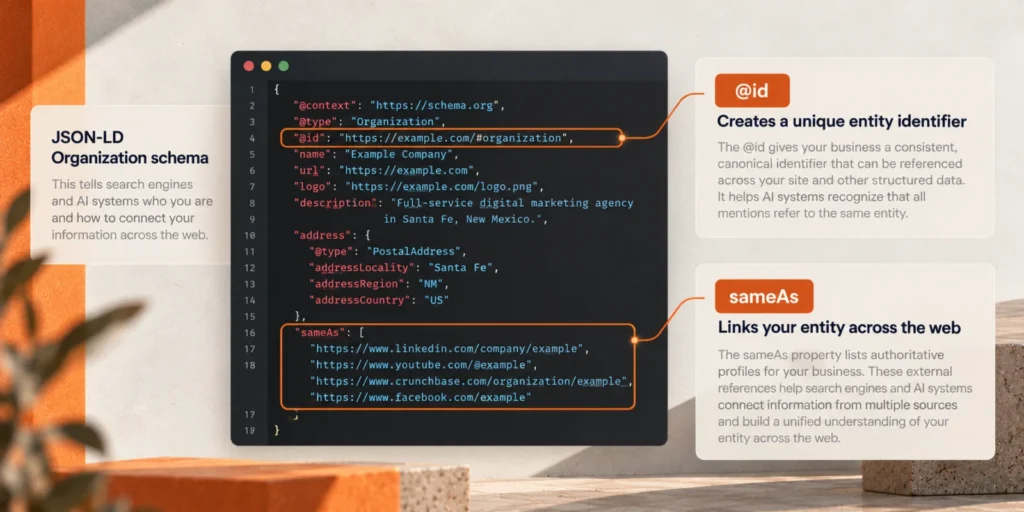
This is the anchor for your brand. Put it on your homepage with a stable @id, then point to that @id from every other block on the site. Include name, url, logo, sameAs, and founder where it applies.
Person
Person schema connects a byline to a real individual with a public record. Use it for founders, authors, and named experts. Then link it to LinkedIn and other verified profiles through sameAs.
sameAs
sameAs is a property, not a type. It lives on Organization, Person, and LocalBusiness. It may be the most useful single field for AI search, because it links your entity to outside profiles that someone else maintains. Those profiles are the corroboration a model looks for.
Article and BlogPosting
These mark a page as authored content with a headline, author, publisher, and date. That’s what lets a model treat your post as a source rather than loose web text.
FAQPage
FAQPage schema structures direct question-and-answer pairs. It’s about as close as you can get to handing an answer engine a quote that’s ready to use. Google no longer shows FAQ rich results for most sites, but the markup still makes your answers easy for machines to parse.
Product
Use Product schema for anything you sell. Price, availability, and review data help shopping answers show current specifics instead of stale, scraped ones.
LocalBusiness
LocalBusiness schema covers address, hours, and service area. It’s how an AI assistant answers “who does this near me” with your business instead of a guess pulled from a directory.
How do entity graphs and sameAs help AI engines verify you?
One schema block on one page is a single fact. A set of blocks that reference each other across your site, and point out to verified profiles, is an entity graph. That graph is what AI engines lean on to build confidence in who you are.
The mechanics are simple. First, give your Organization and Person entities @id values. Next, reuse those same @ids in the author and publisher fields of every Article. Then add sameAs links to LinkedIn, Crunchbase, Wikipedia, or other independent profiles. Now a model has several sources backing the same identity claim, and retrieval systems are built to reward that kind of agreement.
Most sites that struggle here already have schema of some kind. The trouble is consistency. The Organization name changes from page to page, sameAs is missing, or the byline doesn’t match the author in the markup. Each of those breaks the graph and pushes the model back toward treating you as unverified.
How do you implement schema markup for AI?
Work through these steps in order. Each one builds on the last.
- Add site-wide Organization schema to the homepage, with a stable
@idyou reuse everywhere. - Add Person schema for every named author or founder, with sameAs links to real, active profiles.
- Add Article or BlogPosting schema to every post, and reference the Organization and Person by
@idinstead of restating them. - Add FAQPage schema only where the page answers discrete questions, and copy the visible answer text exactly.
- Add Product or LocalBusiness schema where it fits, and keep prices, stock, and hours current. Stale structured data is worse than none.
- Validate with Google’s Rich Results Test and the Schema Markup Validator before you publish, then re-check after any template change.
- Keep names and dates identical across the visible page, the schema, and the author bio page.
One more technical note. Render your JSON-LD on the server. If a plugin or tag manager injects it with JavaScript after the page loads, crawlers that don’t run JavaScript may never see it.
Here’s a minimal example of an Article that points to a reusable Organization and Person:
{
  "@context": "<https://schema.org>",
  "@type": "Article",
  "headline": "Schema Markup for AI Search: A Practical Guide",
  "author": {
    "@type": "Person",
    "@id": "<https://andzeros.com/#doug-saltzman>",
    "name": "Doug Saltzman",
    "sameAs": ["<https://dougsaltzman.com>"]
  },
  "publisher": {
    "@type": "Organization",
    "@id": "<https://andzeros.com/#organization>",
    "name": "And Zeros",
    "url": "<https://andzeros.com>",
    "sameAs": ["<https://www.linkedin.com/company/andzeros>"]
  },
  "mainEntityOfPage": "<https://andzeros.com/schema-for-ai-search/>"
}
The @id fields do the heavy lifting. They let this Article point at the same Person and Organization used everywhere else on the site, so you aren’t scattering disconnected copies across every page.
Image note for WordPress: annotated JSON-LD snippet highlighting the @id and sameAs fields that wire entities into one graph. Alt text: schema markup for AI: annotated JSON-LD showing @id and sameAs entity references
Which schema mistakes hurt AI visibility?
A few habits undo good schema faster than anything else.
Schema that contradicts the page
If the author, dates, or company name in your JSON-LD don’t match the visible page, you’re sending mixed signals. Models tend to discard conflicting signals rather than try to resolve them.
Thin or missing sameAs
An Organization or Person block with no sameAs is an unverified claim. Even one or two solid links, like LinkedIn or Crunchbase, make a real difference to disambiguation.
Boilerplate and standalone blocks
Templated FAQ or Product schema that doesn’t match the page reads as low quality to systems that cross-check markup against rendered text. Treating each page’s schema as an island has a similar cost. Without @id reuse, AI systems have to work out your identity from scratch on every page, and often they won’t bother.
Set-and-forget maintenance
Prices change, hours change, and authors come and go. Schema that isn’t part of your content process slowly goes stale and starts working against you. Passing the Rich Results Test won’t catch this, since it checks syntax one page at a time. Coherence across the whole site takes a manual audit.
How does And Zeros approach schema?
We treat schema as part of a site’s infrastructure. For every client, we map the entity graph first: the Organization, the key people, and how they connect. Only then do we touch page templates. Article, FAQPage, Product, and LocalBusiness schema get built on that foundation, so every new page inherits a verified identity on day one. We validate across the whole site instead of page by page. Schema updates also ship in the same workflow as new content, so the markup stays in sync with what’s on the page.
If you’d like a second set of eyes on your entity graph, or a full AEO/GEO audit, talk to And Zeros.
FAQ
Does schema markup directly improve AI search rankings?
No, schema markup isn’t a direct ranking factor for AI search. It makes your identity and your answers unambiguous. Once your content is already relevant, that clarity makes it easier for an AI system to justify citing you over a page it can’t attribute.
Which schema type should I add first if I can only do one?
Start with site-wide Organization schema that has a stable @id and solid sameAs links. Every other block on your site, including Person, Article, and Product, points back to it. That gives it the widest reach of anything you can add in a single afternoon.
Do I need FAQPage schema on every blog post?
Only add FAQPage schema where the page has real, visible questions and answers. The JSON-LD should match the on-page text word for word. Bolting it onto pages without a real Q&A section adds nothing and can look inconsistent to systems that compare schema against the rendered page.
Is JSON-LD better than microdata or RDFa for AI search?
Yes, JSON-LD is the better choice for most sites. Google recommends it, and it sits in its own script block instead of being woven through your HTML. That makes it far easier to template, validate, and keep current across a large site. Just render it on the server, since some AI crawlers don’t run JavaScript.
How is schema for AI search different from schema for classic SEO?
Classic SEO schema chases rich results, while schema for AI search is about identity and answer extraction. Rich results mean stars, breadcrumbs, and product details in the listing. AI search schema proves who you are through sameAs and @id, then structures content so a model can quote an accurate, attributed answer.