SEO
Summary: Does GEO work for every website? No. GEO delivers real, measurable value for some businesses and is a low-priority distraction for others. The difference comes down to whether the people who'd buy from you actually ask AI tools questions before they buy.
Does GEO work? The honest answer
Most of the content you’ll find on generative engine optimization treats it like SEO circa 2010: universally beneficial, always worth doing, just a matter of budget. That’s marketing, not strategy.
The reality is that ChatGPT, Perplexity, Gemini, and Google’s AI Overviews and AI Mode get asked fundamentally different kinds of questions depending on the category. Academic research on generative engine optimization backs this up: the tactics that actually earn citations vary sharply by content type and query intent. Someone researching a $40,000 CRM migration or a knee surgeon in Santa Fe is going to ask an AI assistant for a shortlist and a rationale. Someone who wants a phone charger is going to search Amazon, not prompt an LLM for a recommendation and then click through three citations. And with less than a third of Google searches now ending in a click, where your buyers actually spend that research time matters more than ever.
GEO works (meaning it produces citations, and citations produce qualified traffic and trust) in categories where people already use AI tools as part of the buying journey. It doesn’t work, in the sense of moving revenue, for categories where they don’t. That’s not a hedge. It’s the actual shape of the opportunity, and pretending otherwise is how agencies sell retainers to businesses that won’t see a return.
The good news: figuring out which side of that line you’re on isn’t guesswork. It comes down to purchase complexity, research behavior, and how much trust the decision requires.
Who benefits most from GEO
A handful of business types consistently show up in AI answers because their buyers ask AI tools for help before they buy.
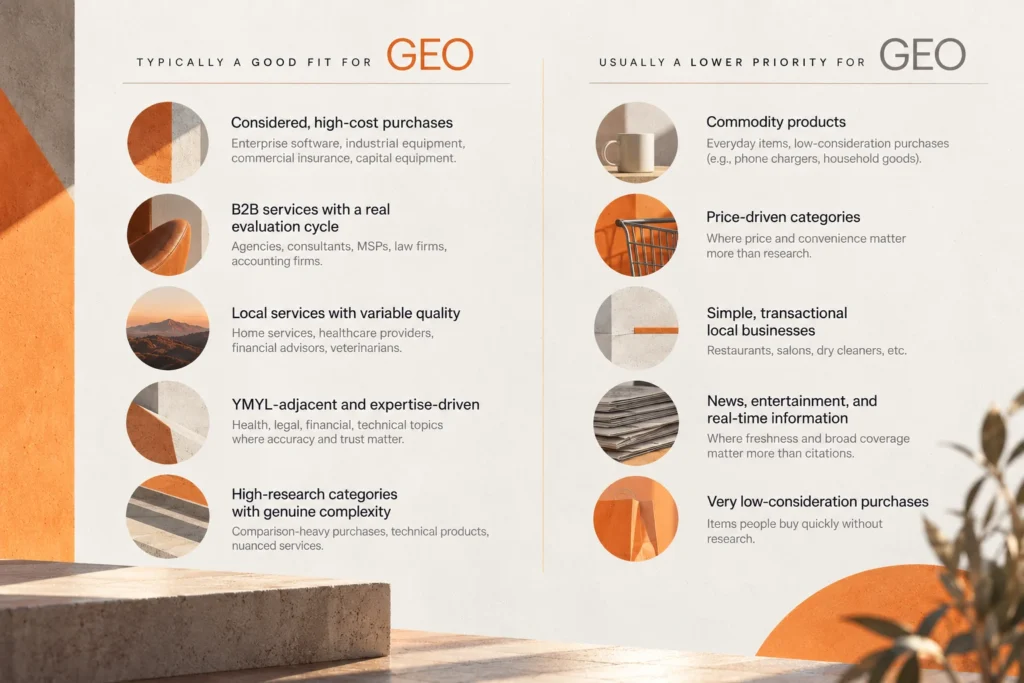
Considered, high-cost purchases. Enterprise software, industrial equipment, commercial insurance, capital equipment: anything where a wrong choice is expensive and a buyer wants a second opinion before talking to a salesperson. Buyers ask “what’s the best [category] for [use case]” and expect a reasoned comparison, not just a list of vendors.
B2B services with a real evaluation cycle. Agencies, consultants, MSPs, law firms, accounting firms: categories where “who should I hire” is a question people genuinely ask an AI assistant, especially early in a search when they’re still forming a shortlist. If your sales cycle involves discovery calls and proposals, your buyers are probably asking AI tools to help them prep for those calls.
Local services with variable quality and real stakes. Home services (roofers, HVAC, contractors), healthcare providers, financial advisors, veterinarians. These are categories where trust matters more than price, reviews are scattered across multiple platforms, and an AI assistant can genuinely save someone research time by synthesizing an answer. “Who’s a good [specialist] near [city]” is a query type that’s grown fast in AI tools precisely because it used to require ten browser tabs.
YMYL-adjacent and expertise-driven categories. Health, legal, financial, and technical topics where accuracy carries real consequences. Generative engines are cautious about what they cite here: they lean on sources that demonstrate credentialed expertise and clear sourcing. That caution is actually an advantage for businesses that do the work to earn it, because it filters out weaker competitors.
High-research categories with genuine complexity. Anything with a comparison-heavy buying process: software categories with a dozen viable vendors, technical products with real spec tradeoffs, services where “it depends on your situation” is the honest answer. If your best content has always been the comparison guide or the “how to choose” post, GEO is a natural extension of what’s already working.
The common thread across all of these: the buyer’s journey includes a research phase where they’re actively trying to reduce uncertainty, and that’s exactly the phase where they now open an AI assistant instead of, or alongside, a search engine.
Where GEO should be a lower priority
It’s just as important to be honest about the other side.
Commodity and impulse purchases. If your product is bought on price, availability, and habit (office supplies, basic apparel, common household goods), buyers aren’t asking an AI assistant to help them decide. They’re searching a marketplace or going back to a brand they already know. GEO effort here is largely wasted.
Hyper-local, walk-in businesses with no real differentiation. A single coffee shop or nail salon with no distinct positioning isn’t likely to get cited in an AI answer over the ten other options nearby, and the query volume that would actually route to them through AI tools is small relative to Maps, Instagram, and word of mouth. Local SEO fundamentals matter more here than GEO.
Businesses with no defensible content or expertise angle. GEO rewards sources that generative engines judge credible and citation-worthy: content backed by real experience, data, or specificity. If you can’t produce anything an AI system would want to cite over a competitor’s page, investing in GEO before building that foundation is putting effort in the wrong order.
Very early-stage or pre-product-market-fit businesses. If you don’t yet know who your buyer is or what they search for, GEO is premature. It’s an amplifier for a working positioning and content strategy, not a substitute for one.
Transactional, bottom-of-funnel-only businesses. If your entire customer acquisition motion is paid ads driving directly to a purchase page, with no research phase in between, GEO’s upper-funnel value doesn’t have anywhere to attach. It’s not that it can’t work; it’s that it’s not where your near-term ROI lives.
None of this means these businesses get zero value from good content or search visibility. It means GEO specifically, as a prioritized initiative with dedicated budget, isn’t the highest-leverage move for them right now.
How to decide for your site
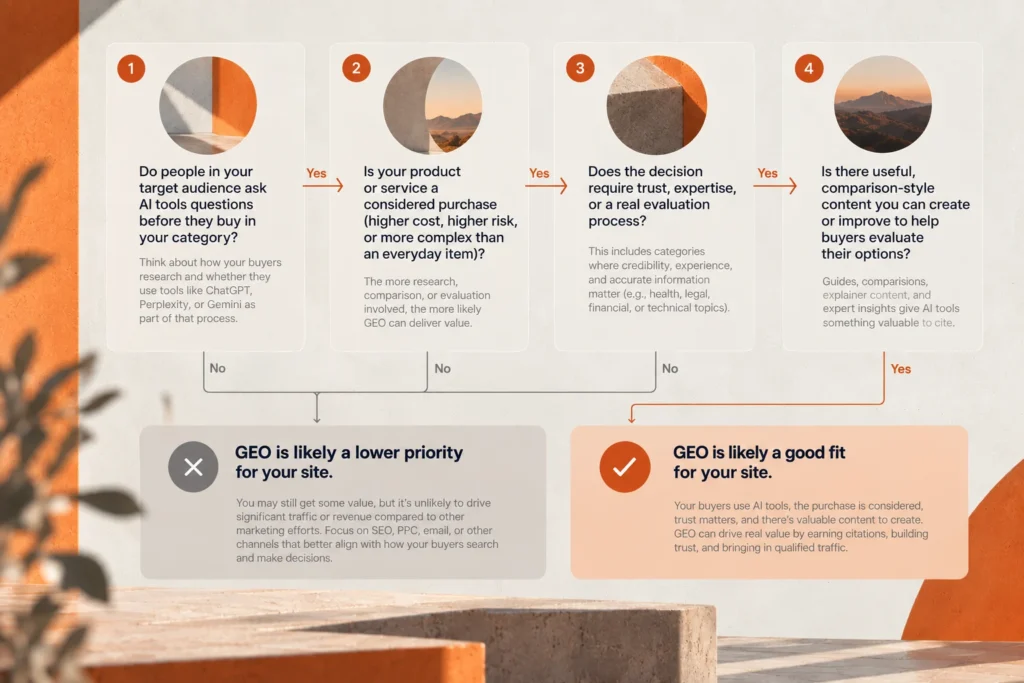
Run your business through four honest questions before committing budget to GEO. The practical version of the question is simple: does GEO work for a business like yours, given how your buyers actually make decisions?
1. Do buyers research before they buy? If your average sale involves comparison, consideration, or a “let me look into this” moment, you’re a candidate. If it’s an impulse or habitual purchase, you’re probably not.
2. Is the purchase cost or risk high enough to justify research? Higher price points and higher-consequence decisions (health, money, legal, safety) push people toward asking more sources (including AI assistants) before committing.
3. Do you already have, or can you build, genuinely citation-worthy content? Original data, real expertise, specific answers to specific questions. If your content today is thin or generic, that’s the first problem to solve, independent of GEO.
4. Can you point to actual queries your buyers are likely asking AI tools? This is the test that separates strategy from wishful thinking. Pull your actual customer questions (from sales calls, support tickets, and search console) and ask honestly whether they read like something a person would type into ChatGPT versus something they’d type into Google Maps.
If you answer “yes” to most of these, GEO deserves real budget and a real strategy. If you answer “no” to most of them, your marketing dollars are better spent on the channels where your buyers actually are, and that’s a legitimate, honest place to land.
How And Zeros scopes GEO
We don’t sell GEO to every business that asks for it. Before we take on a client, we look at the same four questions above, using actual query data where we can get it, not assumptions. If the fit is there, we build a program around the specific questions your buyers ask AI tools, not a generic content calendar. If the fit isn’t there, we’ll tell you, and point you toward the channels that will actually move revenue.
If you’re still asking “does GEO work for my business?” and aren’t sure which side of that line you’re on, that’s a conversation worth having before you commit a budget line to it. Get in touch with And Zeros and we’ll give you a straight answer.
FAQ
Does GEO work for small businesses?
Sometimes. Small businesses in high-trust, high-research categories like local healthcare, home services, or specialized B2B consulting can benefit meaningfully from GEO, even with modest budgets. Small businesses selling commodity products usually see limited return, since their buyers rarely ask AI tools for purchase advice regardless of company size.
Is GEO a replacement for SEO?
No. GEO and SEO overlap heavily but serve different query behaviors and different stages of the buying journey. Most businesses that benefit from GEO still need traditional SEO fundamentals like technical health, site structure, and organic rankings in place first. GEO builds on that foundation instead of replacing it.
How do I know if my industry is a good fit for GEO?
Look at whether your buyers go through a research phase before purchasing, whether the purchase carries real cost or risk, and whether you can produce content specific and credible enough to be worth citing. Industries with all three tend to be strong fits.
Can a low-priority business still get some value from GEO?
Possibly, but the value is usually smaller and slower to materialize than in a strong-fit category. In those cases, it often makes more sense to focus budget on higher-leverage channels first, build genuine expertise and content, and revisit GEO once the foundation and buyer research behavior support it.
Does company size determine whether GEO works?
Not directly. Purchase complexity and buyer research behavior matter far more than company size or revenue. A small B2B consultancy with a considered sales cycle can be a better GEO fit than a large retailer selling commodity goods that buyers purchase on price and habit alone.
What’s the risk of doing GEO when it’s not a good fit?
Wasted budget and content effort that doesn’t move the metrics that matter, like pipeline, sales calls, and revenue, because the citations it earns don’t correspond to how your actual buyers make decisions. Teams end up celebrating visibility that never translates into qualified leads or closed deals.