
And Zeros Logo
  • Home
  • About
  • Services
    • Branding
    • Platform
    • Growth
    • AI SEO
      • AEO
      • GEO
  • Portfolio
  • Zero Crossing
  • Contact
    Contact
    Location:
    Santa Fe, New Mexico
    Email:
    hello@andzeros.com
    Phone:
    ‪(505) 395-6413‬
    LinkedinInstagram
    Get in Touch

    • Subscribe
    Subscribe
    And Zeros Logo
    • Home
    • About
    • Services
      • Branding
      • Platform
      • Growth
      • AI SEO
        • AEO
        • GEO
    • Portfolio
    • Zero Crossing
    • Contact
      Contact
      Location:
      Santa Fe, New Mexico
      Email:
      hello@andzeros.com
      Phone:
      ‪(505) 395-6413‬
      LinkedinInstagram
      Get in Touch

      • Subscribe
      Subscribe
      • Home
      • About
      • Services
        • Branding
        • Platform
        • Growth
        • AI SEO
          • AEO
          • GEO
      • Portfolio
      • Zero Crossing
      • Contact
        Contact
        Location:
        Santa Fe, New Mexico
        Email:
        hello@andzeros.com
        Phone:
        ‪(505) 395-6413‬
        LinkedinInstagram
        Get in Touch

        • Subscribe
        AI
        HomeArchive by Category "AI"

        Category: AI

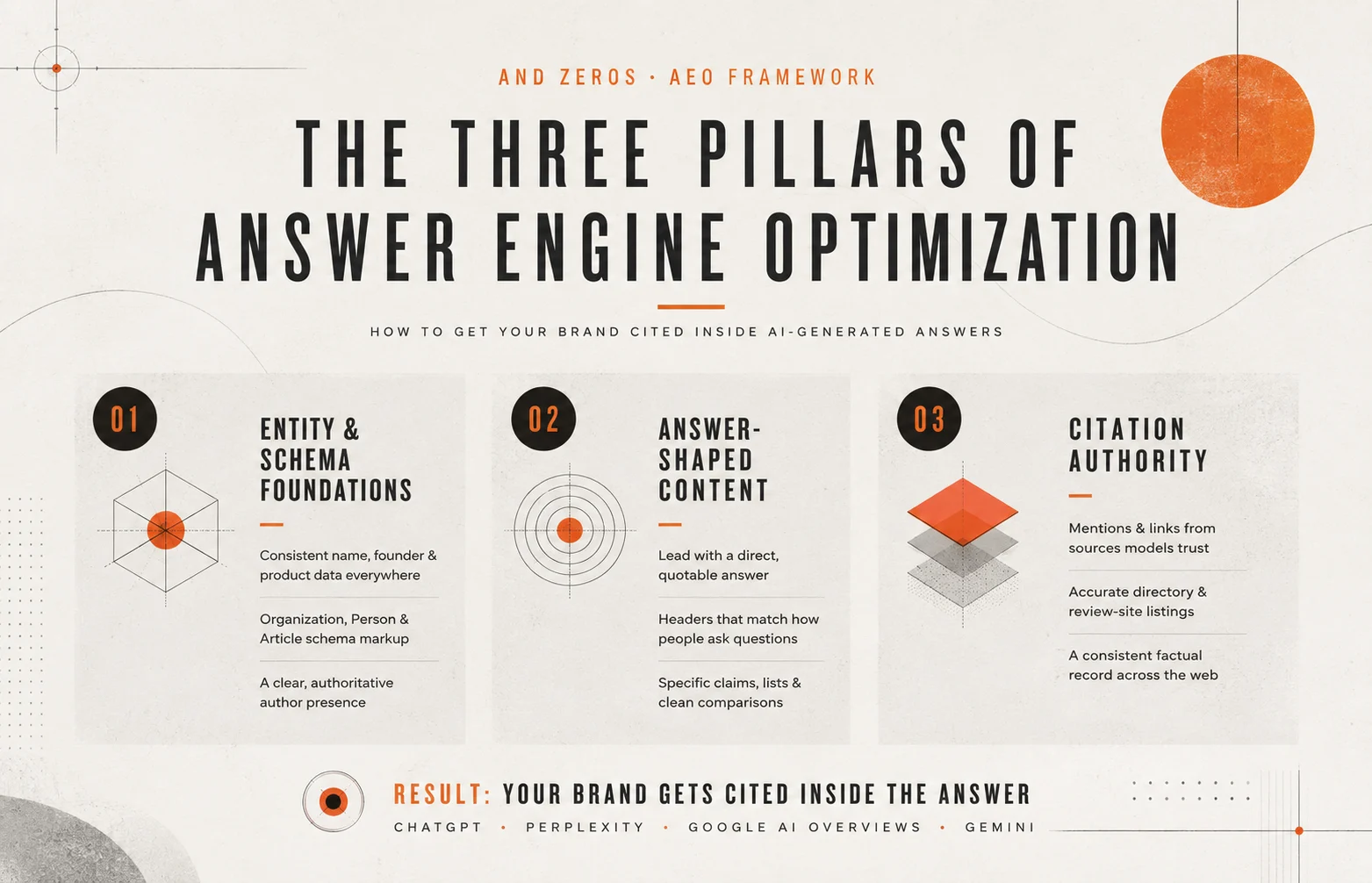
        Abstract visualization of AEO vs SEO showing information moving through layered search and AI processing systems toward a final selected answer.
        AISEO
        August 20, 2026By Doug Saltzman

        AEO vs SEO: What’s the Difference?

        AEO vs SEO comes down to one core difference: SEO optimizes your content to rank in search engine results pages so a human clicks through to your site, while AEO optimizes your content to be pulled directly into an AI-generated answer (in ChatGPT, Perplexity, or Google’s AI Overviews) where you’re cited as a source, whether or not anyone ever clicks.

        That’s the one-sentence version. The full picture is more useful, because AEO and SEO aren’t rivals: they’re two optimization targets built on a lot of shared infrastructure, with a few real points of divergence that change how you write, structure, and measure content.

        Quick definitions

        SEO (Search Engine Optimization) is the practice of ranking content on search engine results pages (primarily Google and Bing) so that it appears high enough to earn a click. Success is measured by rankings, organic traffic, and click-through rate. The unit of output is a webpage designed to be visited.

        AEO (Answer Engine Optimization) is the practice of structuring content so that AI systems (large language models and the retrieval systems behind them) can extract it, trust it, and cite it in a generated answer. Success is measured by citation frequency, share of voice inside AI answers, and brand mentions in zero-click responses. The unit of output is a passage designed to be quoted.

        Both disciplines depend on the same starting point: content has to exist, be crawlable, and say something true and specific. From there, the paths split.

        AEO vs SEO: side-by-side comparison

        DimensionSEOAEO
        Optimizes forRanking position and clicksCitation and inclusion in AI-generated answers
        Primary metricOrganic traffic, rankings, CTRCitation share, brand mentions in AI answers, referral traffic from AI platforms
        Content unitFull page built for a search intentSelf-contained, quotable passage or answer block
        Ranking / selection systemGoogle/Bing algorithm (links, relevance, UX signals)LLM retrieval + generation (semantic match, source trust, extractability)
        Where you show upSearch results page, position 1 to 10Inside the answer text itself, often with a linked citation
        Key tacticsKeyword targeting, backlinks, site speed, internal linking, on-page optimizationDirect-answer formatting, structured data, clear entity definitions, FAQ blocks, original data points
        Content structureLong-form pages optimized for scannability and dwell timeFront-loaded answers, tight definitions, tables, and lists an LLM can lift cleanly
        Feedback loopSearch Console, rank trackers: days to weeksAI answer monitoring tools, manual prompt testing (often less mature and slower to attribute)
        Failure modePage ranks but never surfaces above the fold or loses to a featured snippetPage gets crawled and used to train or ground an answer, but you’re never named as the source

        Where they overlap

        The overlap is bigger than most people assume, which is why “just do SEO better” is half-right advice.

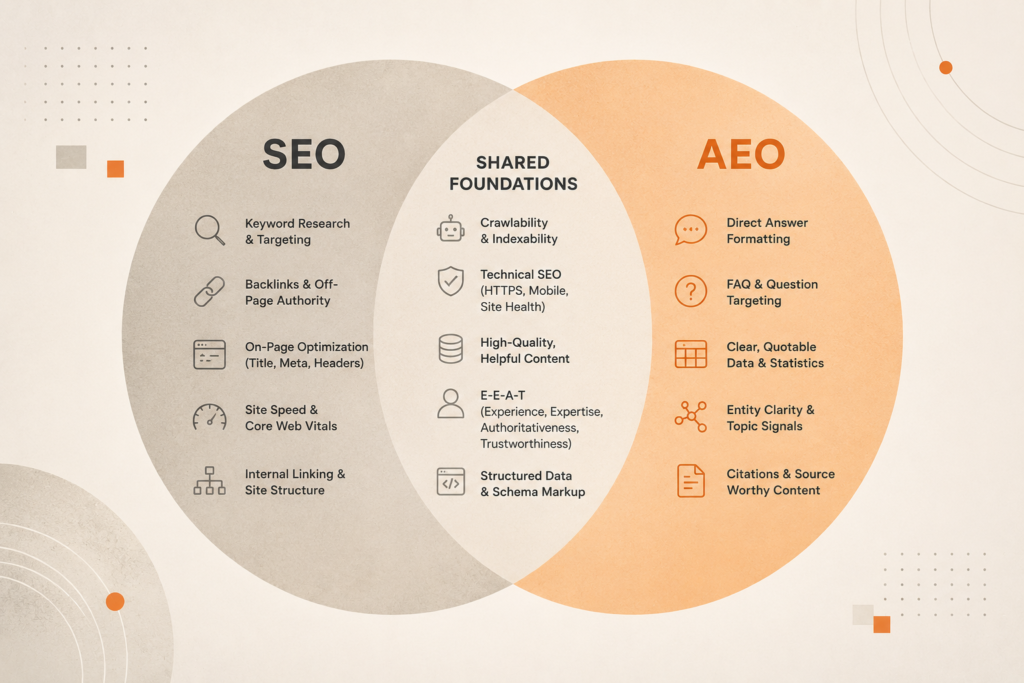
        • Technical foundations are identical. Crawlability, site speed, clean HTML, and indexability matter to both a Googlebot and an LLM’s retrieval layer. If your site isn’t crawlable, neither discipline works.
        • Topical authority helps both. A domain that consistently publishes accurate, specific content on a topic earns trust signals that search engines rank on and that retrieval systems weight when selecting sources.
        • Structured data is doing double duty. Schema markup (Article, FAQPage, Organization) was built for search engines but is increasingly useful context for AI systems trying to understand what a page is and who’s behind it.
        • E-E-A-T-style trust signals matter to both. Clear authorship, real credentials, and a traceable organization behind the content improve both search rankings and an AI system’s willingness to cite you as a source.
        • Good writing is good writing. Clear, specific, well-organized content that actually answers the question performs better in both systems than vague, keyword-stuffed filler.

        Where they diverge

        The differences show up in the details of how you write and structure content, not in whether you write it at all.

        • The unit of success is different. SEO rewards a page that ranks and gets clicked. AEO rewards a passage that gets extracted and quoted, sometimes without a click at all. That changes how you think about ROI and attribution.
        • Answer placement matters more in AEO. SEO tolerates a slow build-up before the payoff. AEO wants the direct, citable answer near the top, in a form an LLM can lift as a self-contained unit: a definition, a table, a numbered list.
        • Links matter less to AEO, source trust matters more. Backlinks are a core SEO ranking factor. LLM retrieval leans more heavily on whether the source reads as authoritative and unambiguous on the specific claim being cited: original data, clear sourcing, and a named author help here.
        • Query patterns differ. SEO still optimizes heavily around discrete keywords and search volume. AEO has to account for conversational, multi-part prompts that don’t map cleanly to a keyword list.
        • Measurement is immature for AEO. SEO has two decades of tooling: Search Console, rank trackers, attribution models. AEO measurement (tracking when and how often you’re cited across AI platforms) is newer, less standardized, and often requires manual prompt testing alongside emerging monitoring tools.
        • Zero-click is the norm, not the exception. With fewer than a third of Google searches now ending in a click, a zero-click result reads as a missed opportunity in SEO. In AEO, being cited without a click is often the entire point: the value is brand visibility and trust, not a session.
        AEO vs SEO: shared foundations and where the two strategies diverge

        Do you need both?

        Yes, and treating them as separate budgets or separate teams is a mistake. Here’s why.

        AI answer engines are increasingly a discovery layer that sits on top of the same web your SEO strategy already targets. Many of them use web search and crawled content as grounding for their answers. A page that doesn’t exist, isn’t crawlable, or has no authority won’t show up in either channel. AEO doesn’t replace the technical and topical foundation SEO already requires: it adds a formatting and trust layer on top of it.

        At the same time, ranking #1 in Google doesn’t guarantee an AI system will cite you. Answer engines select and synthesize differently than a ranking algorithm sorts a results page. A page can rank well and still get skipped in favor of a competitor’s tighter, more citable answer on the same topic.

        The practical position: build the SEO foundation you’d build anyway (crawlable, fast, authoritative, well-linked) and then layer AEO-specific formatting on top: direct answers up front, clean structured data, explicit entity definitions, and content built to be quoted, not just read.

        How to start

        1. Audit what’s already citable. Pick your 10 highest-intent pages and check whether they lead with a direct, quotable answer to the core question, or bury it under three paragraphs of setup.
        2. Add direct-answer blocks. For your most important questions, write a two-to-three sentence answer that could stand alone as a citation, then expand underneath it.
        3. Structure comparisons and processes as tables and lists. LLMs extract these cleanly; walls of prose are harder to lift accurately.
        4. Ship FAQPage and Article schema. It costs little and gives both search engines and AI systems explicit, machine-readable context.
        5. Name a real author and organization. Anonymous content is harder to trust (for readers and for retrieval systems alike).
        6. Test your own prompts. Ask ChatGPT and Perplexity the questions your buyers ask, and see who gets cited. That’s your actual AEO baseline, not a rank tracker.

        How And Zeros does both

        We build content programs that treat SEO and AEO as one system, not two roadmaps: the same technical and topical foundation, formatted so it ranks and gets cited. If you want a straight read on where your content stands in AI answers today, talk to And Zeros about an AEO audit.

        FAQ

        Is AEO replacing SEO?

        No. AEO adds a citation-focused layer on top of the technical and topical work SEO already requires. Sites with weak SEO foundations, meaning poor crawlability and thin authority, tend to perform poorly in AI answers too, since many answer engines ground responses in web content that has to be found and trusted first.

        Do I need separate content for AEO and SEO?

        Usually not separate content, just separate formatting choices within the same content. The research, topical coverage, and technical setup overlap almost completely. What changes is how directly and cleanly the answer is presented near the top of the page.

        How do I measure AEO performance?

        Track citation frequency by manually testing your target prompts across ChatGPT, Perplexity, and Google AI Overviews, watch for referral traffic from AI platforms in your analytics, and monitor brand mention frequency. Dedicated AEO monitoring tools are emerging, but manual prompt testing remains a reliable baseline.

        Does schema markup actually help with AEO?

        It gives AI systems explicit, structured context about your content, including who wrote it, what organization stands behind it, and what question it answers. It won’t guarantee a citation on its own, but it removes ambiguity that could work against you.

        What’s the difference between AEO and GEO?

        They’re closely related and often used interchangeably. AEO typically emphasizes structuring content to be selected as a direct answer, while GEO is a broader term covering optimization for any generative AI output. Learn more about AEO in our dedicated breakdown at /aeo-vs-geo/.

        Will AEO hurt my SEO rankings?

        No, the practices reinforce each other. Direct answers, clear structure, and strong authorship signals are good for search rankings too. There is no tradeoff where optimizing for citations degrades ranking performance.

        Read More
        Abstract visualization of Generative Engine Optimization with interconnected spheres and orbital paths representing how AI systems retrieve, evaluate, and cite information.
        AISEO
        August 6, 2026By Doug Saltzman

        What Is GEO? Generative Engine Optimization Explained

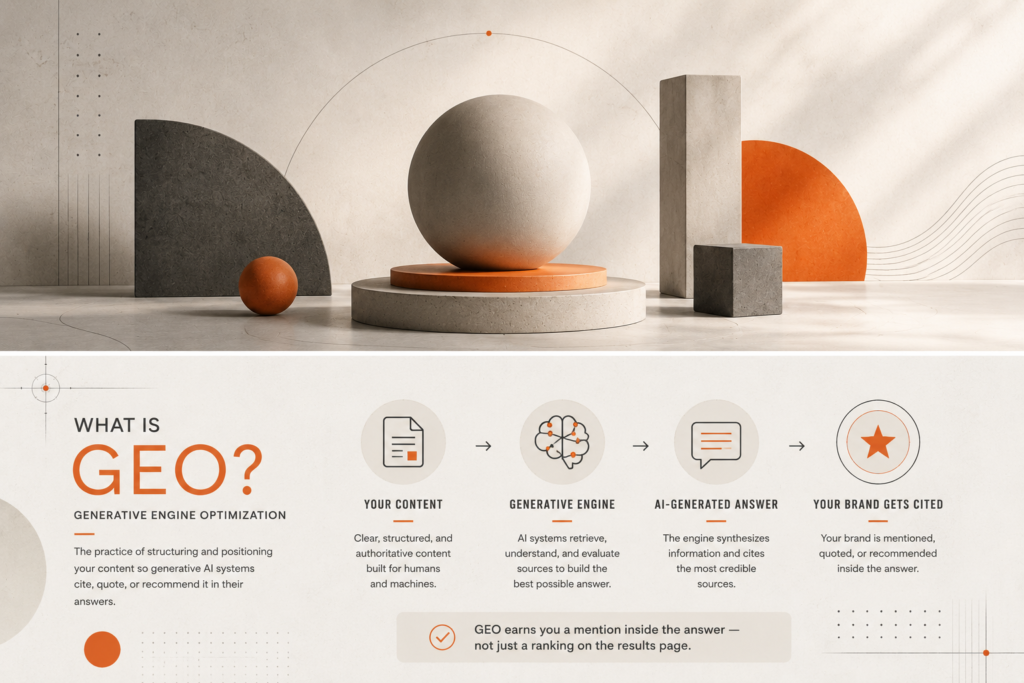
        What is GEO? Generative Engine Optimization (GEO) is the practice of structuring and positioning your brand’s content so that generative AI systems (ChatGPT, Perplexity, Google AI Overviews, and Gemini) cite, quote, or recommend it in their answers. Where SEO earns you a ranking on a results page, GEO earns you a mention inside the answer itself.

        That distinction is the whole game. A growing share of research and buying journeys now start and end inside a chat window, with no click, no results page, and no ten blue links: just a synthesized answer with a handful of sources woven in. If your brand isn’t one of those sources, you’re invisible in a channel that’s becoming a primary entry point to the internet. GEO is the discipline of making sure you are.

        What is GEO (generative engine optimization)?

        What Is GEO?

        So, in one line: what is GEO? It’s optimizing your content to be the source an AI reaches for when it writes an answer, rather than a link a human scrolls past on a results page. Traditional search rewards you for ranking near the top; generative engines reward you for being clear, credible, and easy to quote, because the model has to lift a trustworthy statement from somewhere, and GEO makes that statement yours.

        The practical implication is that GEO changes who you’re optimizing for. You’re no longer only persuading a human to click; you’re also making it effortless for a machine to retrieve your content, understand it, trust it, and repeat it accurately.

        Why GEO Emerged

        For two decades, “being findable” meant ranking on a search engine results page. Users typed a query, scanned ten blue links, and clicked through. SEO optimized for that click.

        Generative engines break that model. When someone asks ChatGPT “what’s the best CRM for a 10-person sales team” or asks Perplexity to compare two SaaS tools, the engine doesn’t hand back a list of links to evaluate: it synthesizes an answer, often citing three to eight sources inline. The user reads the synthesis and may never visit any of the cited pages. The AI has already done the comparison shopping on their behalf.

        This shift happened fast, for three converging reasons:

        • Answer engines went mainstream. ChatGPT, Perplexity, Copilot, and Google’s AI Overviews moved from novelty to daily-use tools for a huge share of internet users within a few years.
        • Search itself got a generative layer. Google now surfaces AI-generated summaries above traditional results for a large share of queries, meaning even “normal” search behavior increasingly runs through a generative filter first.
        • Zero-click behavior became the norm, not the exception. By SparkToro’s analysis, fewer than a third of Google searches now send a click to the open web. Users increasingly get their answer without a website visit at all, which means the old proxy for success — organic traffic — no longer captures the full picture of whether your brand is winning the conversation.

        Brands that only optimize for the SERP are optimizing for a shrinking share of the discovery journey. GEO is the response: it treats “getting cited by the AI” as a distinct, measurable objective, not a byproduct of ranking well.

        How Generative Engines Choose Sources

        Generative engines don’t cite content at random, and they don’t cite it just because it ranks #1 on Google. Understanding how they actually select and weight sources is the foundation of any GEO strategy.

        Retrieval, not just ranking

        Most generative engines use some form of retrieval-augmented generation (RAG): the model doesn’t answer purely from what it memorized during training. It retrieves relevant, current content from an index (its own crawl, a search API, or both), then synthesizes an answer grounded in what it retrieved. That means your content has to be crawlable, indexable, and topically relevant to the exact question being asked, not just broadly authoritative on the subject.

        Clarity and extractability win over cleverness

        Generative engines favor content that’s easy to lift a clean, self-contained answer from. A direct, well-scoped sentence that answers a specific question outperforms a beautifully written paragraph that buries the point five sentences in. The original GEO research (Aggarwal et al., KDD 2024) found that adding citations, quotations, and statistics to content measurably increased how often generative engines surfaced it. Clear headers, explicit definitions, comparison tables, and tightly scoped Q&A sections all make content easier for a model to extract and cite accurately.

        Trust signals still matter, differently

        Generative engines weigh source credibility, just like search engines do, but the signals shift toward things that indicate genuine expertise and reliability: clear authorship, demonstrated first-hand experience, consistent factual accuracy, structured data that removes ambiguity, and a track record of being cited elsewhere (including by other AI-visible sources). Backlinks still matter, but being referenced accurately across the web (in forums, review sites, comparison content, and other publications the engine also crawls) matters just as much.

        Freshness and specificity

        Broad, evergreen authority helps, but many generative answers favor sources that address the query’s specific angle precisely: the exact comparison, the exact use case, the exact number. Generic “ultimate guide” pages often lose out to narrower pages that answer one question completely. If you want help putting this into practice, our GEO services are built around exactly this kind of retrieval-first content work.

        GEO vs. SEO vs. AEO

        These three disciplines overlap but aren’t the same, and treating them as identical is a common (and costly) mistake.

        SEO (Search Engine Optimization) optimizes for ranking position on traditional search results pages. The goal is a click. Success is measured in rankings, organic traffic, and click-through rate.

        AEO (Answer Engine Optimization) optimizes content to directly answer a specific question in a format built for extraction: think featured snippets, “People Also Ask” boxes, and voice assistant answers. AEO is narrower and more tactical than GEO: it’s about winning a single answer slot for a single query. (For a deeper dive, see what is AEO.)

        GEO (Generative Engine Optimization) optimizes for being cited, quoted, or synthesized into a generative AI’s response across a conversation, not just a single query-answer pair. GEO also has to account for how models retrieve and weigh sources, not just how a snippet algorithm parses a page.

        In practice, the three are complementary rather than competing. Strong SEO fundamentals (crawlability, site structure, topical authority) make GEO easier. AEO-style direct-answer formatting makes your content more extractable for generative engines too. Think of it as concentric circles: SEO is the foundation, AEO is a formatting discipline that sits on top of it, and GEO is the broader strategic layer that determines whether AI systems trust and select your content at all.

        Core GEO Tactics

        GEO isn’t a single technique: it’s a set of practices that work together. Each of the tactics below is part of what a full GEO services engagement puts in place.

        Structure content for extraction

        Lead with the direct answer. Use descriptive H2/H3 headers that mirror real questions. Keep key facts in short, self-contained sentences a model can lift without needing surrounding context. Use tables for comparisons and lists for steps.

        Build genuine topical depth

        Generative engines are more likely to trust and cite sources that demonstrate comprehensive coverage of a topic, not just a single optimized page. A cluster of interlinked, specific pages around a subject signals real expertise in a way a single page can’t.

        Use structured data

        Schema markup (Article, FAQPage, Organization, Person) doesn’t just help traditional search: it gives generative engines unambiguous, machine-readable facts about who wrote the content, what organization stands behind it, and what questions it answers. Less inference required means more accurate citation.

        Earn mentions beyond your own site

        Because generative engines synthesize across many sources, being accurately described on third-party sites (review platforms, comparison articles, industry publications, forums) increases the odds your brand shows up in an AI’s answer, even when the AI never visits your website directly.

        Answer the question completely, once

        Fragmented content that half-answers a question across five different pages is harder to cite than one page that answers it fully. Depth and completeness on a single, well-scoped page consistently outperforms thin content spread across many pages.

        Keep facts current and accurate

        Because generative engines weigh accuracy and consistency, outdated or contradicted claims quietly erode citation likelihood over time. Treat cornerstone content as something to revisit and correct, not something to publish and forget.

        How to Measure GEO

        GEO doesn’t have the mature analytics tooling SEO has had for twenty years, but it’s not unmeasurable: you just have to track different signals.

        • Direct prompting audits. Regularly ask the major generative engines the questions your buyers would ask, and log whether your brand is mentioned, cited, or recommended, and in what context.
        • Referral traffic from AI platforms. Most analytics platforms can now segment traffic originating from ChatGPT, Perplexity, and similar tools. Track it as its own channel, not folded into “other.”
        • Share of voice in AI answers. Compare how often your brand appears in AI-generated answers to a defined set of category questions versus how often competitors appear in the same answers.
        • Brand mention sentiment and accuracy. When you are cited, is the information correct? Inaccurate citations are a signal that your content isn’t structured clearly enough for the model to extract it faithfully.
        • Downstream conversion signals. Where analytics allow it, track what visitors who arrive via an AI citation actually do: this is often a small but high-intent segment.

        None of these metrics replace organic traffic and rankings; they sit alongside them as a second measurement system for a second discovery channel.

        How to Get Started with GEO

        You don’t need to rebuild your content strategy from scratch. Start with a focused sequence:

        1. Audit your current AI visibility. Ask ChatGPT, Perplexity, and Google AI Overviews the questions your buyers actually ask. Note whether you show up, who does instead, and why their content likely won a citation.
        2. Fix extractability on your highest-intent pages first. Rewrite openings to lead with a direct answer. Add clear headers, FAQ sections, and structured data.
        3. Build out topical depth around your core categories, rather than spreading effort thin across unrelated keywords.
        4. Strengthen your presence beyond your own site. Accurate listings, reviews, and mentions on third-party sources the engines also crawl.
        5. Set up a recurring measurement cadence so you can see whether citation frequency and accuracy improve over time, not just guess.

        Treat it as an ongoing discipline, not a one-time project. Generative engines update how they retrieve and weigh sources continually, and your content needs to keep pace.

        How And Zeros Approaches GEO

        We treat GEO as a strategic discipline, not a set of prompt-injection tricks. That means auditing how generative engines currently talk about your brand and your category, rebuilding cornerstone content so it’s genuinely easy for a model to retrieve and cite accurately, and putting measurement in place so you can see the impact instead of guessing at it. If you want a second opinion on where your brand currently stands in AI-generated answers, learn more about our geo or get in touch with And Zeros. It’s usually a short conversation to find out.

        FAQ

        What is GEO in one sentence?

        GEO (Generative Engine Optimization) is the practice of structuring and positioning your content so that generative AI systems like ChatGPT, Perplexity, and Google AI Overviews cite, quote, or recommend your brand inside their answers.

        Is GEO the same as SEO?

        No. SEO optimizes for ranking position on a traditional search results page and earning a click. GEO optimizes for being cited or synthesized into a generative AI’s answer, which may never produce a click at all. They share foundational overlap, but they’re measured differently and require different tactics.

        How is GEO different from AEO?

        AEO is a narrower, tactical discipline focused on winning a single direct-answer slot, like a featured snippet or voice response, for one query. GEO is broader: it covers how generative engines retrieve, weigh, and synthesize your content across a whole conversation, including trust signals, structured data, and topical depth AEO doesn’t address.

        Do I need to abandon SEO to do GEO?

        No. SEO fundamentals such as site structure, crawlability, topical authority, and backlinks are the foundation GEO builds on. GEO extends that foundation to cover how generative engines retrieve, weigh, and cite content across AI platforms. Most brands should run both in parallel rather than choosing one over the other.

        Which AI platforms does GEO cover?

        Generally ChatGPT, Perplexity, Google AI Overviews, Gemini, Copilot, and any other generative system that retrieves and cites external sources when answering. Tactics vary slightly by platform, but the underlying principles (extractability, accuracy, structured data, third-party corroboration) apply broadly across all of them.

        How long does GEO take to show results?

        There’s no fixed timeline, and anyone promising a specific number of weeks is guessing. Because generative engines recrawl and reweight sources on their own schedules, changes can show up faster than traditional SEO in some cases and slower in others. Consistent, ongoing optimization matters more than a single push.

        Can small or local businesses do GEO, or is it just for big brands?

        Small and local businesses can compete effectively in GEO, often more easily than in traditional SEO, because generative engines reward specific, well-structured answers to narrow questions rather than sheer domain authority. A well-built local or niche page can out-cite a much bigger competitor’s thin content.

        Read More
        Editorial graphic illustrating schema markup for AI search with structured data code, entity relationships, article, product, review, and local business schema elements in a cream and orange visual system.
        SEOAI
        July 23, 2026By Doug Saltzman

        Schema Markup for AI Search After FAQ Rich Results Die

        A zero crossing is the moment a signal flips from positive to negative. Nothing dramatic happens at the crossing itself, but everything after it is a different sign than everything before. That’s about where search is right now, and FAQ rich results are the tell.

        On May 7, 2026, Google stopped showing FAQ rich results in search. There was no blog post and no goodbye. The notice just showed up in the structured data docs one Thursday, and the little accordion snippets a lot of us spent years marking up quietly disappeared from the results page. By June the reporting drops out of Search Console. By August the API stops admitting they ever existed.

        If you built FAQ schema to grab real estate in the blue links, yeah, this one stings. HowTo already went the same way, restricted to a handful of government and health sites back in 2023 and now basically dead for everyone else.

        Here’s the part I keep having to talk people down from: the right move is not to rip out your FAQPage markup. Structured data just changed jobs, and almost nobody updated the job description.

        The reward moved. The work didn’t.

        For about fifteen years, the deal with schema was transactional. You added markup, Google handed you a rich result (stars, a recipe card, a price, an FAQ accordion), and that little bit of visual candy earned you clicks. Structured data was basically a bribe you paid the SERP in exchange for pixels.

        That deal is falling apart, and not just for FAQs. The whole rich-result economy is getting eaten by a different consumer of your markup: the language model now sitting between the user and your page.

        When somebody asks ChatGPT “what’s the best way to waterproof a basement,” or types a question into Google’s AI Mode, there’s no blue link to decorate. There’s an answer, stitched together from sources, with a few citations hanging off the side. Your goal stopped being be the result. It’s be the source the answer gets built from. And the machinery deciding which sources get pulled into that answer reads your page nothing like a human does, and honestly not much like classic Googlebot did either.

        That’s the whole reframe. Rich results were structured data for humans looking at a search page. In 2026, structured data is ground truth for a model that’s trying very hard not to be wrong.

        What Google actually says (and why it isn’t a contradiction)

        Let’s kill the myth first, because it holds up everything else.

        Structured data is not a ranking factor. John Mueller said it flat out again in 2025, “structured data won’t make your site rank better,” which lines up with a position Google has held since at least 2018: “there’s no generic ranking boost for SD usage.” Adding schema does not push you up the results. Full stop.

        So why bother, if the rich results are dying and it won’t help you rank?

        Because ranking was never the point of schema in the first place. What structured data does, in Google’s own words, is make your content eligible for features, make your entities easier to understand, and cut down the ambiguity a machine has to work through when it parses your page. Mueller’s line is that structured data is the directions to the party, not the invitation. It won’t get you through the door. But once you’re invited, it’s the difference between the model walking straight up to your front door and the model wandering the block guessing which house is yours.

        That “understanding” job used to be a nice-to-have. In an answer-engine world it’s the entire game. Microsoft has been blunter about this than Google, actually. Bing’s product team has said outright that schema helps their LLMs understand content for Copilot. The mechanism is the same everywhere: models ground their answers in retrieved passages, and they’d rather use passages they can read without guessing.

        So here’s the honest version, the one I’d put on a slide. Structured data does not cause AI citations. It removes the reasons a model has not to cite you. When an engine can verify, without squinting, who published a page, who wrote it, what entity it’s about, what the price is, and which other sources agree, you become the low-risk thing to quote. Models are like nervous interns. They quote the source they’re most sure won’t get them yelled at.

        The schema types that still earn their keep

        Not all markup is equal now. The types that mattered for rich results and the types that matter for AI grounding overlap, but the weight has shifted hard toward anything that nails down identity, authority, and verifiable facts. Here’s where I’d spend the time.

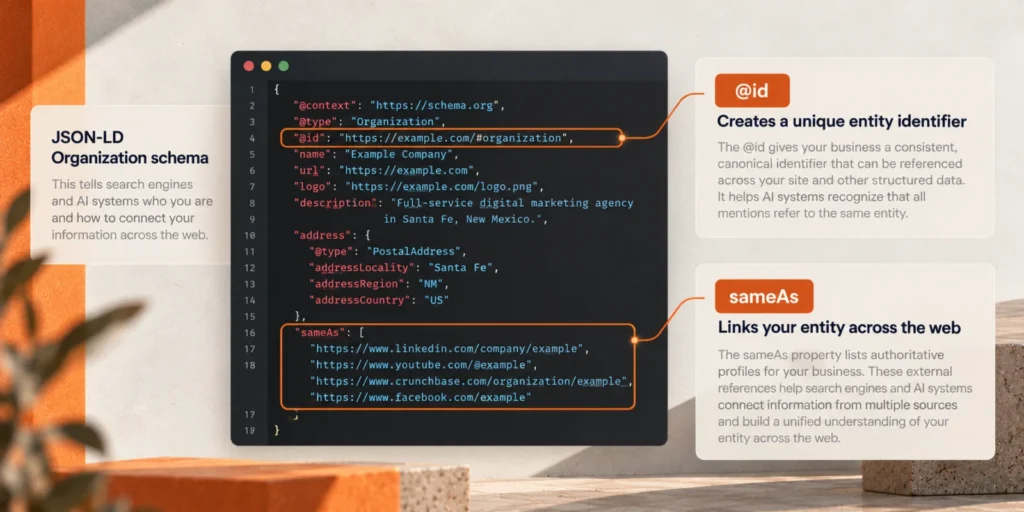
        Organization is the foundation, and it’s the one most sites do worst. This is where you tell every engine, no ambiguity, who you are: legal name, logo, URL, and critically your sameAs links to the profiles that back up your existence (LinkedIn, Wikidata, Crunchbase, a Wikipedia entry if you’re lucky enough to have one). This is the entity-graph play, and it’s the most underused piece of markup on the web. More on it in a second.

        Article and NewsArticle attach the metadata answer engines lean on to decide whether a page is trustworthy and current: a clear headline, a named author, a publish date, a modified date. Models favor recent, well-attributed content because recency and attribution are cheap proxies for reliability. If your best content has no author entity and no dates, you’re asking a model to trust an anonymous, undated page over a competitor’s bylined one. It won’t.

        Product and Offer now get consumed directly by AI shopping agents and Google’s AI Mode. Price, currency, availability, SKU. When a model is assembling a “best X under $200” answer, structured product data is the difference between showing up with an accurate price and getting skipped because your price lived inside a JavaScript widget the crawler never rendered.

        Review and AggregateRating hand engines quantified sentiment, a number they can compare across sources without parsing prose. Mark it up honestly (we’ll get to the honesty part) and it becomes comparison fuel.

        LocalBusiness is table stakes for anything tied to a place, and it has to match your Google Business Profile exactly. Name, address, phone, hours. Mismatches between your schema and your other listings are precisely the kind of ambiguity that makes a model drop you.

        BreadcrumbList quietly tells engines about your site structure and how your topics relate, which helps them understand where a page sits in the bigger picture.

        Notice what isn’t at the top of that list: FAQPage and HowTo. Which brings us back to the question you’re probably still holding.

        So should you keep the FAQ schema?

        Yes. Keep it. Just stop expecting the SERP to pay you for it.

        Google itself confirmed that leaving FAQ markup in place won’t cause search problems, because unused structured data doesn’t hurt you, and FAQPage is still a valid Schema.org type. The rich result is gone, but the markup still does the thing that matters more now: it hands a model a clean, pre-parsed set of question-and-answer pairs. A well-formed FAQPage block might be the most extraction-friendly structure you can put on a page, because it maps one-to-one onto the exact shape of a query and its answer. That’s not a rich-result feature anymore. It’s a gift to the retrieval layer.

        The shift is all in your head, honestly. You’re not marking up FAQs to win an accordion. You’re marking them up because a question with a crisp, self-contained answer is exactly what an answer engine is shopping for.

        The entity graph is where the leverage actually is

        If you do one thing after reading this, make it sameAs.

        Answer engines don’t think in pages. They think in entities (people, organizations, products, places) and the relationships between them. The reason a model will confidently cite one brand and ignore another one making the identical claim usually comes down to whether it can resolve the entity, meaning connect “the company on this page” to a stable, corroborated node in its picture of the world.

        sameAs is how you draw those connections on purpose. Here’s a real Organization block that does it:

        json

        <script type="application/ld+json">
        {
          "@context": "https://schema.org",
          "@type": "Organization",
          "name": "Zero Crossing",
          "url": "https://writeandzeros.com",
          "logo": "https://writeandzeros.com/logo.png",
          "description": "Web development and search visibility for the AI era.",
          "sameAs": [
            "https://www.linkedin.com/company/writeandzeros",
            "https://twitter.com/writeandzeros",
            "https://www.crunchbase.com/organization/writeandzeros",
            "https://www.wikidata.org/wiki/Q000000"
          ]
        }
        </script>

        Every URL in that array is a witness. You’re telling the engine that this entity is the same one LinkedIn, Crunchbase, and Wikidata already know about. Each corroborating link drops the model’s uncertainty a little, and lower uncertainty is what gets you quoted. A brand with a dense, verifiable entity graph is a safe citation. A brand that exists only on its own website is a coin flip.

        Do the same thing for authors. An Article whose author is a real Person entity, with a sameAs pointing to their LinkedIn or their body of work, is far better grounded than a byline that’s just a string of text:

        json

        <script type="application/ld+json">
        {
          "@context": "https://schema.org",
          "@type": "Article",
          "headline": "Schema Markup for AI Search After FAQ Rich Results Die",
          "datePublished": "2026-07-23",
          "dateModified": "2026-07-23",
          "author": {
            "@type": "Person",
            "name": "Doug [Last Name]",
            "url": "https://writeandzeros.com/about",
            "sameAs": ["https://www.linkedin.com/in/yourprofile"]
          },
          "publisher": {
            "@type": "Organization",
            "name": "Zero Crossing",
            "logo": {
              "@type": "ImageObject",
              "url": "https://writeandzeros.com/logo.png"
            }
          },
          "mainEntityOfPage": "https://writeandzeros.com/schema-for-ai"
        }
        </script>

        That’s the gap between “some page said this” and “a named expert, tied to a verifiable track record, published this on a dated, attributed page.” Only one of those is a citation a model feels safe making.

        Schema and chunking are the same project

        Here’s the piece most schema guides skip: your structured data and your content structure have to agree, because they’re describing the same thing to the same reader.

        Answer engines rarely grab a whole page. They grab passages, often 100 to 300 words, and they want each one to be a complete, standalone thought. That has real consequences for how you write, and your schema should mirror your prose instead of fighting it.

        Three rules pull most of the weight here.

        Write answer-first. Lead each section with the direct answer, then support it. A model pulling a 200-word passage should get the payload in the first two sentences, not after four paragraphs of you clearing your throat. If your FAQPage acceptedAnswer text and your on-page answer say the same thing the same crisp way, you’ve reinforced the signal twice.

        Kill the pronoun penalty. Retrieval rips a passage out of context, so a sentence like “The company’s revenue grew 3% last quarter” is useless on its own. Which company? Which quarter? Repeat the entity names instead of leaning on “it,” “they,” and “this.” Your schema already names the entity out loud, so your prose should too, and then the extracted chunk carries its own context wherever it lands.

        Chunk by meaning, not by machine. Use H2s and H3s to break content into modules where each section is one complete idea that stands on its own. This isn’t readability theater. It maps your page to the exact unit an engine retrieves, and it lets your headings and your BreadcrumbList tell a consistent story about what lives where.

        When your markup, your headings, and your sentences all describe the same entities and facts the same way, you’ve stripped out the ambiguity that makes a model hedge. That consistency is the real optimization, not any single tag.

        The ways people get this wrong

        A few failure modes worth calling out, because they’re common and they backfire.

        Marking up things that aren’t on the page. Schema has to describe visible content. Invent an aggregate rating, stuff in FAQs no human ever sees, claim a price that contradicts your product page, and you’re not gaming anything. You’re feeding the engine a contradiction, and contradictions are exactly what make a source look untrustworthy. Fastest way to not get cited is to get caught being wrong.

        Chasing dead rich results. If your schema strategy is still a checklist of “which SERP features can I unlock,” you’re optimizing for a surface that keeps shrinking. FAQ and HowTo are gone. Others will follow. Optimize for grounding instead, and rich results become a nice side effect rather than the whole point.

        Fake or bought reviews in Review markup. Past the obvious policy risk, it poisons the exact signal (quantified, trustworthy sentiment) you wanted the markup to send in the first place.

        Orphaned entities. An Organization block with no sameAs. An author who’s just a text string. A LocalBusiness whose name, address, and phone don’t match your Google Business Profile. Every one of those is an unresolved entity, and unresolved entities are uncited entities.

        A 20-minute audit you can run today

        Pull up your most important page and check, in this order.

        Does it have an Organization block (or Person, if it’s a personal site) with a populated sameAs array pointing to at least three corroborating profiles? If not, that’s your highest-leverage fix, no contest.

        Does your main content carry Article markup with a named author entity, a datePublished, and a dateModified that’s actually current? Undated, anonymous content is the easiest thing in the world for a model to skip.

        For commercial pages, is your Product and Offer data present, with an accurate current price and availability, and does it match what a human sees on the page?

        Are your headings breaking the page into standalone, answer-first sections, with entity names repeated instead of pronouns?

        Run the whole thing through Schema.org’s validator and Google’s Rich Results Test. Fix every error and warning, not because you’re chasing a rich result, but because a validation error is literally the machine telling you it couldn’t read your claim.

        And keep your FAQPage markup. Just move it, in your head, out of the “rich results” column and into the “extraction-friendly ground truth” column, where it lives now.

        The bottom line

        The death of FAQ rich results isn’t really a story about one deprecated feature. It’s the clearest sign yet that the audience for your structured data changed underneath you. For years you marked up pages to earn decorations on a search results screen. Now you’re marking them up to be the source a model trusts enough to quote when there’s no search results screen at all.

        Structured data won’t rank you. Google’s been consistent, and correct, about that for years. What it does is quietly, unglamorously strip out every reason a machine has to be unsure about who you are, what you’re claiming, and whether it can afford to put your name next to an answer. On an internet more and more run by models that would rather stay quiet than be wrong, being the source there’s no doubt about is the entire ballgame.

        The accordion’s gone. The markup underneath it just got a promotion.

        Read More
        Abstract Zero Crossing-inspired composition showing a single clear signal surrounded by layers of visual noise using torn paper, textured black surfaces, architectural forms, and warm orange accents to represent domain-level topical coherence.
        SEOAI
        June 30, 2026By Doug Saltzman

        Your Best Page Means Nothing If Your Domain Is Noise

        There’s a frustrating pattern we keep running into with clients who have done everything right at the page level. Good structure, answer-first blocks, named entities, proper schema. The page looks exactly like what every GEO guide tells you to build, and it still doesn’t get cited consistently.

        The reason is almost never the page, it’s the domain it lives on.

        AI systems don’t evaluate your content the way a human editor would, reading one article and deciding whether it’s worth referencing. They’re building a model of what your entire domain is about before they decide whether to pull anything from it. If that model comes back as “unclear” or “too broad” or “a little bit of everything,” your individual pages get discounted before they’re even considered. The signal from the good page gets washed out by the noise from everything around it.

        This is why a focused niche site with twenty tightly related articles will consistently outperform a large brand site with two hundred scattered ones in AI citation. It’s not about volume. It’s about coherence.

        What topical coherence actually means

        A domain sends a coherent signal when every piece of content on it reinforces the same core topic cluster. An HR consulting firm that publishes articles about compliance, employee retention, hiring frameworks, and workforce planning is coherent. The model can look at that domain and build a clear picture of what it’s an authority on.

        That same HR consulting firm that also publishes articles about general leadership inspiration, productivity hacks, office design trends, and founder mindset content is incoherent from the model’s perspective. It’s not because those topics are bad, but because they dilute the topical picture. The model can’t confidently categorize the domain, so it treats the whole thing as a weaker signal source on the queries that actually matter for the business.

        Most brand sites fall into the second category without realizing it. The scattered content usually happened for legitimate reasons… ie: a blog that started without a strategy, a content team that chased trending topics, a few years of “let’s just put something out; but the cumulative effect is a domain that AI systems can’t cleanly slot into a topic category.

        The practical problem this creates

        When an AI system is assembling an answer about HR compliance for small businesses and it’s deciding which sources to cite, it’s not just looking at the quality of the individual pages it retrieved. It’s weighting those pages by how much it trusts the domain they came from on this specific topic. A domain with 40 articles all tightly related to HR consulting gets a higher topical trust score on that query than a domain with 200 articles where 40 of them are about HR and the rest are about everything else.

        This is why niche sites punch above their weight in AI citation. They’re not winning on authority, they’re winning on coherence. The model knows exactly what they’re about and trusts them on that topic accordingly.

        What to do about it

        The first step is an honest audit of what your domain actually looks like from the outside. Pull a list of every piece of content you’ve published and group it by topic. If you can’t draw a clear circle around a primary subject with most of your content inside it, you have a coherence problem.

        The second step is a pruning decision. Content that’s genuinely off-topic for your domain’s core subject either gets consolidated into something more focused, redirected to a more appropriate page, or removed. This is the part most teams resist because it feels like throwing away work. But a smaller, coherent domain consistently outperforms a larger, scattered one for GEO citation, and the gap is widening as AI systems get better at topical modeling.

        The third step is a content plan that treats every new piece as a reinforcement of the domain signal, not just a standalone article. Before you publish anything, the question isn’t just “is this good content”, it’s “does this make our domain’s topical picture clearer or murkier.”

        Why this matters more every quarter

        The brands that figured out page-level SEO early built a compounding advantage that lasted years. The same thing is happening right now with domain-level topical coherence for GEO. The window where getting this right is a genuine differentiator is open but it won’t stay open. As more teams start optimizing for AI citation, the ones who already have coherent domain signals will be much harder to displace than the ones who are still catching up on individual page structure.

        Your best page is only as strong as the domain it lives on. That’s the part of GEO most people haven’t started working on yet.

        At And Zeros, domain-level topical audits are part of how we set up GEO programs for clients. If you want to know what signal your domain is actually sending, get in touch.

        Read More
        Entity Authority vs Keyword Authority
        SEOAI
        June 23, 2026By Doug Saltzman

        Entity Authority vs Keyword Authority: The Playbook AI Engines Reward

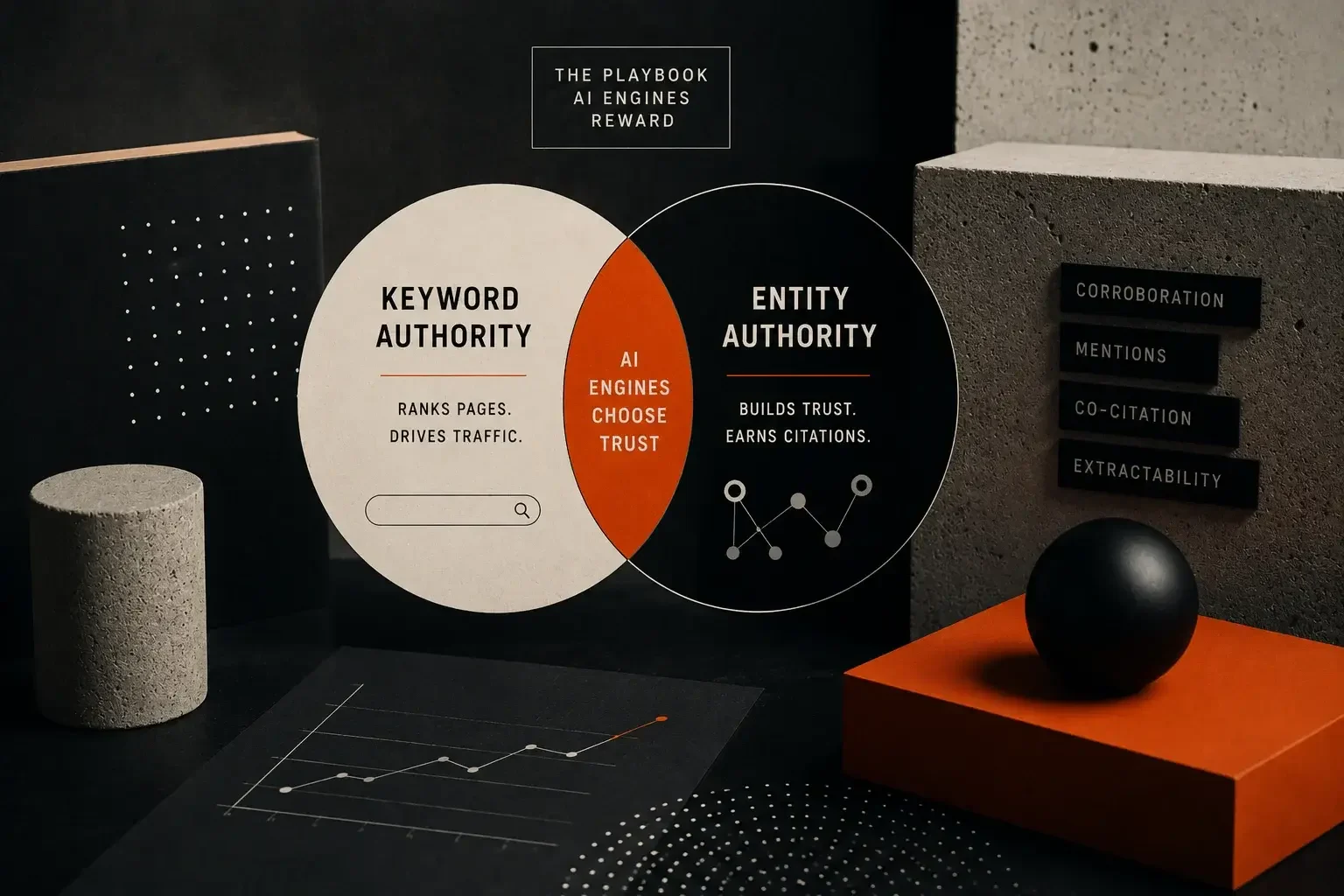
        Entity authority is how confidently an AI engine understands who your brand is and whether it trusts you enough to reuse you in an answer. Keyword authority gets you traffic from Google. Entity authority gets you cited by ChatGPT, Perplexity, and AI Overviews. The two are different optimization targets, and most SEO teams are still chasing the first. HubSpot, Notion, and Stripe each built a moat on the second, and the playbook is replicable.

        A brand can rank on page one and still get summarized away in AI answers, because ranking measures page relevance and citation measures entity trust. Those are not the same machine reading the same signal.

        The data backs the split. One 2026 analysis put the correlation between Domain Authority and AI citation probability at roughly 0.18, while E-E-A-T signals correlated around 0.81. A separate Moz study of nearly 40,000 queries found that 88% of Google AI Mode citations sit outside the organic top 10. So the positions teams spent a decade fighting for are mostly not the positions AI pulls from. That gap is the whole story.

        This post breaks down what entity authority is, how AI engines build the knowledge graph that decides who gets quoted, three brand teardowns you can copy, and a literal checklist for auditing where you stand today.

        What is entity authority and why does it differ from keyword authority?

        Entity authority is the level of confidence a search or AI system has that it knows who you are, what category you belong to, and why it should rely on you. Keyword authority is page-level relevance to a search string. Entity authority is brand-level trust across the whole web.

        Topical authority answers “what does this site talk about.” Entity authority answers “who is this, and should we rely on them.” A keyword-optimized page proves you covered a term. An entity-authoritative brand proves, across many sources, that you are the reference voice for a subject. AI engines reason with entities, not pages. When an engine builds an answer, it is not pulling one ranked URL. It is weighing sources against each other and checking whether the same brand shows up, described the same way, across Wikipedia, LinkedIn, Reddit, review platforms, news, and third-party mentions.

        That difference has a practical edge. A brand with a small content library but strong entity authority can displace a much larger publisher in AI answers, because the engine has a clear, corroborated model of who is speaking. A five-year-old site with no named authors and no original data gets out-cited by a six-month-old site that has both. Keyword authority is a ranking input. Entity authority is a trust substrate that other signals attach to.

        How AI engines build the knowledge graph

        AI engines do not read your site the way a crawler checks a keyword. They resolve entities first, then decide what is citable. Entity resolution is the step where the system unambiguously identifies your brand, classifies it into a category, and maps its relationships to other known entities. Everything downstream depends on that step clearing. If the engine cannot resolve who you are, your credibility signals have nothing to attach to.

        Three things drive whether resolution succeeds and citation follows. First, corroboration across channels. Engines look for consistent factual profiles, your name, description, and category, repeated the same way across independent sources. Second, brand mention frequency. Research from The Digital Bloom found brand search volume correlated about 0.334 with LLM citations, outweighing backlinks. AI models prefer brands people already search for. Third, co-citation patterns. When trusted sources reference you alongside the category leaders, the system reads that pattern and places you in the same neighborhood.

        Then there is extractability. Pages updated within the last 30 days have been measured earning roughly 3.2 times more ChatGPT citations, and adding statistics to content has been shown to lift AI visibility 30 to 40% in the Princeton and Georgia Tech GEO study. Structure matters too. Tables, clear definitions, named authors, and visible “last updated” dates all make a page easier for an engine to pull without paraphrasing. But structure has a ceiling. Content that lives only on your own domain, no matter how well-formatted, hits a wall that earned third-party authority breaks through.

        HubSpot teardown: how adjacent concept pages built a moat

        HubSpot’s play is the cleanest example of building entity authority through topical architecture. The company popularized the pillar-and-cluster model, a comprehensive pillar page on a broad topic, surrounded by cluster pages that each go deep on one subtopic and link back. The structure was designed for Google, but it maps almost perfectly onto what AI engines reward.

        Here is why it works for citation. Each cluster page is a standalone answer to one question, with room for its own data, examples, and named-expert input. The pillar signals comprehensive coverage of the category. The internal linking tells the engine these pages form a connected body of expertise rather than scattered one-offs. HubSpot’s own research found that more interlinking correlated with better placement and rising impressions. When they restructured, the team even manually de-linked old posts so each cluster’s authority concentrated cleanly instead of leaking across unrelated pages.

        The moat is built from adjacency. HubSpot does not just own “CRM.” It owns the dozens of concept pages around CRM, marketing, and sales that AI engines now treat as the connected map of the category. HubSpot’s own State of AEO 2026 report, analyzing citations across ChatGPT, Gemini, Perplexity, and AI Overviews, found that pages with outbound links, statistics, author bios, and visible update dates earned more citations. Those are exactly the elements a cluster page has room to carry. The lesson for a smaller brand is not the scale. It is the architecture. Pick a category, map its connected concepts, and build a standalone, evidence-backed answer for each one.

        Notion teardown: winning a category they don’t compete in

        Notion’s entity authority comes from owning a vocabulary it did not invent. Search “second brain,” “Life OS,” or “productivity system” and the results are saturated with Notion. The PARA method came from Tiago Forte. The second-brain concept predates Notion’s marketing. Notion attached its brand to that language so thoroughly that AI engines now resolve the category and the product as neighbors.

        The mechanism is the template ecosystem plus a flood of corroborating third-party content. Notion’s own marketplace hosts countless “second brain” and “productivity system” templates, and an enormous independent layer of creators, bloggers, YouTubers, and Medium writers reinforces the same association. When thousands of independent sources describe building a second brain in Notion, the engine reads consistent co-occurrence. The brand and the concept become linked entities, even though the concept is older and broader than the tool.

        This is the move most teams miss. Notion is not winning a keyword war for “note-taking app.” It is winning a conceptual association for how people think about personal knowledge management. The brand sits inside the category’s vocabulary rather than next to it. For a smaller brand, the replicable version is to find the concept your customers use to describe the job they are doing, then become the corroborated reference for that concept across owned and earned channels, not just your own site.

        Stripe teardown: entity authority in B2B finance

        Stripe built entity authority by becoming an intellectual brand, not just a payments API. The clearest artifact is Stripe Press, the in-house publisher releasing books on technological and economic advancement. A payments company publishing books looks like a detour until you see it as entity engineering. Founder Patrick Collison framed it as building tools and infrastructure to grow the online economy, and the press is one of those tools.

        The strategy works on two layers at once. The first is “engineering as marketing,” where deep developer documentation and technical tools act as acquisition channels and earn strong rankings for technical queries. The second is the intellectual layer, where Stripe Press and the annual data reports position the brand alongside ideas about progress and economic growth. Stripe’s Global Payments and Treasury Report uses proprietary transaction data and has earned coverage in the Financial Times and the Wall Street Journal, the kind of earned authority that strengthens entity resolution far more than any owned page can.

        The result is a brand AI engines resolve cleanly as “the economic infrastructure for the internet,” a category phrase Stripe authored and now owns. Stripe also reinforces this with original data nobody else has. When an engine needs a citable claim about online payments or internet commerce, Stripe’s reports are the corroborated source. The transferable principle for a B2B brand is original data plus earned coverage. You do not need a publishing house. You need one proprietary dataset and one piece of coverage in a source the engines already trust.

        How to audit your brand’s current entity authority

        Start by testing what the engines already believe about you. Open ChatGPT, Perplexity, Gemini, and Google AI Overviews and ask the same set of category questions a real buyer would ask, the research-stage prompts like “what is X” and the comparison prompts like “best X for Y.” Record who gets cited and how often. This is not keyword research. The prompts have to match how buyers actually research, or being in the answer means nothing commercially.

        Then map three things. First, entity clarity. Does each engine describe your brand consistently, in the right category, with the right specialty. Inconsistent or vague descriptions mean resolution is failing. Second, source diversity. Count the distinct domains the engines cite when your brand appears. If a competitor gets pulled from 15 domains and you get pulled from three, the gap is corroboration, not content. Third, citation share. Within your tracked prompt set, what percentage of answers cite you versus each competitor. That number is your real position in AI search, and it rarely matches your Google ranking.

        The five-step entity expansion playbook

        Once the audit shows where you stand, expansion follows a repeatable sequence. Each step targets a different driver of entity resolution.

        1. Lock entity hygiene. Make your name, description, and category identical everywhere, your site, LinkedIn, Crunchbase, review platforms, and any directory. Add Organization, Person (for authors), and relevant schema so machines parse identity without guessing. Inconsistency here quietly poisons every other step.
        2. Map and build the concept cluster. Identify the connected concepts in your category, then build a standalone, evidence-backed answer for each, linked together. This is the HubSpot move at a smaller scale. Each page should answer one question fully and stand on its own as an extraction target.
        3. Claim a category vocabulary. Find the phrase your customers use for the job they are doing and become the corroborated reference for it, the Notion move. Use it consistently across owned content and seed it into the earned and community channels where buyers actually research.
        4. Produce original data and earn coverage. One proprietary dataset, one report, one piece of coverage in a source the engines trust, the Stripe move. Original numbers are inherently citable, and earned mentions break the owned-domain ceiling that structure alone cannot.
        5. Maintain freshness and named expertise. Refresh key pages on a regular cadence, keep visible update dates, attach named authors with real credentials, and add statistics to every claim. These are the extractability signals that move a resolved entity into the cited set.

        The 18-24 month investment horizon

        Entity authority compounds, which is the good news and the catch in the same sentence. Each placement in a trusted publication strengthens resolution. Each well-structured page adds an extraction target. Each consistent mention reinforces the category association. None of those pay off in a single sprint. This is a multi-quarter program, and realistic teams should plan on roughly 18 to 24 months before the citation share moves meaningfully and holds.

        The reason to start now is the same reason it takes time. Competitors building this infrastructure today are accumulating an advantage that widens monthly. Entity-dependent signals are becoming more central to AI search, not less, so the gap between brands that invested early and brands that waited will keep compounding. Keyword authority still matters for traditional ranking. But entity authority is the substrate the next decade of discovery runs on, and substrates are slow to build and slow to lose.

        FAQ

        How do I know if I already have entity authority?

        You have entity authority when AI engines describe your brand consistently and cite you for category questions without prompting. Test it directly. Ask ChatGPT, Perplexity, and Gemini a set of buyer-stage questions in your category and see whether you appear, how you are described, and how many distinct sources back the mention. Consistent description plus citations from several independent domains means resolution is working. Vague or contradictory descriptions mean it is not.

        Can a startup build entity authority?

        Yes. Entity authority rewards clarity and corroboration more than size, so a small brand with a tight category definition and consistent cross-channel presence can out-cite a larger, vaguer competitor. A six-month-old site with named authors, original data, and current pages has been measured out-citing older, higher-DR sites that lack those signals. The startup path is narrower focus, not bigger budget. Own one clearly defined slice completely rather than covering a broad category thinly.

        Does Wikipedia count more than other sources?

        Not categorically. A Wikipedia entry helps entity resolution because it is a structured, corroborated identity record, and pursuing one is worth it if your brand is notable enough to qualify. But no single source type is universally more valuable. In some categories editorial listicles dominate AI citations, in others Reddit threads or review platforms carry more weight. The only reliable answer is to reverse-engineer what the engines actually cite for your category and build presence there, rather than assuming Wikipedia is the whole game.

        Is this just thought leadership rebranded?

        No. Thought leadership is content you publish on your own properties. Entity authority is how machines resolve and trust your brand across the whole web, most of which you do not control. Thought leadership can feed it, since original ideas attract the mentions and coverage that strengthen resolution. But you can produce endless thought leadership and still fail to be cited if the engine cannot form a clear, corroborated model of who is speaking. The work happens off your domain as much as on it.

        Audit framework: measure your entity authority across the major engines

        Use this as a literal checklist. Run it once to baseline, then quarterly to track movement.

        Step 1, build your prompt set. Write 15 to 25 questions a real buyer asks, split across research-stage (“what is [category],” “how does [job] work”) and comparison-stage (“best [category] for [use case],” “[competitor] alternatives”). Avoid your own keyword list. Use the language buyers use.

        Step 2, run every prompt across four engines. ChatGPT, Perplexity, Google AI Overviews, and Gemini. Record for each answer: whether your brand appears, how it is described, and every source domain cited.

        Step 3, score entity clarity (0 to 5). Across the four engines, is your brand described consistently, in the correct category, with the right specialty. 5 means identical and correct everywhere. 0 means absent or wrong. Self-verify by checking each engine’s description against your own one-line positioning.

        Step 4, score source diversity. Count the distinct domains that cite you across the full prompt set. Then count the same for your top two competitors. The ratio is your corroboration gap.

        Step 5, calculate citation share. Of all answers in your set, what percentage cite you, versus each competitor. This is your AI search position. Compare it to your Google ranking for the same topics, the gap between the two numbers is the size of your entity-authority opportunity.

        Step 6, audit entity hygiene. Confirm your name, description, and category match exactly across your site, LinkedIn, Crunchbase, G2 or Capterra, and any directory. Flag every inconsistency. Confirm Organization and author schema are present and valid.

        Step 7, log freshness and evidence. For your top 10 category pages, record last-updated date, presence of named author, and number of original statistics. These are the extractability signals. Anything stale, anonymous, or evidence-thin goes on the fix list.

        Re-run steps 2 through 5 every quarter. Movement in citation share and source diversity, not keyword rank, tells you whether the entity work is landing.

        Read More
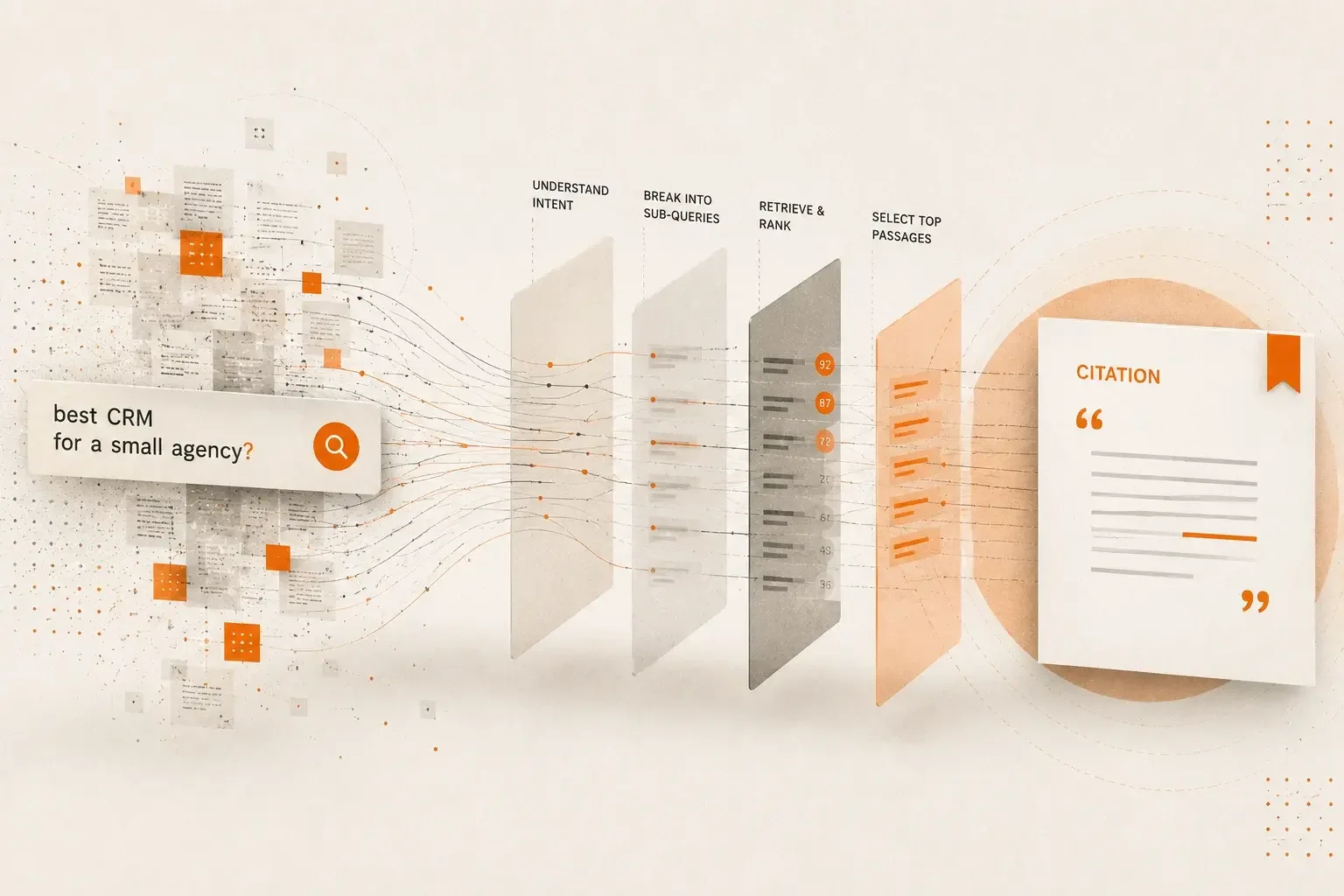
        Light editorial illustration showing an AI citation pipeline where search queries break into sub-queries, pass through ranking layers, and resolve into a cited answer.
        SEOAI
        June 2, 2026By Doug Saltzman

        How AI Engines Actually Decide What to Cite

        Retrieval-Augmented Generation is the mechanism behind every AI citation. The engine breaks your prompt into narrower sub-queries, retrieves a candidate set of passages, scores each by relevance and authority, then synthesizes the answer and attributes the pieces it used. Teams that understand RAG mechanics optimize systematically. Everyone else optimizes by guessing.

        Most people picture an AI engine reading their page the way a person would, top to bottom, weighing the argument. That is not what happens. The engine never sees your page as a page. It sees a pool of text fragments, ranked by math, and it pulls the few that answer the specific question in front of it. If you know how that pool gets built and ranked, you can write for it. If you do not, you are publishing into a process you cannot see.

        What is RAG and how does it work?

        Retrieval-Augmented Generation is a technique that lets a language model pull in external text before it answers, instead of relying only on what it learned during training. The model first retrieves relevant documents from an index or a live web search, then generates its response grounded in that retrieved material. This is the structure behind grounded answers in ChatGPT, Perplexity, Google’s AI surfaces, and Claude when web access is on.

        The reason RAG exists is accuracy. A model working from training data alone has a fixed knowledge cutoff and a tendency to fabricate specifics. By blending generation with a retrieval step, the engine sticks closer to source material and can show its work. That last part matters for you! A system that retrieves before it answers is a system that has to choose sources, and any choice can be reverse-engineered.

        There are two retrieval modes worth separating.

        Real-time RAG fetches live web pages during the query, which is how Perplexity and ChatGPT’s search mode operate. Training-data answers come from pre-learned knowledge with no live fetch. The architecture decides the behavior. A page can sit at position one in Google and still never get cited, because the engine runs a separate evaluation for whether your text is extractable and trustworthy enough to fold into a written answer.

        What happens between your prompt and the citation?

        The whole thing runs in the time it takes the answer to start streaming, which is why it feels instant. Underneath, several steps fire in sequence. The engine analyzes intent, decomposes the prompt into sub-queries, runs those searches in parallel, assembles a candidate set of passages, scores them, and synthesizes a response that attributes the fragments it actually used.

        The synthesis step is where citation happens. The model is not citing your domain because it respects your brand. It is citing the specific passage it lifted to satisfy one sub-query. Your page can contribute one sentence to an answer that pulls from five other sources, and that single contribution is your citation. This reframes the entire optimization target. You are not trying to win a page. You are trying to own a passage that answers a question cleanly enough to survive the scoring step.

        Why does prompt decomposition matter for AEO?

        Prompt decomposition, often called query fan-out, is the step where the engine breaks one complex prompt into several narrower sub-queries and searches each independently. A prompt like “best CRM for a small agency” does not run as one search. It fans out into questions about pricing, integrations, ease of use, small-team features, and real user reviews, even though the user typed none of those explicitly.

        A single prompt can spawn anywhere from a handful to twenty or more sub-queries depending on complexity. Each one runs its own retrieval. This is the mechanic that breaks keyword-era thinking. You might rank beautifully for the headline phrase and stay invisible to the sub-queries that actually decide the citations, because a competitor answered those adjacent questions better than you did.

        The practical move is to map the fan-out before you write.

        List the questions a thorough answer would need to resolve, then make sure your content resolves each one in a discrete, self-contained section. Semrush ran a controlled test optimizing four articles specifically against fan-out queries and saw citations of those pieces more than double. The lesson is that owning the supporting questions, not just the headline term, is what gets you pulled into answers.

        How does the engine score candidate sources?

        Once the candidate passages are assembled, the engine ranks them on two axes that pull in different directions: relevance and authority.

        Relevance is semantic match, measured by how close your passage sits to the sub-query in vector space, the mathematical representation of meaning. Authority is the trust layer, the signals that say this source is reliable enough to repeat.

        Relevance usually does the heavy lifting. Research on ChatGPT citations across millions of prompts found that within a given retrieval set, freshness and authority matter, but relevance to the fanned-out queries is what determines whether a retrieved page actually gets cited rather than just fetched and ignored. A new page that matches the sub-queries well gets cited. A new page that does not gets retrieved and dropped.

        Authority becomes the tie-breaker when relevance is close. In news queries, where many pages match the topic almost identically, engines fall back on page age and source reputation to break the tie. Academic work points the same direction: studies of ChatGPT’s source selection in scholarly contexts found it leans heavily on citation-count signals and well-known journals, amplifying sources that already carry consensus weight. The takeaway for your content is that relevance gets you into the candidate set, and authority decides close calls. You need both, in that order.

        Why does answer block placement on your page change citation odds?

        The engine retrieves passages, not pages, and it extracts the chunk that most cleanly answers the sub-query. If your answer is buried in the eighth paragraph behind setup and throat-clearing, the extractable unit is harder to isolate and easier to skip in favor of a competitor who stated the answer directly. Structure is not decoration here. It is what makes a passage machine-parsable.

        This is the entire case for answer-first writing. Lead a section with a direct, declarative statement that contains the exact phrasing of the question, then support it underneath. A section that opens with its own answer is a clean extraction target. A section that winds up to its answer forces the engine to do work it will often skip. The H2s on your page function like an index of questions; each one should be answerable from the first lines beneath it without the engine needing the rest of the section.

        What signals does each engine weight differently?

        The engines do not behave alike, and treating them as one target wastes effort. Perplexity cites generously, averaging around 6.6 sources per response, and holds onto those citations longer. ChatGPT cites far fewer, typically three to four domains per response, and churns through them fast. Google’s AI surfaces cite the most, often more than a dozen domains, with a more stable core set per prompt.

        Source turnover is the sharpest difference.

        SISTRIX tracked source stability across 82,619 prompts over 17 weeks and found ChatGPT replaces roughly 74% of its cited domains every week, while Google replaces around 56%. The median ChatGPT prompt does not hold a single domain across all 17 weeks. Google’s AI Mode, by contrast, tends to keep a stable core of a couple of domains per prompt plus a rotating carousel.

        There is also a freshness split. Analysis of millions of citations found ChatGPT skews toward fresher content than Google’s organic results by a wide margin, yet the median age of pages it cites still lands around 500 days, with some cited pages over seven years old. Freshness is a strong signal, especially for news, but it does not override relevance. The strategic read is that platform choice changes your tactics more than your industry does. A piece optimized for Perplexity’s durable, multi-source behavior is a different artifact from one chasing ChatGPT’s fast-rotating, few-source answers.

        How can you reverse-engineer which prompts your content can win?

        Start from the fan-out, not the keyword. Take a prompt your audience actually types and decompose it yourself into the sub-queries an engine would generate. Free fan-out simulators exist for this, and so does manual work: write down every question a complete answer would have to resolve. That list is your real target set.

        Then check which of those sub-queries you already answer cleanly and which you do not. Run the prompt through the engines you care about and read which domains get cited for each facet. The sources winning the sub-queries you are missing are your direct competition for that answer, and the gap between their passages and yours is your edit list. This is more honest than a rank check, because it tells you which specific questions your content can credibly win rather than which phrases you happen to rank for.

        What can you change this week based on RAG mechanics?

        Three moves, none of which require a rebuild. First, convert your H2s into the actual questions your audience asks, and make the first two sentences under each one a complete, standalone answer. That single change turns vague sections into clean extraction targets.

        Second, map the fan-out for your two or three highest-value pages and add sections for the sub-queries you are not yet answering. You are filling the gaps that decide citations, not adding filler. Third, pick your platform priority deliberately. If your audience lives in Perplexity, lean into depth and durable, well-sourced passages that survive its longer citation window. If they live in ChatGPT, accept the fast churn and build a publishing cadence that re-earns citations rather than expecting one piece to hold. The mechanics are knowable. The teams that act on them stop guessing.

        FAQ

        Is RAG the same as web search inside AI?

        Not exactly. Web search is one source RAG can retrieve from, but RAG is the broader pattern of fetching external text and grounding the answer in it. That text can come from a live web crawl, a private document store, or a vector index. When ChatGPT or Perplexity searches the web mid-answer, that is RAG using web search as its retrieval layer. RAG over a company’s internal docs uses no web search at all.

        Why do AI engines cite different sources for the same prompt?

        Because each engine decomposes the prompt differently, retrieves from different indexes, and weights relevance, authority, and freshness on its own curve. ChatGPT pulls three to four fast-rotating domains, Perplexity pulls around 6.6 and holds them longer, and Google’s AI Mode pulls a dozen or more with a stable core. Same question, different fan-out, different scoring, different citations. Source rotation compounds it: ChatGPT alone swaps roughly 74% of its cited domains week to week.

        Does the citation half-life data still apply?

        Yes, and it is more useful than a single fabricated number. Research on 3.5 million citation events puts ChatGPT’s citation half-life at about 3.4 weeks, the fastest of the major platforms, with Perplexity nearly 70% longer at 5.8 weeks and Google’s surfaces clustered in the four-to-five-week range. The practical meaning is that a ChatGPT citation needs re-earning roughly monthly, while a Perplexity citation works for you longer. Plan your publishing cadence around the platform you are optimizing for.

        Read More
        Editorial-style still life featuring five AI citation source types represented as abstract research documents, podcast transcript elements, comparison sheets, and publication artifacts arranged on a dark textured background with muted cream and terracotta tones.
        SEOAI
        May 26, 2026By Doug Saltzman

        The Five Source Types That Convert AI Retrieval Into Citation

        Most of the conversation around GEO and AEO is about getting retrieved. Getting your content into the pool that an AI system pulls from when it’s assembling an answer.

        Retrieval is not the goal, citation is.

        There’s a meaningful difference between your content being considered and your content being used. The brands winning in AI search right now aren’t just producing more content and hoping the volume works in their favor. They’re producing the right types of content that convert from retrieval to citation at a higher rate than everything else.

        After studying citation patterns across dozens of queries in our clients’ industries, five source types showed up consistently as the ones that actually close that gap.

        Why the retrieval-to-citation ratio matters

        AI systems pull from a large pool of potentially relevant content when assembling a response. Most of that content gets retrieved and then discarded because it doesn’t meet whatever threshold the model is using for citation quality. The brands that understand this stop asking how do I get more content out there and start asking what kind of content actually makes the cut.

        Chasing volume on the wrong source types is one of the most common and expensive mistakes we see. You can publish 50 blog posts and get retrieved constantly and cited almost never. Or you can publish five things in the right formats and show up in AI answers consistently. The ratio is what matters.

        Here are the five source types that convert.

        1. Wikipedia entity pages

        Wikipedia has the highest retrieval-to-citation ratio of any source type we’ve tracked. AI systems treat it as a baseline trust signal. If your brand, your founder, or your core framework has a legitimate Wikipedia presence, you are starting every query from a position of verified authority.

        The key word is legitimate. Thin pages, promotional language, and unsourced claims get flagged and removed. Getting onto Wikipedia the right way means having third-party coverage that establishes notability first. Press mentions, industry awards, conference appearances, academic citations. The Wikipedia page is the endpoint, not the starting point.

        Once it exists and is maintained correctly, the compounding effect is significant. Every AI system that uses Wikipedia as a training or retrieval source carries your entity forward.

        How to activate: identify whether your brand or founder already has enough third-party coverage to support a page. If yes, draft a neutral, sourced entry or work with someone who knows Wikipedia’s guidelines. If no, build the coverage first and revisit.

        2. Vendor blog posts with original data

        Generic vendor content gets retrieved and discarded at a high rate. Vendor content with original data, meaning research you ran, surveys you fielded, patterns you observed across your own client base, converts at a significantly higher rate.

        The reason is straightforward. AI systems are looking for information they can’t find everywhere else. If your blog post is restating what 10 other posts already say, the model has no incentive to cite you specifically. If your post contains a finding, a ratio, a pattern, or a framework that exists only on your site, you become a primary source.

        This is also one of the most accessible plays for smaller teams. You don’t need a research budget, you need to document what you’re actually seeing in your work and publish it clearly.

        How to activate: look at the work you’re already doing for clients. What patterns are you noticing? What data points are you tracking that others aren’t publishing? Turn those observations into posts structured around a clear, citable finding.

        3. Comparison and review pages

        A Princeton GEO study found that adding citations, statistics, and authoritative voice boosted AI citation visibility by up to 40%. It’s not because comparison articles are better written but because they’re structurally easier for a model to extract from.

        Comparison pages answer a specific, high-intent question in a format that maps directly to how AI systems chunk and retrieve content. They name specific entities, they make declarative statements, and they organize information in a way that makes the extraction trivial.

        Comparison pages outperform pure review pages because they force specificity. A review of one product can be vague. A comparison of two products requires naming both, stating clear differences, and making a recommendation. That structure is exactly what AI systems are looking for.

        How to activate: identify the comparison queries in your space. Tool A versus Tool B. Agency model versus in-house. Strategy X versus Strategy Y. Build pages that answer those questions directly and completely, with your genuine perspective, not a diplomatic both-sides treatment.

        4. Niche industry publications

        High-authority general publications carry domain authority. Niche industry publications carry topical authority, which is increasingly what AI systems use to determine whether a source is credible on a specific subject.

        A mention in a trade publication that covers your exact industry, written for your exact audience, signals to the model that your brand is recognized within the relevant topic cluster. This is different from a generic press mention. The specificity of the publication is part of the signal.

        The practical challenge is identifying which publications in your space actually carry weight with AI systems versus which ones look authoritative but aren’t indexed or trusted in ways that matter. The test is whether the publication’s content surfaces in AI answers on relevant queries. If it does, a mention there is worth pursuing.

        How to activate: map the publications that already appear in AI answers on your core topics. Pursue contributed articles, expert quotes, and data citations in those specific outlets rather than spreading effort across everything.

        5. Founder-led podcasts with transcripts

        This is the most underestimated source type on the list and I love me a good podcast!

        Audio content is not retrievable by AI systems but transcripts are.

        A founder-led podcast where you’re discussing your frameworks, your observations, and your specific point of view on your industry generates something uniquely valuable when it’s transcribed and published correctly: a large volume of naturally structured, entity-rich, first-person expert content that reads as authentic rather than produced.

        The reason this converts well is that podcast transcripts tend to be specific in ways that edited blog content often isn’t. You reference real examples, real tools, real scenarios. You make declarative statements without hedging them to death. You use the language of your industry naturally. All of that is exactly what AI systems are looking for when they’re deciding whether to cite a source.

        How to activate: if you’re already doing a podcast, make sure every episode has a cleaned transcript published on your site as a standalone page with proper headers and structured markup. If you’re not doing a podcast, a long-form interview or Q&A format with a transcript achieves the same effect.

        The right mix

        You don’t need all five working simultaneously to see results. But you do need more than one because different AI systems weight different source types differently and the landscape is shifting fast enough that concentration in any single source type carries risk.

        A practical starting point for most teams is to focus on vendor content with original data first because it’s fully within your control and produces compounding value quickly. Layer in comparison pages on your core queries. Then work toward the Wikipedia and niche publication plays as your third-party coverage builds.

        Founder podcast infrastructure is a longer-term build but one of the highest-ceiling plays on the list if you’re willing to be consistent with it.

        Where to start

        The most common mistake is trying to do everything at once and doing none of it well. Pick the source type where you have the most existing material or the clearest path to producing it, execute it at a high level, and measure whether your citation rate on relevant queries improves before adding the next layer.

        AI citation is not a volume game. It’s a quality and structure game. The teams that figure that out early are building an advantage that compounds every quarter.

        At And Zeros, auditing AI citation presence and building the content infrastructure to improve it is a core part of what we do. If you want to know how your brand is showing up inside ChatGPT, Perplexity, and Google AI Overviews, get in touch.

        Read More
        Abstract editorial-style visualization of a five-step weekly AEO workflow with compounding growth chart, textured analog design elements, and retro-inspired data blocks on a dark cinematic background.
        SEOAI
        May 21, 2026By Doug Saltzman

        The Five-Step Weekly AEO Cadence That Produces Compounding Results

        A working weekly AEO program runs five activities, every week, sustained over time:

        • Monday: review citation movement from the previous week
        • Tuesday: publish one substantive piece of content
        • Wednesday: one outreach for earned mention
        • Thursday: refresh one existing page
        • Friday: five-sentence internal report

        That’s the entire operational cadence and the teams winning AEO in 2026 aren’t doing more than this. The teams losing AEO are either doing nothing, doing five things in a sprint and then disappearing for a month, or doing 20 things one week and zero the next.

        Cadence beats intensity.

        The compounding only happens when the rhythm is sustained.

        Why is cadence the metric that matters?

        Most marketing teams measure AEO programs by output.

        Pieces published per quarter, Reddit threads commented on, and podcasts pitched. The output metrics produce a comfortable narrative. TLDR: more work equals more results.

        The output metrics are wrong for AEO!

        AEO citation share is a function of sustained presence in the source types that drive citations. A team that publishes one excellent piece per week for 52 weeks will outperform a team that publishes 200 pieces in Q1 and then disappears until Q4. The compounding effect requires the rhythm.

        There ar three reasons cadence matters more than volume.

        One: AI engines reward source consistency.

        When an AI engine evaluates whether a brand is a defensible source on a topic, it looks at the consistency of the brand’s presence over time. Sporadic publication patterns signal inauthentic engagement with the topic. Consistent publication patterns signal genuine expertise. The engines weight the second pattern higher.

        Two: maintenance work compounds.

        Citations decay. The work to maintain inclusion is structural, not optional. A team running a weekly cadence does refresh work routinely. A team running on sprints does it only when they remember. The first team maintains citation share. The second team watches it decline.

        Three: the team builds pattern recognition.

        The Monday citation review, run weekly, produces something that quarterly reviews can’t: pattern recognition. The team learns what types of content earn citations in their category. They learn which competitors are gaining and losing share, and why. They learn how the engines respond to different content structures.

        What does Monday citation review actually involve?

        On Monday morning block 60-90 minutes on the senior AEO operator’s calendar. Open the previous week’s citation data. The activity has four parts.

        Part one: read the citation share dashboard.

        Look at the headline number. Citation share across your priority 20 buyer prompts, current week vs previous week. Note the direction and magnitude of change.

        If your citation share is flat, the analysis stops here and the rest of the time goes to forward-looking work. If your citation share moved meaningfully (more than 2 percentage points in either direction), continue to part two.

        Part two: identify the prompts driving the change.

        Not all prompts move equally. Drill into the prompt-level view. Identify which specific prompts gained or lost citation share. Most weeks, the aggregate movement is concentrated in 2-4 specific prompts, not distributed evenly.

        Part three: name the most likely cause.

        For each prompt with meaningful movement, name one likely cause in one sentence. Examples:

        • “Citation share dropped from 31% to 22% on prompt 7. A competitor (HubSpot) published a definitive comparison guide on April 14 that’s now appearing as the top citation across ChatGPT and Perplexity.”
        • “Citation share increased from 12% to 18% on prompt 12. Our pricing page refresh on April 22 added structured data that’s getting picked up by Claude and Gemini.”

        The discipline of naming a cause forces the team to develop hypotheses rather than just observe data.

        Part four: identify the top action for the next week.

        Based on the movements and hypotheses, identify the single highest-leverage action the team will take this week to improve citation share in the priority prompts. Not three actions. One action. Specific, owned, and dated.

        The Monday review ends when the action is named, owned, and dated. The rest of the week executes against it.

        What should Tuesday’s publish look like?

        Tuesday is publish day. One piece. Not three. Not five. One.

        The single most important AEO finding from Q2 2026 was that brands gaining citation share published less, not more. The eight B2B SaaS brands that gained meaningful citation share in Q2 each published one major piece in the quarter, not five.

        Depth beats breadth.

        The publish on Tuesday should be one of three types: a definitive piece (3,000-5,000 words, designed to be cited), a cluster support piece (800-1,500 words, supporting a definitive piece), or a maintenance refresh that’s substantial enough to count as new.

        In aggregate: 4-6 definitive pieces, 12-20 cluster supports, 4-6 refreshes per year. That’s 20-32 pieces per year, or roughly one per Tuesday with appropriate gaps. This is dramatically less than most content teams publish. The reduction is the point…. I can see you smiling now!

        What does Wednesday outreach for earned mention involve?

        Wednesday is the day that breaks most AEO programs.

        The Monday review is comfortable (it’s data work). The Tuesday publish is familiar (it’s content work).

        The Wednesday outreach is uncomfortable for most marketing teams because it’s relationship work, and relationship work doesn’t fit cleanly into marketing function org charts.

        The activity is one substantive outreach per week aimed at earned-media-light placements. Niche podcasts. Vertical publications. Industry conferences. Wikipedia contribution opportunities. Guest posts on established industry blogs.

        The outreach is targeted, not spray-and-pray. The Monday review should have surfaced which earned-media targets matter most for your priority prompts.

        Expected hit rate: 1 in 5 outreaches converts to a real placement. Expected timeline: 4-12 weeks from outreach to publication. At 52 outreaches per year, that’s roughly 10 earned-media placements per year. Across two years, 20 placements. Each one compounds… not to shabby now.

        A senior person should do this work. A junior contractor running automated outreach will get a 1-in-50 response rate. A senior strategist who has actually engaged with the target’s content for three months will get a 2-in-5 response rate.

        What does Thursday’s page refresh involve?

        Thursday is maintenance day. Pick one existing page that’s losing citation share and refresh it.

        A real refresh has six elements:
        Updated data, strengthened answer block, improved schema, new examples, stronger internal linking, and re-publication signaling. Not just changing the date.

        Maintenance is the most-underrated AEO activity. Most teams skip it entirely. It’s invisible work but it does keep your priority pages in the AI citation pool, which matters because citation half-life means pages drop out without intervention.

        What does the Friday five-sentence report look like?

        Five sentences:

        Sentence 1: Citation share number, current week.
        Sentence 2: Movement direction and most likely cause.
        Sentence 3: Top action for next week.
        Sentence 4: Owner and deadline for the top action.
        Sentence 5: Confidence rating (high/medium/low) with one sentence of context.
        

        The CMO reads it in 30 seconds. The format forces specificity, produces decisions, surfaces confidence, builds pattern recognition over 52 weeks, and makes AEO legible at executive level.

        Where do most teams get stuck?

        Typically we see three failure modes:

        The cadence becomes intermittent.
        A launch happens and they skip a week. Then a conference. By month four, the rhythm is broken.

        The senior operator role is unfilled or junior.
        Work gets delegated. Junior team produces good data and weak strategy. The strategy doesn’t ship.

        The cadence runs but doesn’t connect to broader marketing strategy.
        AEO runs parallel to content, PR, community. Nothing coordinates.

        Fix: protect the cadence ruthlessly. Staff a senior owner. Make the cadence the central rhythm, not a parallel function.

        How long until results show?

        The honest timeline: 30-90 days for early signals, 6-9 months for meaningful citation share movement, 18-24 months for category-level pulling away.

        Days 1-30: learning the cadence. Citation share doesn’t move yet.

        Days 31-90: first content from the cadence starts being indexed. Early citation pickups appear.

        Days 91-180: pattern recognition develops. Citation share starts moving measurably.

        Days 181-365: compounding kicks in. The library of definitive pieces anchors citation share across multiple prompt clusters.

        Months 13-24: the team pulls away from competitors who didn’t start a sustained cadence.

        Teams that quit before day 180 never see the compounding. Teams that maintain the cadence past day 365 build moats that take years to dislodge.

        Frequently asked questions

        What if I’m a one-person marketing team?

        The cadence is designed for a one-person operator. The five activities take 8-12 hours per week for a senior person, which is workable for a solo marketer with AEO as a primary responsibility.

        Can the cadence be run by an agency?

        Yes. Many agencies are starting to package it. The agency runs Monday review and Friday report, drafts Tuesday publish, identifies Wednesday outreach targets, executes Thursday refresh. The in-house team approves and ships.

        What if my CMO doesn’t want a weekly report?

        The five-sentence format is short enough that most CMOs will read it. If not, switch to bi-weekly. Don’t go monthly. Monthly loses too much signal.

        What if I miss a week?

        It happens. Run the cadence again next week as if nothing happened. The damage from a single missed week is small. The damage from quitting after a missed week is large.

        Read More
        Collage of Reddit threads, YouTube videos, LinkedIn posts, forums, GitHub repos, and niche blogs illustrating how AI engines pull citations from non-Tier-1 sources across the web
        AISEO
        May 19, 2026By Doug Saltzman

        Why 97.4% of AI citations come from places PR teams don’t manage

        The short answer

        97.4% of citations in AI-generated answers come from non-Tier-1 sources. Reddit threads, YouTube transcripts, niche forums, vertical publications, long-tail blogs, LinkedIn long-form posts. The other 2.6% comes from the publications most marketing budgets are allocated against. These are your Forbes, Bloomberg, the New York Times, and the Wall Street Journal. The implication is that PR-led AEO strategies are optimizing for 2.6% of citations and missing the rest of the market.

        Three things follow:

        • The press release as an AEO tool is functionally dead in 2026
        • The AEO organizational role needs to live across PR, content, and community functions
        • Most marketing budgets are inverted, spending heavily on the 2.6% and ignoring the 97.4%

        This piece walks through the data, the implications for marketing org structure, the budget reallocation that follows, and what an earned-media-light AEO program actually looks like in practice.

        What is the 97.4% finding?

        The 97.4% finding comes from Profound, the AEO platform that raised $58.5M in 2025. Profound analyzed a large sample of AI-generated answers from ChatGPT, Perplexity, and Google AI Overviews, then categorized the cited sources by publication type. The methodology is public and the finding has replicated across every independent test I’ve seen since.

        The categorization split sources into two buckets:

        Tier-1 publications include Forbes, Bloomberg, the New York Times, the Wall Street Journal, the Financial Times, Reuters, the Economist, the Washington Post, Wired, the Atlantic, and a small number of equivalent global publications. These are the publications most public-relations efforts are oriented toward securing coverage in.

        Non-Tier-1 sources include everything else. Reddit threads. YouTube videos and their transcripts. Niche industry publications. Long-tail vertical blogs. LinkedIn long-form posts. Substack newsletters. Forum communities. Wikipedia. Vendor blogs. Comparison sites. Review platforms. GitHub repositories. Podcast transcripts.

        The split is 2.6% Tier-1, 97.4% non-Tier-1.

        This is a structural finding, not a noise pattern. It holds across query types (definitional, comparison, buying). It holds across categories (B2B SaaS, healthcare, e-commerce, professional services, financial services). It holds across the four primary AI engines tested. The replication consistency is what makes it worth building strategy around.

        Why does this break the traditional PR-AEO assumption?

        The traditional assumption among CMOs and PR teams is that Tier-1 placements drive AI visibility. The reasoning runs roughly like this: Tier-1 publications have the highest domain authority. AI engines preference high-authority sources during retrieval. Therefore Tier-1 placements should produce disproportionate AI citation share.

        The data disagrees in three specific ways.

        AI engines prefer passage relevance over domain authority during retrieval.

        When an AI engine generates an answer, it doesn’t just rank sources by authority. It retrieves passages that directly answer the question. A 200-word Reddit comment that answers the question precisely will beat a 2,000-word New York Times article that addresses the question peripherally. The retrieval mechanics favor specificity. Tier-1 publications optimize for comprehensiveness, which is the wrong target.

        AI engines weight conversation density as a quality signal.

        Reddit threads in particular benefit from comment density. A thread with 200 substantive comments signals to the retrieval system that the topic has been examined from multiple angles. The engine reads this as triangulated truth and weights it higher than single-author sources. Tier-1 publications are structurally single-author and lose this signal.

        AI engines have been deliberately tuned away from over-reliance on traditional media authority.

        The major AI labs (OpenAI, Anthropic, Google, Perplexity) have all faced public scrutiny for reproducing media biases. The response has been to broaden citation source diversity. Internal retrieval mechanisms increasingly weight earned-media-light sources that traditional authority models would have under-cited. This is policy, not accident.

        The combined effect is that Tier-1 placements still contribute to brand awareness, executive credibility, and capital-markets perception. They do not drive AI citation share. The two outcomes have decoupled, and most marketing teams have not noticed yet.

        What sources actually drive AI citations?

        Working from the Profound data and three months of independent replication on And Zeros client work, the citation source breakdown by category looks roughly like this:

        For B2B SaaS:

        • Reddit threads: 32% of citations
        • Niche industry publications: 12%
        • YouTube videos and transcripts: 9%
        • Comparison pages from established SaaS companies: 7%
        • Wikipedia entries: 5%
        • Vendor blog posts with original data: 4%
        • G2 and Capterra-style review platforms: 3%
        • LinkedIn long-form posts: 3%
        • Substack and other newsletter platforms: 2%
        • GitHub repositories and documentation: 2%
        • Founder podcasts and interviews: 1.5%
        • Long tail: 19.5%

        For healthcare:

        • Regulated authorities (FDA, NIH, CDC): 41%
        • Major medical reference sites (Mayo Clinic, WebMD): 28%
        • Academic and peer-reviewed sources: 9%
        • Patient experience forums and Reddit: 6%
        • Professional medical publications: 5%
        • Long tail: 11%

        For e-commerce:

        • YouTube product reviews and unboxings: 24%
        • Reddit lifestyle and category subreddits: 18%
        • Review platforms (Trustpilot, Sitejabber): 11%
        • Comparison sites and shopping guides: 9%
        • Brand blogs with original data: 6%
        • Influencer blog content: 5%
        • Long tail: 27%

        For professional services:

        • Vertical industry publications: 28%
        • LinkedIn long-form posts (especially by named experts): 14%
        • Industry conference content and slide decks: 9%
        • Niche newsletters: 8%
        • Reddit threads in industry-specific subreddits: 7%
        • Long tail: 34%

        The patterns differ by category but the structural finding holds: Tier-1 publications appear in single-digit percentages across all of them. The 97.4% non-Tier-1 finding is not a B2B SaaS quirk. It’s a property of how AI engines retrieve citations across the board.

        What does this mean for PR teams in 2026?

        The honest answer is uncomfortable. Most PR teams are working on the wrong problem if their KPIs include AI search visibility.

        PR teams are structurally excellent at:

        • Relationships with tier-1 publication editors
        • Pitching newsworthy stories
        • Managing executive interview opportunities
        • Crisis communications
        • Long-form thought leadership placements
        • Brand perception in capital markets

        None of these activities, executed well, materially move AI citation share in 2026. They move brand awareness, executive credibility, and analyst perception. Those are real outcomes, they are not AEO outcomes.

        The PR functions that do move AEO citation share are different:

        • Strategic appearances on niche podcasts (especially vertical-specific ones)
        • Wikipedia notability work and entity injection
        • LinkedIn thought leadership at the named-executive level (with sustained cadence)
        • Long-form contributor relationships with niche vertical publications
        • Reddit AMAs and substantive ongoing participation
        • YouTube interview placements where the transcript will be indexed

        These activities require different skill sets, different relationships, and different success metrics from traditional PR. They are closer to community management than to media relations.

        Most PR teams are not staffed to do this work. Some PR leaders are aware of the gap, but few have the budget authority or organizational mandate to restructure their function around the new mechanics.

        This is the central tension in the AEO-PR conversation. The gap between what PR teams are good at and what AEO requires is structural, not skill-based. Closing it requires reorganization, not retraining.

        What should marketing leaders do this week?

        Here are three concrete actions for the next seven days:

        One: audit your current marketing budget against the source mix.

        Pull the budget allocation. Map each line item to the AEO source mix. Identify the gap. Most teams will find they’re spending heavily on the 2.6% (Tier-1 PR, paid acquisition) and nothing on the categories that drive the 97.4% (Reddit participation, LinkedIn long-form by executives, niche podcast tour, Wikipedia work, community management).

        The gap is the opportunity. Quantify it.

        Two: identify whether the AEO operator role exists in your org.

        Look at the org chart. Find the person who is explicitly accountable for AEO citation share. If no one is, the role is vacant. If someone is, ask whether they have authority across SEO, content, PR, and community. If not, the role is structurally weak.

        Three: pick one earned-media-light workstream and pilot it for 90 days.

        For most B2B SaaS teams, the right pilot is LinkedIn long-form by named executives. The skills exist internally. The platform doesn’t require external relationships. The compounding starts within 90 days.

        Frequently asked questions

        What if my company has no presence on Reddit at all?

        Start with phase 1 of the Reddit AEO playbook: read every thread your category’s primary subreddit produces for 90 days before posting anything. This is research, not participation. The research phase doesn’t expose you to risk and builds the pattern recognition you’ll need before contributing.

        Does the 97.4% finding hold for B2C brands?

        Yes, with category-specific source mix variations. B2C brands see higher citation share from YouTube and lifestyle subreddits compared to B2B brands that see higher Reddit and LinkedIn citation share. The structural finding holds. The dominant source types differ.

        How does this interact with traditional SEO?

        Traditional SEO and AEO are increasingly different disciplines with different optimization targets, but they share infrastructure (your domain, your content management system, your editorial team). The right approach in 2026 is to run both as parallel programs with shared infrastructure but distinct strategies.

        What if my PR team pushes back on this analysis?

        Most PR teams will. The pushback is usually about Tier-1 brand value, which is real but separate from AEO. The honest framing is; Tier-1 PR delivers brand awareness, executive credibility, and capital-markets perception. It does not drive AEO citation share. Both outcomes matter. We need to fund both, but stop confusing one for the other.

        Read More
        Google Used to Send Traffic. Now It Gives Answers.
        SEOAI
        May 12, 2026By Doug Saltzman

        Google Used to Send Traffic. Now It Gives Answers.

        For about 20 years, getting found online meant the same thing.

        Show up in the ten blue links on page one and hope someone clicks. We built entire strategies around that concept. Keywords, page authority, backlinks, position tracking. The whole industry ran on it.

        That mechanic is breaking down and the shift happened faster than most people realize.

        Google, ChatGPT, Perplexity, and every other major search surface are increasingly answering questions directly instead of sending people somewhere to find the answer. One response at the top of the page with a handful of cited sources underneath it. While not yet obsolete, the click is becoming a secondary habit. The citation is what matters now.

        If your content isn’t structured in a way these systems can extract from, you may never get either.

        What actually changed

        The old game was about popularity.

        Domain authority, backlink count, how many people were pointing at your site. Those signals still definitely matter but they’re no longer the deciding factor for whether an AI system uses your content in a response.

        What these systems are actually looking for is clarity and structure. Can they find a direct answer to the question in your content without having to read the whole page? Are you naming specific things like tools, frameworks, people, and data points instead of gesturing at categories? Is your site set up in a way the system can actually parse?

        A well-structured page from a smaller site will get cited over a vague page from a high-authority domain because the model needs something it can use, not something that’s technically impressive.

        The three things that actually help

        The first is writing for extraction instead of reading.

        Every section of your content should open with a direct answer to whatever the heading promises. Not a buildup, not context-setting, a straight answer in the first two or three sentences. Models chunk content and they pull from the clearest, most direct blocks they find.

        The second is naming specific things.

        If you’re writing about marketing strategy and you say “leading CRM platforms” instead of “HubSpot, Salesforce, and Pipedrive,” you’re giving the model nothing to work with. Specificity is what lets these systems build a picture of whether you actually know what you’re talking about.

        The third is structured data.

        This is the one most small teams skip because it sounds technical and optional. It’s neither. Schema markup is essentially the language AI systems use to read your site’s logic. If it’s messy or missing, you’re invisible to a layer of the system that’s becoming more important every quarter. It’s not complicated to implement but it has to be done right.

        What this means for how you think about content

        The brands that are going to stay visible as search continues to shift are the ones treating their content like a data asset instead of a publishing calendar. Every piece should be structured to answer a specific question clearly, reference specific entities, and make it easy for a system to understand what you’re an authority on.

        That’s a different brief than “write a blog post about X.” Just remember it’s not harder, it’s just a different mental model.

        The good news is most of your competitors haven’t made this shift yet. The window to build a meaningful advantage here is open but it won’t stay open forever.

        This is a core part of what we do for clients at And Zeros. Auditing how your brand reads to AI systems and fixing what’s broken. Get in touch if you want to know where you stand.

        Read More
        • 1
        • 2
        logotype

        Boutique digital marketing rooted in Santa Fe.

        Services

        Branding

        Growth

        Platform

        AEO

        GEO

        AI SEO

        Contact

        Santa Fe, New Mexico

        hello@andzeros.com

        (505) 395-6413‬

        Working hours

        Mon – Fri : 9am-5pm

        Social

        LinkedinInstagram

        Copyright © 2026 And Zeros LLC. All Rights Reserved.