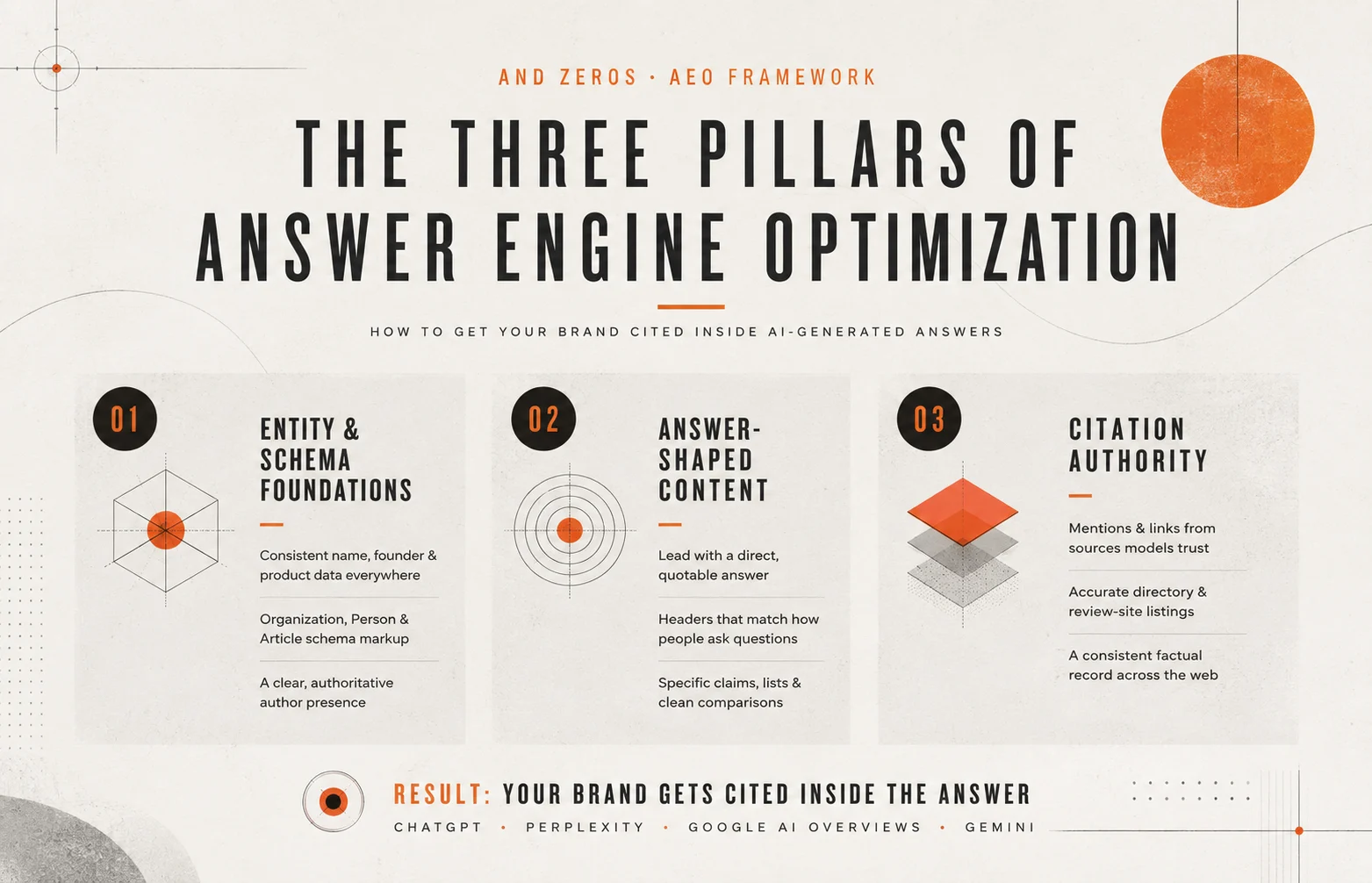
AEO vs SEO comes down to one core difference: SEO optimizes your content to rank in search engine results pages so a human clicks through to your site, while AEO optimizes your content to be pulled directly into an AI-generated answer (in ChatGPT, Perplexity, or Google’s AI Overviews) where you’re cited as a source, whether or not anyone ever clicks.
That’s the one-sentence version. The full picture is more useful, because AEO and SEO aren’t rivals: they’re two optimization targets built on a lot of shared infrastructure, with a few real points of divergence that change how you write, structure, and measure content.
Quick definitions
SEO (Search Engine Optimization) is the practice of ranking content on search engine results pages (primarily Google and Bing) so that it appears high enough to earn a click. Success is measured by rankings, organic traffic, and click-through rate. The unit of output is a webpage designed to be visited.
AEO (Answer Engine Optimization) is the practice of structuring content so that AI systems (large language models and the retrieval systems behind them) can extract it, trust it, and cite it in a generated answer. Success is measured by citation frequency, share of voice inside AI answers, and brand mentions in zero-click responses. The unit of output is a passage designed to be quoted.
Both disciplines depend on the same starting point: content has to exist, be crawlable, and say something true and specific. From there, the paths split.
AEO vs SEO: side-by-side comparison
| Dimension | SEO | AEO |
|---|---|---|
| Optimizes for | Ranking position and clicks | Citation and inclusion in AI-generated answers |
| Primary metric | Organic traffic, rankings, CTR | Citation share, brand mentions in AI answers, referral traffic from AI platforms |
| Content unit | Full page built for a search intent | Self-contained, quotable passage or answer block |
| Ranking / selection system | Google/Bing algorithm (links, relevance, UX signals) | LLM retrieval + generation (semantic match, source trust, extractability) |
| Where you show up | Search results page, position 1 to 10 | Inside the answer text itself, often with a linked citation |
| Key tactics | Keyword targeting, backlinks, site speed, internal linking, on-page optimization | Direct-answer formatting, structured data, clear entity definitions, FAQ blocks, original data points |
| Content structure | Long-form pages optimized for scannability and dwell time | Front-loaded answers, tight definitions, tables, and lists an LLM can lift cleanly |
| Feedback loop | Search Console, rank trackers: days to weeks | AI answer monitoring tools, manual prompt testing (often less mature and slower to attribute) |
| Failure mode | Page ranks but never surfaces above the fold or loses to a featured snippet | Page gets crawled and used to train or ground an answer, but you’re never named as the source |
Where they overlap
The overlap is bigger than most people assume, which is why “just do SEO better” is half-right advice.
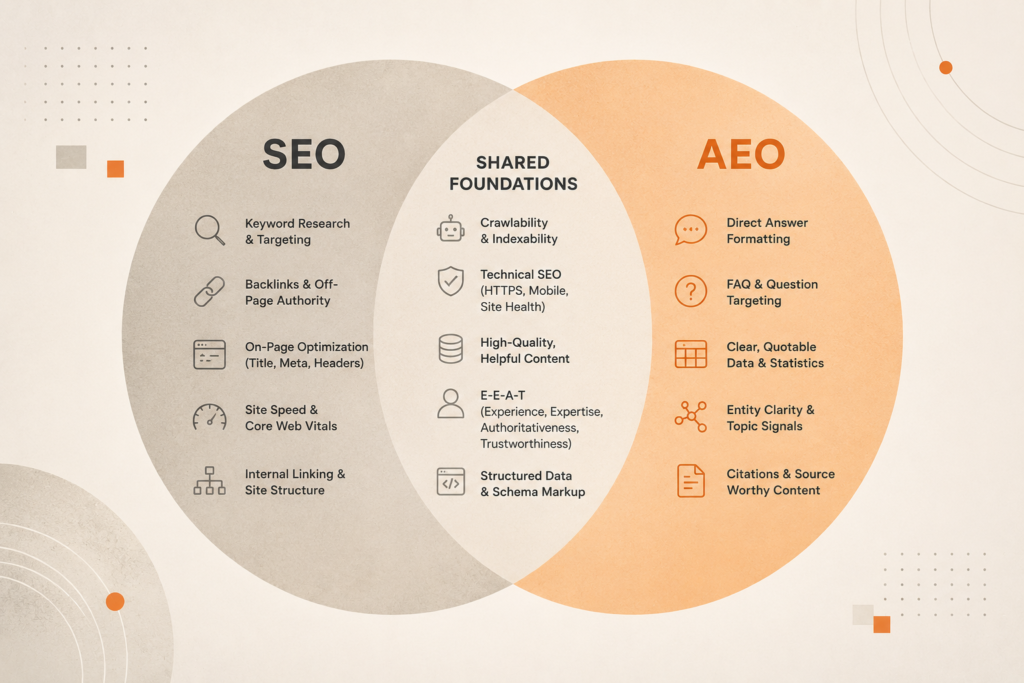
- Technical foundations are identical. Crawlability, site speed, clean HTML, and indexability matter to both a Googlebot and an LLM’s retrieval layer. If your site isn’t crawlable, neither discipline works.
- Topical authority helps both. A domain that consistently publishes accurate, specific content on a topic earns trust signals that search engines rank on and that retrieval systems weight when selecting sources.
- Structured data is doing double duty. Schema markup (Article, FAQPage, Organization) was built for search engines but is increasingly useful context for AI systems trying to understand what a page is and who’s behind it.
- E-E-A-T-style trust signals matter to both. Clear authorship, real credentials, and a traceable organization behind the content improve both search rankings and an AI system’s willingness to cite you as a source.
- Good writing is good writing. Clear, specific, well-organized content that actually answers the question performs better in both systems than vague, keyword-stuffed filler.
Where they diverge
The differences show up in the details of how you write and structure content, not in whether you write it at all.
- The unit of success is different. SEO rewards a page that ranks and gets clicked. AEO rewards a passage that gets extracted and quoted, sometimes without a click at all. That changes how you think about ROI and attribution.
- Answer placement matters more in AEO. SEO tolerates a slow build-up before the payoff. AEO wants the direct, citable answer near the top, in a form an LLM can lift as a self-contained unit: a definition, a table, a numbered list.
- Links matter less to AEO, source trust matters more. Backlinks are a core SEO ranking factor. LLM retrieval leans more heavily on whether the source reads as authoritative and unambiguous on the specific claim being cited: original data, clear sourcing, and a named author help here.
- Query patterns differ. SEO still optimizes heavily around discrete keywords and search volume. AEO has to account for conversational, multi-part prompts that don’t map cleanly to a keyword list.
- Measurement is immature for AEO. SEO has two decades of tooling: Search Console, rank trackers, attribution models. AEO measurement (tracking when and how often you’re cited across AI platforms) is newer, less standardized, and often requires manual prompt testing alongside emerging monitoring tools.
- Zero-click is the norm, not the exception. With fewer than a third of Google searches now ending in a click, a zero-click result reads as a missed opportunity in SEO. In AEO, being cited without a click is often the entire point: the value is brand visibility and trust, not a session.
Do you need both?
Yes, and treating them as separate budgets or separate teams is a mistake. Here’s why.
AI answer engines are increasingly a discovery layer that sits on top of the same web your SEO strategy already targets. Many of them use web search and crawled content as grounding for their answers. A page that doesn’t exist, isn’t crawlable, or has no authority won’t show up in either channel. AEO doesn’t replace the technical and topical foundation SEO already requires: it adds a formatting and trust layer on top of it.
At the same time, ranking #1 in Google doesn’t guarantee an AI system will cite you. Answer engines select and synthesize differently than a ranking algorithm sorts a results page. A page can rank well and still get skipped in favor of a competitor’s tighter, more citable answer on the same topic.
The practical position: build the SEO foundation you’d build anyway (crawlable, fast, authoritative, well-linked) and then layer AEO-specific formatting on top: direct answers up front, clean structured data, explicit entity definitions, and content built to be quoted, not just read.
How to start
- Audit what’s already citable. Pick your 10 highest-intent pages and check whether they lead with a direct, quotable answer to the core question, or bury it under three paragraphs of setup.
- Add direct-answer blocks. For your most important questions, write a two-to-three sentence answer that could stand alone as a citation, then expand underneath it.
- Structure comparisons and processes as tables and lists. LLMs extract these cleanly; walls of prose are harder to lift accurately.
- Ship FAQPage and Article schema. It costs little and gives both search engines and AI systems explicit, machine-readable context.
- Name a real author and organization. Anonymous content is harder to trust (for readers and for retrieval systems alike).
- Test your own prompts. Ask ChatGPT and Perplexity the questions your buyers ask, and see who gets cited. That’s your actual AEO baseline, not a rank tracker.
How And Zeros does both
We build content programs that treat SEO and AEO as one system, not two roadmaps: the same technical and topical foundation, formatted so it ranks and gets cited. If you want a straight read on where your content stands in AI answers today, talk to And Zeros about an AEO audit.
FAQ
Is AEO replacing SEO?
No. AEO adds a citation-focused layer on top of the technical and topical work SEO already requires. Sites with weak SEO foundations, meaning poor crawlability and thin authority, tend to perform poorly in AI answers too, since many answer engines ground responses in web content that has to be found and trusted first.
Do I need separate content for AEO and SEO?
Usually not separate content, just separate formatting choices within the same content. The research, topical coverage, and technical setup overlap almost completely. What changes is how directly and cleanly the answer is presented near the top of the page.
How do I measure AEO performance?
Track citation frequency by manually testing your target prompts across ChatGPT, Perplexity, and Google AI Overviews, watch for referral traffic from AI platforms in your analytics, and monitor brand mention frequency. Dedicated AEO monitoring tools are emerging, but manual prompt testing remains a reliable baseline.
Does schema markup actually help with AEO?
It gives AI systems explicit, structured context about your content, including who wrote it, what organization stands behind it, and what question it answers. It won’t guarantee a citation on its own, but it removes ambiguity that could work against you.
What’s the difference between AEO and GEO?
They’re closely related and often used interchangeably. AEO typically emphasizes structuring content to be selected as a direct answer, while GEO is a broader term covering optimization for any generative AI output. Learn more about AEO in our dedicated breakdown at /aeo-vs-geo/.
Will AEO hurt my SEO rankings?
No, the practices reinforce each other. Direct answers, clear structure, and strong authorship signals are good for search rankings too. There is no tradeoff where optimizing for citations degrades ranking performance.