Development
Summary: Most professional small business websites launch in 4 to 8 weeks, and the build itself is rarely what slows them down. Content and approvals set the pace. This guide breaks down each phase and shows how a site can go live in as little as two weeks.
How long does it take to build a website? It is the second question every business owner asks, right after cost. The honest answer depends less on your developer and more on how ready you are on day one.
In audio, a session runs on time when the charts are written before the band walks in. Web builds work the same way. The hours at the keyboard are predictable. The waiting is what stretches a project.
How long does it take to build a website in 2026?
Timelines have shrunk. A 2019 G2 guide estimated that an agency build would take at least 18 weeks. Today, Elementor’s 2026 timeline guide puts a professional small business site at 4 to 8 weeks. Better tools and tighter processes made up most of that gap.
Here is how the 2026 estimates break down by site type, for professional builds:
| Site type | Typical scope | Professional timeline |
|---|---|---|
| Brochure site | 1 to 5 pages | 1 to 2 weeks |
| Small business site | 5 to 15 pages, blog, forms | 4 to 8 weeks |
| Small e-commerce store | Under 50 products | 8 to 12 weeks |
| Large e-commerce store | 500+ products | 4 to 8 months |
| Custom web application | Logins, data, integrations | 6 to 12+ months |
Most service businesses land in the small business row. That covers a home page, service pages, an about page, a blog and a contact form.
What are the phases of a website build?
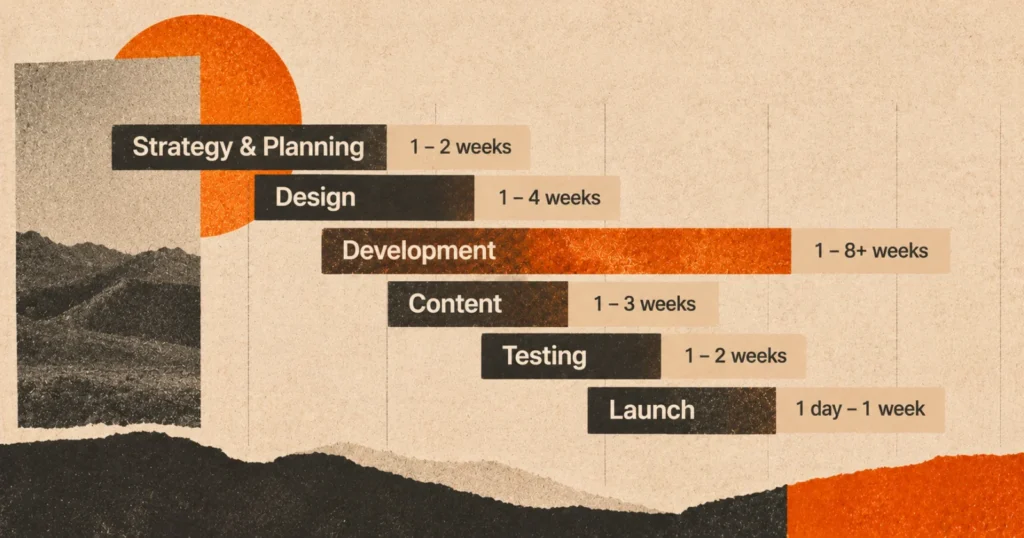
A website build moves through six phases. Some overlap, and content can run alongside design. These ranges come from Elementor’s 2026 phase breakdown:
- Strategy and planning, 1 to 2 weeks. Goals, audience, sitemap and wireframes.
- Design, 1 to 4 weeks. Mockups and revision rounds. Fast feedback keeps this near one week.
- Development, 1 to 8+ weeks. Pages, forms, integrations and any custom features.
- Content, 1 to 3 weeks. Final copy, photos and image compression.
- Testing, 1 to 2 weeks. Browsers, phones, forms, speed and accessibility.
- Launch, 1 day to 1 week. Go-live, redirects, sitemap submission and analytics checks.
Run back to back, those ranges add up to about 5 weeks to 5 months. The phases with the widest spread are design and development. Both swing on feedback speed and scope.
What slows down a website project?
Content is the top cause of delays. Elementor’s guide names missing copy and images as the biggest reason projects stall, with scope creep in second place. A finished design can sit for weeks while a team writes its About page.
Approvals come next. Every round of design feedback waits on someone. One decision maker might reply in a day. A committee of five can take a week per round, and a build often needs more than one round.
Scope creep is the third. A request like “can we add member logins?” sounds small. In practice it can add weeks of development and testing.
Technical surprises matter less than most people expect. Old domain logins, lost hosting access and missing brand files cause more lost days than code.
How long does an And Zeros website build take?
We run three build tracks. Each one ships a finished, tested site. The difference is how much has to be ready before we start.
Standard build: 2 months
This is our default for service businesses. Eight weeks gives room for discovery, two design rounds, a full build and real testing. It also leaves space for your team to write content while we design. Most clients pick this track.
Expedited build: 1 month
The expedited track compresses the same process into four weeks. It works when your content is mostly ready and one person can approve design within a day or two. We overlap design and development to save time.
Extreme sprint: 2 weeks
The sprint is for launches with a hard date, like an event, a rebrand reveal or a funding round. It needs final content on day one and same-day feedback. The scope stays tight, so extra features wait for a second phase after launch.
Every track includes one month of support after launch. That covers the stretch when post-launch issues tend to show up.
How can you build a website faster?
Start with content. If your copy and photos are final before kickoff, you can cut weeks from any timeline. Elementor’s guide calls this the most important step you can take.
Next, name one decision maker. A single person with authority to approve design keeps revision rounds short.
Then lock the scope. Write down the pages and features you need for launch. Park everything else on a phase two list.
Last, gather your access early. Domain registrar logins, hosting accounts, Google Analytics and brand files should be in one place before day one.
Does a faster build hurt SEO?
A fast build only hurts SEO when steps get skipped. Redirects, title tags, schema and page speed take hours of work. They do need to be on the plan.
Rebuilds carry the most risk. An old site’s rankings live in its URLs, and a missing redirect map can erase them at launch. We cover that process in our website redesign SEO guide. On a sprint, the redirect map gets built in week one, before any page goes live.
Planning a new site with a launch date in mind? Talk to us about which track fits.
FAQ
How long does a website take to build with a website builder?
A simple site on a website builder can launch in 1 to 3 days. That assumes a template and finished content. A 5 to 15 page small business site usually takes 1 to 2 weeks on your own.
How long does it take to build an e-commerce website?
A small e-commerce store with under 50 products takes 8 to 12 weeks with a professional. Large stores with 500 or more products and inventory integrations can take 4 to 8 months.
How long does it take to build a Shopify website?
A basic Shopify store can launch in a few weeks. Timelines grow with product count, custom theme work and app integrations. Product photos and descriptions are the usual bottleneck.
Can a website be built in two weeks?
Yes, a professional website can be built in two weeks with tight scope and ready content. It needs final copy and photos on day one, same-day feedback and a short feature list.
What is the biggest cause of website delays?
Late content is the biggest cause of website delays. Copy and images often take longer to finish than design and development. Having them ready before kickoff is the fastest way to shorten any build.