DevelopmentSEO
Summary: Website redesign SEO comes down to protecting what your current site has earned before launch day. In a study of 892 domain migrations, the average site took 523 days to recover its traffic, and AI crawlers like GPTBot can't read content that loads through JavaScript. This guide covers the redirect, rendering and schema steps that keep Google and AI search on your side.
Every audio editor learns one rule early. Cut a waveform anywhere but the zero crossing and you hear a click. Website redesign SEO works the same way. Launch a new site at the wrong point in the wave and the pop shows up in your traffic reports for months.
Redesigning your website for SEO means protecting the signals your current site has already earned before you launch the new one. That takes a full URL map with page-level 301 redirects, server-rendered content that AI crawlers can read, and schema carried over intact. Skip any of those and the new site starts from a deficit.
- Map every old URL to one new URL and 301 it.
- Keep redirects live for at least a year, per Google.
- Serve body copy, navigation and schema in the raw HTML so GPTBot and ClaudeBot can read them.
- Change one big thing at a time when a domain move is involved.
Those four steps protect both audiences a site now serves: Googlebot, and the AI crawlers behind ChatGPT, Claude and Perplexity.
Why do websites lose traffic after a redesign?
Google stores what it knows about your site one URL at a time. Links, rankings and relevance all attach to a specific address. Change that address with no redirect and the history stays behind on a page that now returns a 404.
Google’s site move guide is direct about the fix. Map old URLs to new ones, then use permanent redirects like 301 or 308, which Google says “don’t cause a loss in PageRank.” The same guide says to change one thing at a time, and to finish a domain move before you change the layout.
Most redesigns break that rule. A new domain, a new CMS, a new URL structure and a new design all ship on one launch day. Then nobody can tell which change caused the drop.
How long does SEO take to recover after a site migration?
For domain moves, the honest answer is longer than most owners expect. Dan Taylor’s study in Search Engine Journal tracked 892 domain migrations. The average site took 523 days to match its old domain’s estimated organic traffic. 17% still had not caught up after 1,000 days.
The fastest sites recovered in 19, 22, 23 and 33 days. That spread tells you most of the outcome comes down to execution. Google’s own guidance says a medium site can take “a few weeks or more” before new URLs start to show, and redirects should stay up “generally at least 1 year.”
A redesign that keeps the same domain usually carries less risk than a full domain move. Still, the same rules apply to every URL you change.
Can AI search engines read your new website?
Many can’t, if the content only appears after JavaScript runs. Vercel measured AI crawler traffic across its network in December 2024. GPTBot made 569 million fetches in a month, and Claude’s crawler made 370 million. Vercel found that none of the major AI crawlers render JavaScript, including GPTBot, ChatGPT-User, OAI-SearchBot, ClaudeBot and PerplexityBot.
They do download script files. ChatGPT’s crawler fetched JavaScript in 11.50% of requests and Claude’s in 23.84%. Neither ran a line of it. Gemini is the exception, since it uses Google’s rendering infrastructure.
So a site built as a client-side app can look perfect in Chrome and rank fine in Google, yet show up nearly blank to ChatGPT. Test your own pages with a plain request: curl -A "GPTBot" https://yoursite.com/page. If your headline and body copy are missing from the response, AI search can’t cite them.
Redirects matter here too. In Vercel’s data, ChatGPT’s crawler hit 404s on 34.82% of fetches, against 8.22% for Googlebot. A redesign that drops old URLs adds more dead ends to a crawler that already wastes a third of its visits.
What should a website redesign SEO checklist include?
This is the cutover plan we run on And Zeros builds.
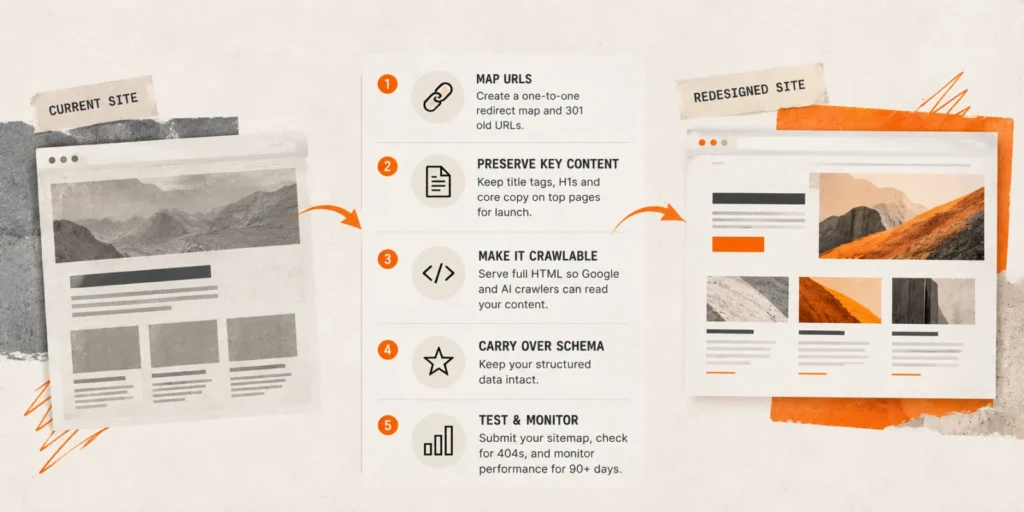
- Crawl the live site and export every indexable URL. Pull top landing pages from Search Console across its full 16 months of data.
- Build a one-to-one redirect map. Each old URL points to its closest new match. Never send everything to the homepage.
- Freeze title tags, H1s and core copy on your top pages for launch. Rewrite them after the new site settles.
- Pick a build that serves full HTML: server-side rendering, static generation or prerendering.
- Carry over schema (Organization, Service, Article, FAQPage) and confirm it appears in the raw HTML.
- Lock staging behind a password, then confirm noindex is gone at launch.
- Submit the new XML sitemap on launch day. Use Search Console’s Change of Address tool if the domain changed.
- Watch for 90 days. Crawl for 404s weekly, compare landing pages to your baseline, and check brand prompts in ChatGPT and Perplexity.
What should you ask a web agency before a redesign?
Most small businesses aren’t asking yet. Bluehost’s State of Small Business AI Confidence report surveyed 350 U.S. owners in May 2026. Only 13% actively optimize for AI search. Another 31% know it exists but don’t know where to start.
That gap shows up in redesign proposals. Before you sign one, ask:
- Who builds the redirect map, and when do we review it?
- What does our homepage show with JavaScript turned off?
- Which schema types carry over, and how will you test them?
- What happens if organic traffic drops 20% after launch?
A good agency answers each with a name and a date. At And Zeros, every web build includes six months of support after launch. That window covers the stretch where migration problems tend to surface. If you’re planning a website rebuild, talk to us before the cut.
FAQ
Does a website redesign hurt SEO?
A website redesign hurts SEO only when ranking signals get lost at launch. Missing redirects, changed URLs, deleted pages and stripped content cause most drops. A planned cutover with a full redirect map can hold rankings steady or improve them.
How long should I keep 301 redirects after a redesign?
Keep 301 redirects for at least one year, and longer if you can. Google’s site move guide says to keep them “for as long as possible, generally at least 1 year” so it can recrawl old links and transfer signals.
Do ChatGPT and Claude crawlers run JavaScript?
No, ChatGPT and Claude crawlers do not run JavaScript. Vercel’s December 2024 data shows GPTBot, ClaudeBot and PerplexityBot fetch script files without executing them. Content that only loads through JavaScript stays invisible to them.
Should I change my domain and redesign at the same time?
Google advises against changing your domain and design at the same time. Its site move guide recommends one change at a time, finishing the domain move before the layout changes. Splitting them makes any traffic drop easier to diagnose.
How long does a site migration take to recover?
A well-run site migration can recover in weeks, but the average domain move takes far longer. Search Engine Journal’s study of 892 domain migrations found an average of 523 days, with the fastest at 19 days.