
SEO
When people ask about AEO vs GEO, the short answer is no, they’re cousins, not twins. Both are about getting your brand cited by AI instead of ranked by Google, but they optimize for different systems with different rules, and conflating them is how teams end up optimizing for the wrong surface.
What AEO Actually Means
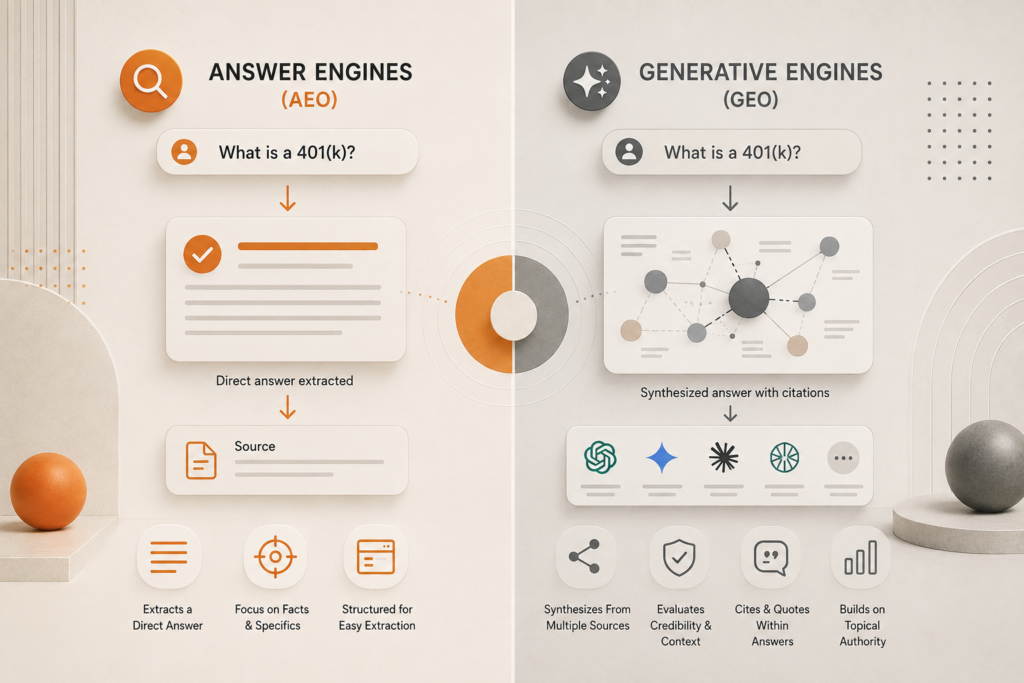
AEO stands for Answer Engine Optimization. It’s the practice of structuring content so that answer engines (think Google’s AI Overviews, Siri, Alexa, and any system built to return a single direct answer to a query) can lift a clean, citable answer out of your page.
Answer engines are extraction machines. They’re looking for the shortest accurate path from a question to a fact: a definition, a number, a step, a yes/no. AEO is won or lost at the paragraph and sentence level: clear structure, direct answers up top, schema markup that tells the machine what it’s looking at, and content organized so a single passage can stand on its own without the rest of the page for context.
What GEO Actually Means
GEO stands for Generative Engine Optimization. It’s the practice of getting your brand cited, quoted, or recommended inside the synthesized responses of generative AI systems: ChatGPT, Claude, Perplexity, Gemini, and the AI-native search experiences built on top of large language models.
Generative engines don’t extract a single passage the way answer engines do. They synthesize an answer from many sources, weighing which sources are credible, well-structured, and worth citing or paraphrasing. GEO is won at the level of the whole content ecosystem: what your site says, what other sites say about you, how consistently your expertise shows up across the web, and whether the model’s training and retrieval process treats you as a trustworthy source to draw from.
AEO vs GEO at a Glance
| AEO | GEO | |
|---|---|---|
| Full name | Answer Engine Optimization | Generative Engine Optimization |
| Target systems | Google AI Overviews, voice assistants, featured snippets | ChatGPT, Claude, Perplexity, Gemini, AI search |
| Unit of optimization | The passage or paragraph | The brand’s presence across the web |
| Core mechanic | Extraction of a direct answer | Synthesis and citation within a generated response |
| What “winning” looks like | Your sentence becomes the answer | Your brand gets named or linked in the response |
| Primary lever | On-page structure, schema, direct answers | Content depth, third-party mentions, topical authority |
Where They Overlap
The AEO vs GEO overlap is real, and it’s why the terms get used interchangeably in the first place. Both AEO and GEO are responses to the same shift: search is moving from “here are ten blue links” to “here’s your answer.” Both reward clarity over cleverness: AI systems of every kind prefer content that states things plainly rather than content optimized to keep a human scrolling. Both depend on structured, well-organized content: headers that map to real questions, facts that are easy to isolate, and schema markup that removes ambiguity about what a page is and who wrote it. And both are measured the same way in practice: not by rankings, but by whether you show up, get cited, or get named when someone asks an AI system a question in your category.
Practically, this means a lot of the same work feeds both disciplines. A well-structured FAQ section, a clearly authored page, consistent facts about your company across your site: all of that helps whether the system pulling from it is an answer engine grabbing one passage or a generative engine synthesizing a paragraph from five sources.
Where They Differ
The AEO vs GEO difference shows up in what you’re optimizing for and how you measure success. AEO is a page-level discipline: you can audit a single URL, fix its structure, add schema, and reasonably expect to see it start surfacing in answer boxes. GEO is closer to a reputation discipline: no single page fixes your GEO. It’s the accumulation of citations, mentions, reviews, comparisons, and expert content across your own site and the wider web that determines whether a generative model treats you as a source worth citing.
That also changes the timeline. AEO wins can show up fast because you’re optimizing a known extraction mechanic on a page you control. GEO is slower and more indirect, because you’re influencing how a model perceives your brand’s authority across sources you don’t fully control: other publications, review sites, forums, and the rest of the web the model draws on.
Finally, they answer different questions about intent. AEO tends to serve narrow, factual, single-answer queries (“what is AEO”). GEO tends to serve broader, comparative, or exploratory queries where the AI is synthesizing a recommendation or explanation from multiple angles (“best AEO agency” or “how should I think about AI search strategy”).
Which Term Should You Use?
Use whichever term matches what you’re actually doing. If you’re restructuring a page, adding FAQ schema, and tightening your definitions so Google’s AI Overview can lift a clean answer, you’re doing AEO. If you’re building topical authority, earning mentions on other sites, and shaping how ChatGPT or Perplexity describes your company, you’re doing GEO.
In client conversations, we don’t force a choice. Most brands need both, and the honest answer to “is AEO the same as GEO” is that they’re two names for adjacent parts of the same shift: optimizing for machines that answer questions instead of machines that rank pages. Some agencies use AEO and GEO as pure synonyms; we think that flattens a real and useful distinction, but it’s not worth arguing about in a pitch. What matters is whether the work covers both the page-level mechanics and the brand-level reputation building.
How And Zeros Thinks About AEO and GEO
We treat AEO and GEO as one integrated program with two layers, not two separate service lines competing for budget. The AEO layer gets your existing pages structured so answer engines can extract clean, accurate answers today. The GEO layer builds the broader footprint (content depth, earned citations, consistent facts about your business) that determines whether generative engines trust you enough to cite you tomorrow.
If you’re trying to figure out where your brand actually stands with AI answer engines, or you want a plan that covers both layers instead of just one, that’s the work we do at And Zeros.
FAQ
Is AEO the same as GEO?
No. AEO (Answer Engine Optimization) and GEO (Generative Engine Optimization) target different systems: AEO focuses on answer engines that extract a single direct response, while GEO focuses on generative AI systems that synthesize answers from multiple sources and decide what to cite.
Which is more important, AEO or GEO?
Neither replaces the other. AEO tends to drive faster, page-level wins in answer boxes and AI Overviews; GEO builds the longer-term brand authority that determines whether generative AI tools cite or recommend you. Most brands need both working together. Treat them as complementary, not competing, priorities.
Do AEO and GEO use the same content strategy?
They share a foundation (clear structure, direct answers, schema markup, and factual consistency), but GEO also requires work outside your own site, like earning mentions and citations across the broader web, which AEO alone doesn’t require. Think of GEO as AEO plus off-site reputation building.
Can I do AEO without GEO, or vice versa?
You can, but you’ll only capture part of the opportunity. AEO without GEO gets your pages structured for extraction but does nothing to build the off-site authority generative engines rely on. GEO without AEO builds reputation but leaves your own pages poorly structured for the answer engines that are already citing content today.
Is GEO the new SEO?
GEO extends SEO rather than replacing it. Traditional SEO still matters for rankings and traffic, but GEO adds a layer focused specifically on how generative AI systems select and cite sources when they synthesize an answer. The two work together, not against each other.